
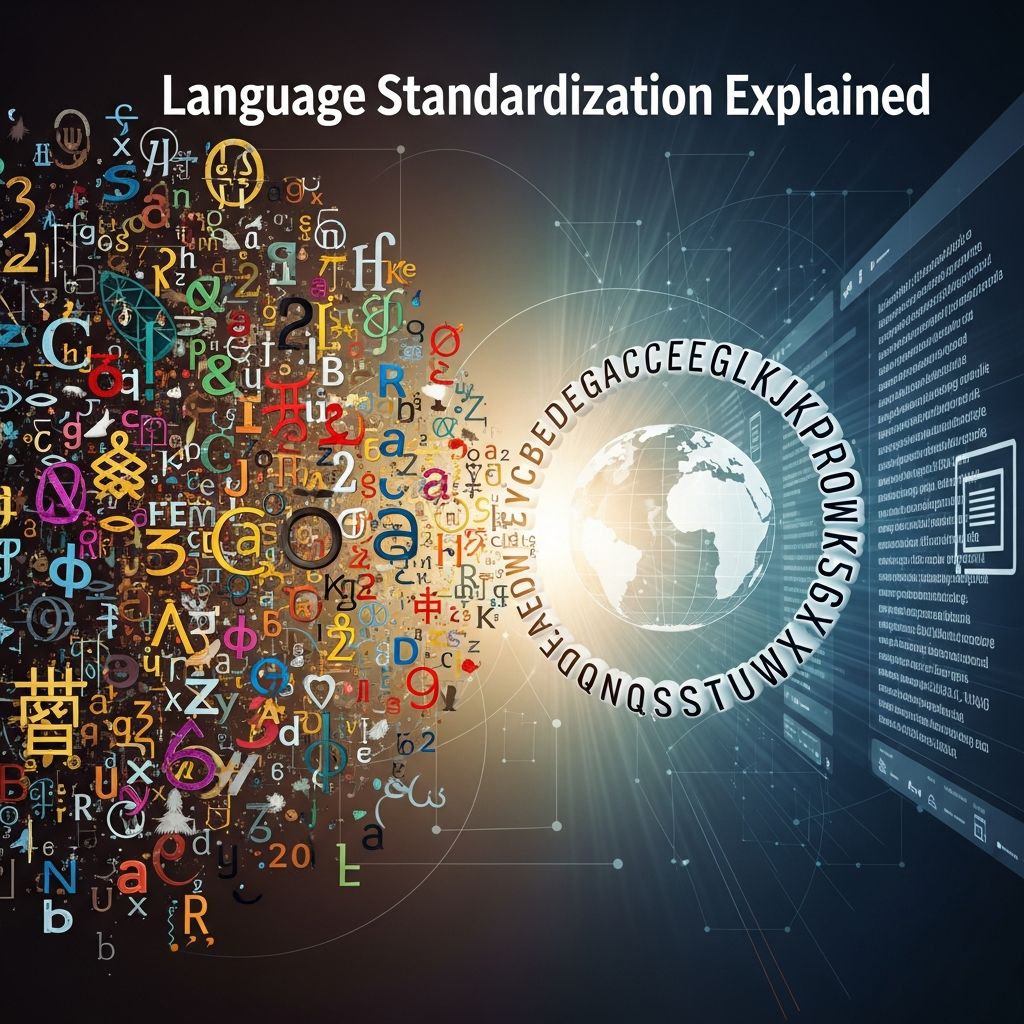
Language standardization transforms diverse dialects into a cohesive system used by communities for effective interaction. This process establishes shared norms in grammar, vocabulary, spelling, and pronunciation, fostering mutual understanding across regions and social groups.
Why Languages Need Standardization
Without standardization, languages fragment into dialects that hinder communication. Standardization creates a common framework, enabling clear exchanges in education, media, governance, and commerce. It minimizes confusion, preserves linguistic heritage, and supports literacy by providing consistent written forms.
In multilingual societies, a standard variety promotes unity. For instance, it allows speakers from varied backgrounds to engage without barriers, essential for national identity and administrative efficiency.
Core Stages of the Standardization Process
Standardization unfolds through distinct phases, each building toward a unified language form. Linguists identify four primary stages: selection, codification, elaboration, and implementation.
1. Selection: Choosing the Base Variety
The initial step involves picking a dialect or variety as the foundation. Often, this is the form spoken in economic or political centers, associated with prestige and power. Selection reflects social dynamics, favoring varieties linked to influential groups.
- Criteria for selection: Prestige, widespread use, association with literature or administration.
- Challenges: Resistance from non-selected dialect speakers, potential exclusion of minority voices.
2. Codification: Documenting the Rules
Once selected, rules are formalized in grammars, dictionaries, and orthographies. This stage regularizes spelling, syntax, and lexicon, creating authoritative references.
Codification ensures consistency; for example, grammar books define sentence structures, while dictionaries standardize word meanings and spellings.
3. Elaboration: Expanding the Lexicon
Languages must adapt to new realities, so elaboration introduces terms for modern concepts via borrowing, compounding, or invention. This keeps the standard relevant for science, technology, and global discourse.
- Methods: Loanwords from other languages, derivations from existing roots, neologisms.
4. Implementation and Acceptance: Widespread Adoption
The final phase promotes the standard through schools, media, laws, and publishing. Acceptance occurs when the variety gains prestige and becomes the norm for formal contexts.
Implementation faces hurdles like enforcing compliance without alienating dialect speakers.
Historical Examples of Language Standardization
Throughout history, standardization has shaped major languages, often tied to nation-building or cultural shifts.
The Emergence of Standard English
English standardization began in the 15th century with the London dialect, boosted by printing presses. Samuel Johnson’s 1755 dictionary and grammars solidified norms, influencing global English today.
Standard Arabic and Diglossia
Modern Standard Arabic (MSA) standardizes Classical Arabic for media and education, distinct from colloquial dialects. This diglossic system balances unity with regional variation.
Norwegian Language Reforms
Norway standardized Bokmål and Nynorsk from Danish-influenced and rural dialects post-independence, illustrating deliberate national efforts.
| Language | Key Event | Outcome |
|---|---|---|
| English | Printing press (1476) | London dialect dominance |
| French | Académie Française (1635) | Uniform grammar and lexicon |
| Arabic | 20th-century revival | MSA for formal use |
Benefits of Standardized Languages
Standardization yields practical advantages for societies.
- Enhanced Communication: Reduces misunderstandings in diverse populations.
- Education Accessibility: Uniform curricula enable mass literacy.
- Cultural Preservation: Documents heritage against dialect erosion.
- Economic Efficiency: Facilitates trade, law, and administration.
Globally, standards like International English support cross-border interactions in business and diplomacy.
Challenges and Criticisms
Despite benefits, standardization sparks debates.
Social Inequality and Linguistic Subordination
Standards often elevate elite varieties, marginalizing others. Access to education determines proficiency, reinforcing class divides. Non-standard speakers face stigma, termed ‘linguistic subordination.’
Loss of Diversity
Rigid standards suppress dialectal richness, potentially eroding cultural identities. Critics argue for pluricentric models allowing regional standards.
Ongoing Evolution
Languages change; standards require updates. Bodies like language academies balance tradition with innovation.
Standardization in the Digital Era
Internet and globalization accelerate change. Social media introduces informal variants challenging traditional standards. Algorithms and autocorrect enforce norms, while global Englishes spawn new standards.
Minority languages leverage digital tools for standardization, aiding revitalization efforts.
Role of Institutions in Maintaining Standards
Academies and councils oversee standardization. France’s Académie Française regulates vocabulary; Germany’s Duden dictionary evolves with usage.
- Functions: Publishing references, advising governments, promoting usage.
- Examples: Real Academia Española for Spanish, Instituto Cervantes globally.
Frequently Asked Questions (FAQs)
What is language standardization in simple terms?
It is creating uniform rules for a language’s grammar, spelling, and words to ensure everyone communicates clearly.
Why is codification important?
Codification provides written references like dictionaries, making rules accessible and enforceable.
Can standardization harm dialects?
Yes, it may sideline dialects, leading to their decline unless preserved actively.
How does English maintain its standard?
Through style guides like Oxford and widespread media/education use.
Is standardization ever complete?
No, languages evolve continually, requiring ongoing adjustments.
Future Directions in Language Standardization
Emerging trends include inclusive standards accommodating gender-neutral language and indigenous voices. AI tools analyze usage for dynamic updates. In postcolonial contexts, hybrid standards blend local and global forms.
Ultimately, balanced standardization promotes unity without erasing diversity, vital for vibrant linguistic ecosystems.
References
- Language Standardization: Meaning & Examples — Vaia. 2023. https://www.vaia.com/en-us/explanations/english/tesol-english/language-standardization/
- LANGUAGE STANDARDIZATION IN GENERAL POINT OF VIEW — Bircu-Journal. 2020-01-01. https://bircu-journal.com/index.php/birci/article/download/4/4
- Language standardization — YouTube (Mokerma English). 2023. https://www.youtube.com/watch?v=RnDdMYFUnpk
- Standard language — Wikipedia. 2026-04-04. https://en.wikipedia.org/wiki/Standard_language
- Language Standardization & Linguistic Subordination — American Academy of Arts & Sciences (Daedalus). 2024. https://www.amacad.org/publication/daedalus/language-standardization-linguistic-subordination
- Language Standardization & Linguistic Subordination — MIT Press (Daedalus). 2024. https://direct.mit.edu/daed/article/152/3/18/117330/Language-Standardization-amp-Linguistic
- Standardisation of languages – life or death? — The Historical Linguist Channel. 2018. https://thehistoricallinguistchannel.com/454-2/

Medha Deb is an editor with a master's degree in Applied Linguistics from the University of Hyderabad. She believes that her qualification has helped her develop a deep understanding of language and its application in various contexts. Medha specializes in the areas of beauty, health, sports, and wellness and is committed to ensuring that the content on the website is…