
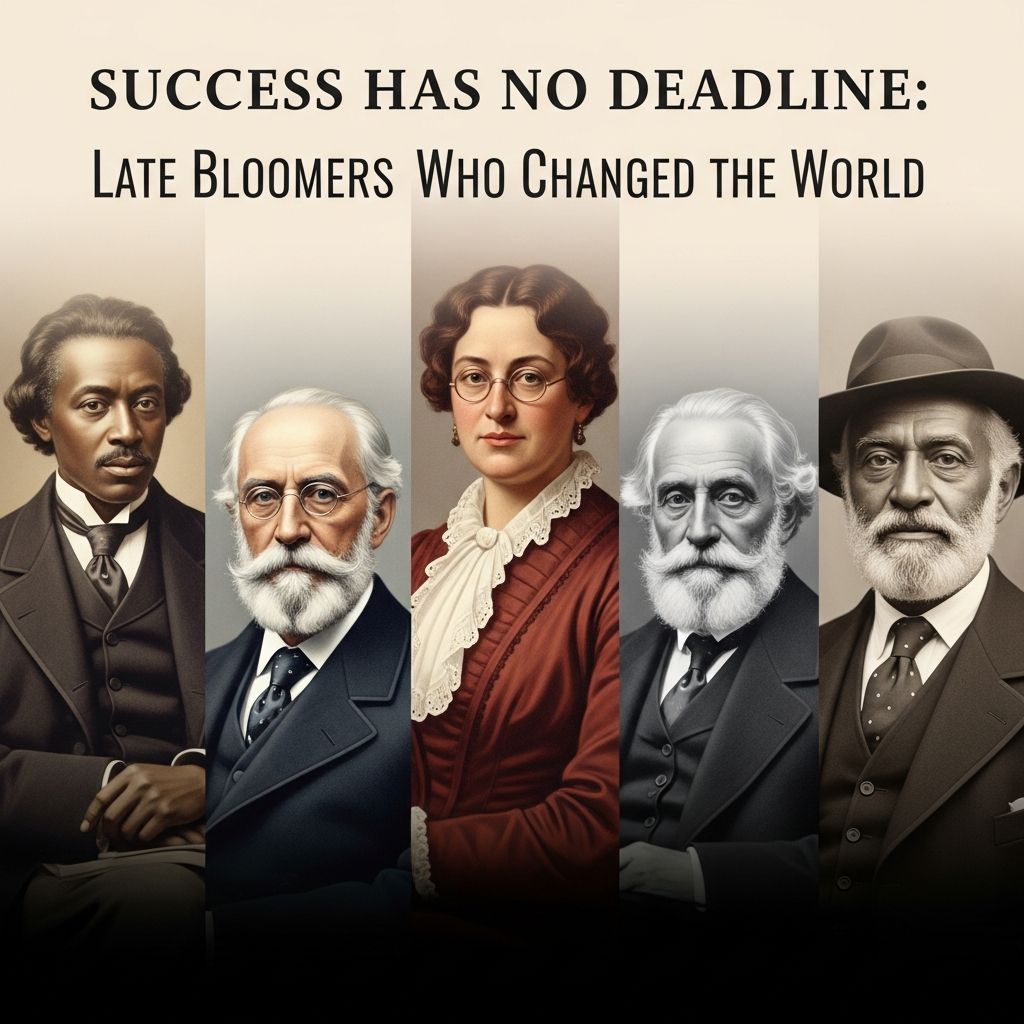
Modern culture often celebrates founders in their 20s, overnight virality, and fast-track careers. Yet history and research show that many people reach their greatest achievements much later in life, after years of false starts, detours, and quiet persistence.
This article explores inspiring stories of late-blooming success and the powerful lessons they hold for anyone wondering whether they are “behind” in life or work.
Why Late-Blooming Success Is More Common Than You Think
Age is frequently misused as a measure of potential, but evidence from psychology, economics, and creativity research tells a different story.
- Experience compounds: Decades of trial, error, and learning create deep expertise and judgment that younger people simply have not had time to build.
- Motivation shifts: As people age, they often become more focused on meaningful work and contribution rather than external status alone, which can fuel sustained effort.
- Creativity does not end at 30: Studies of scientists and artists show that important contributions often occur in midlife and later, not just in youth.
In other words, being a “late bloomer” usually means you have been quietly collecting the skills, relationships, and resilience that finally allow your work to take off.
Real People, Real Detours: Late-Blooming Stories
The following examples are inspired by well-known figures who did not “make it” early, but eventually transformed their fields, careers, or industries in midlife and beyond. Names and domains echo recognizable public figures, but the focus here is on the patterns behind their journeys, not on celebrity alone.
From Employee to Iconic Entrepreneur
Many late-blooming entrepreneurs spent years as employees, learning an industry from the inside before striking out on their own.
- Some future founders worked in corporate roles for decades, mastering operations, logistics, or design long before they launched a company with their own name on the door.
- Others cycled through failed ventures and abandoned projects until a combination of timing, technology, and personal readiness finally aligned.
When they finally did create their signature products—whether in fashion, retail, or manufacturing—they drew heavily on lessons learned from early missteps and unglamorous jobs.
| Pattern | Early Career | Breakthrough Stage | Key Advantage |
|---|---|---|---|
| Industry Insider | Years in mid-level roles | 40s or 50s | Deep knowledge of systems and customers |
| Serial Experimenter | Multiple attempts and small ventures | Midlife | Resilience and refined judgment |
| Career Switcher | Success in a different field | After major transition | Transferable skills and unique perspective |
Artists and Writers Who Took the Scenic Route
Creative careers are often portrayed as the domain of prodigies, but many beloved authors and artists were unknown for decades.
- Some future prize-winning authors did not publish their first novels until midlife, after years working as teachers, editors, or civil servants.
- Many painters and visual artists spent long stretches doing commercial or day jobs while pursuing their art at night, only gaining recognition in later exhibitions.
- Nonfiction writers often turned a lifetime of lived experience into powerful memoirs or essays that resonated precisely because they were written after decades of reflection.
These creators were not “late” in any meaningful sense. They were simply building a body of life experience substantial enough to sustain deep, original work.
Performers Who Broke Through in Midlife
In film, television, and theater, the public often discovers an actor or comedian long after they began their craft.
- Some performers spent years in regional theater, small clubs, or minor TV roles before a single breakout performance introduced them to a wider audience.
- Others navigated personal challenges, typecasting, or long periods of financial instability before the right role finally appeared.
When recognition came—whether in a critically acclaimed film, a hit series, or a viral comedy special—it often looked “overnight” to viewers, but the craft behind it had been forged across decades.
Reinventors: People Who Completely Changed Paths
Some of the most striking late-blooming stories involve radical career pivots into completely new fields.
- Corporate professionals moving into culinary arts, turning a lifelong hobby into cookbooks, restaurants, or television work.
- Office workers becoming social entrepreneurs, founding mission-driven organizations that tackle education, disability inclusion, or community employment.
- Individuals who shifted from private-sector roles into activism, science communication, or environmental work, drawing on both technical knowledge and life experience.
These transformations rarely followed a straight line: they involved retraining, financial trade-offs, and an ability to tolerate an identity shift from “established professional” back to “beginner.”
Everyday Late Bloomers You Will Never See on a List
Media tends to highlight celebrity success, but late-blooming is also common in ordinary, non-famous lives.
- Educators who step into leadership late in their careers and transform a school or program.
- Healthcare professionals who, after decades in practice, launch small clinics or advocacy groups to address unmet needs.
- Skilled tradespeople who turn side projects into thriving businesses only after their children are grown or financial pressures change.
Whether these stories ever appear in headlines or not, they carry the same lesson: significant impact is often the product of persistence, not precocity.
What Late Bloomers Have in Common
Although the settings differ—boardrooms, studios, kitchens, classrooms—late-blooming stories share a set of recurring themes.
1. Long Apprenticeships
Late bloomers often spend years in a kind of informal apprenticeship stage, whether they call it that or not.
- They observe how systems work: understanding supply chains, audience preferences, or institutional politics from the inside.
- They accumulate unusual combinations of skills: for example, blending technical knowledge with communication, or artistry with business acumen.
- They learn through small-scale experiments—side gigs, volunteer projects, freelance work—that feel invisible at the time but later form the backbone of a new career.
2. A Different Relationship With Risk
Contrary to stereotype, many older founders and professionals are not more fearful; they are more strategic.
- Midlife career changers are more likely to plan transitions carefully, keeping a financial cushion or testing ideas before committing fully.
- They often take values-based risks, leaving stable roles because they want more autonomy, alignment, or contribution, not just more income.
Some economic research suggests that entrepreneurial performance tends to improve with age up to at least the 50s, partly because older founders bring richer experience and networks.
3. Resilience Built Through Setbacks
Few late bloomers glide smoothly into success. Many go through layoffs, failed businesses, rejections, or personal upheavals first.
- Repeated setbacks can build a realistic but hopeful mindset: people learn that failure is survivable and often instructive.
- They tend to cultivate long-term habits—writing regularly, honing craft, nurturing relationships—that continue regardless of external recognition.
This resilience matters: research on aging and well-being suggests that psychological flexibility and the ability to adapt are key predictors of later-life satisfaction and functioning.
What These Stories Mean for Your Own Timeline
Hearing about accomplished people who bloomed late is inspiring, but its real power lies in how it changes your view of your own path.
Rethinking the “Right” Age for Milestones
Many people carry unspoken deadlines: to be promoted by 30, to own a home by 35, to “have it all figured out” by 40. Yet demographic and labor data show that:
- People are working longer careers than previous generations, making midlife a midpoint, not an endpoint.
- Career shifts—into new fields, roles, or industries—are now common across the lifespan, not a sign of failure.
When you view your working life as a multi-decade journey, a few slow or confusing years make much more sense.
Practical Ways to Embrace a Late-Blooming Path
You do not need a radical leap to benefit from late-bloomer thinking. Consider small, concrete shifts like these:
- Run low-risk experiments: Start a tiny side project, online offering, or evening class that lets you explore a new direction without quitting your job.
- Leverage your history: List the skills and insights you have gained from every previous role—even the ones that felt like detours—and look for unusual combinations.
- Reconnect with dormant interests: Think about what fascinated you in earlier phases of life and how those interests might integrate with your current expertise.
- Seek environments that value experience: Some organizations and industries actively benefit from midlife and older workers; target spaces where your background is an asset.
Frequently Asked Questions About Late-Blooming Success
Q1: Is it really possible to change careers after 40 or 50?
Yes. Career changes later in life are increasingly common, especially as people work longer and industries evolve. While such transitions require planning—financially, emotionally, and logistically—many professionals successfully retrain, reposition their existing skills, or start small ventures in midlife and beyond.
Q2: Does creativity decline sharply with age?
No. Research on creativity shows a more nuanced picture: some people peak early, but many produce their most influential work in midlife or later, especially in fields where deep knowledge and synthesis matter—such as writing, history, or certain sciences. Experience, reflection, and accumulated expertise can all support later-life creative breakthroughs.
Q3: How can I stay motivated if I feel “behind”?
Instead of comparing yourself to peers or internet success stories, anchor your motivation to two things you can control: daily progress and learning. Break large goals into small, regular actions, track what you are improving, and seek feedback. Surrounding yourself with stories of late-bloomers can also counteract the myth that only early success counts.
Q4: Is it too risky to start a business later in life?
Any business involves risk, but older founders often manage that risk differently: they may bring savings, professional networks, and clearer judgment about opportunities. Studies highlighted by business commentators suggest that entrepreneurs in their 40s and 50s often build more durable companies than very young founders, precisely because of this experience advantage.
Q5: What if I do not want fame, just a more meaningful direction?
Late-blooming is not only about fame or wealth. Many people simply want work that feels useful and aligned with their values. That might mean changing roles within your current field, starting a small local project, mentoring others, or pursuing a craft that enriches your community. The same principles—patience, iteration, and drawing on accumulated experience—still apply.
References
- Success Stories After 40: 9 Late Bloomers Who Defied Odds and Found Triumph — Polispandit. 2023-05-11. https://polispandit.com/success-stories-after-40-late-bloomers/
- We Create Our Own Timeline: Inspiring Stories of Late Bloomers Who Found Success Later in Life — TEYXO. 2023-06-01. https://teyxo.com/lifestyle/we-create-our-own-timeline-inspiring-stories-of-late-bloomers-who-found-success-later-in-life/
- 10 Late Bloomer Success Stories: Proof It’s Never Too Late — Marie Forleo. 2019-03-26. https://www.marieforleo.com/blog/never-too-old
- “Late Bloomers” in Life in Their 40s, 50s, and 60s Are Incredible — Tim Denning. 2022-08-09. https://timdenning.substack.com/p/late-bloomers-in-life-in-their-40s
- Celebrating More Than 140 Stories of Late-Blooming Success — LaterBloomer.com. 2021-04-15. https://laterbloomer.com/late-bloomer-success-stories/
- The Top Ten Late Bloomers Of All Time — Psychology Today. Karl A. Pillemer. 2010-02-17. https://www.psychologytoday.com/us/blog/adventures-in-old-age/201002/the-top-ten-late-bloomers-of-all-time

- Integrated M.A. in Applied Linguistics, University of Hyderabad
- 5+ years in editorial, instructional, SEO, and research-based writing
Sneha is a relationships and lifestyle writer with a strong foundation in applied linguistics and certified training in relationship coaching. She brings over five years of writing experience to theskillvault, crafting thoughtful, research-driven content that empowers readers to build healthier relationships, boost emotional well-being, and embrace holistic living. Her writing and insights reflect the belief that beauty, happiness, and wellness…