
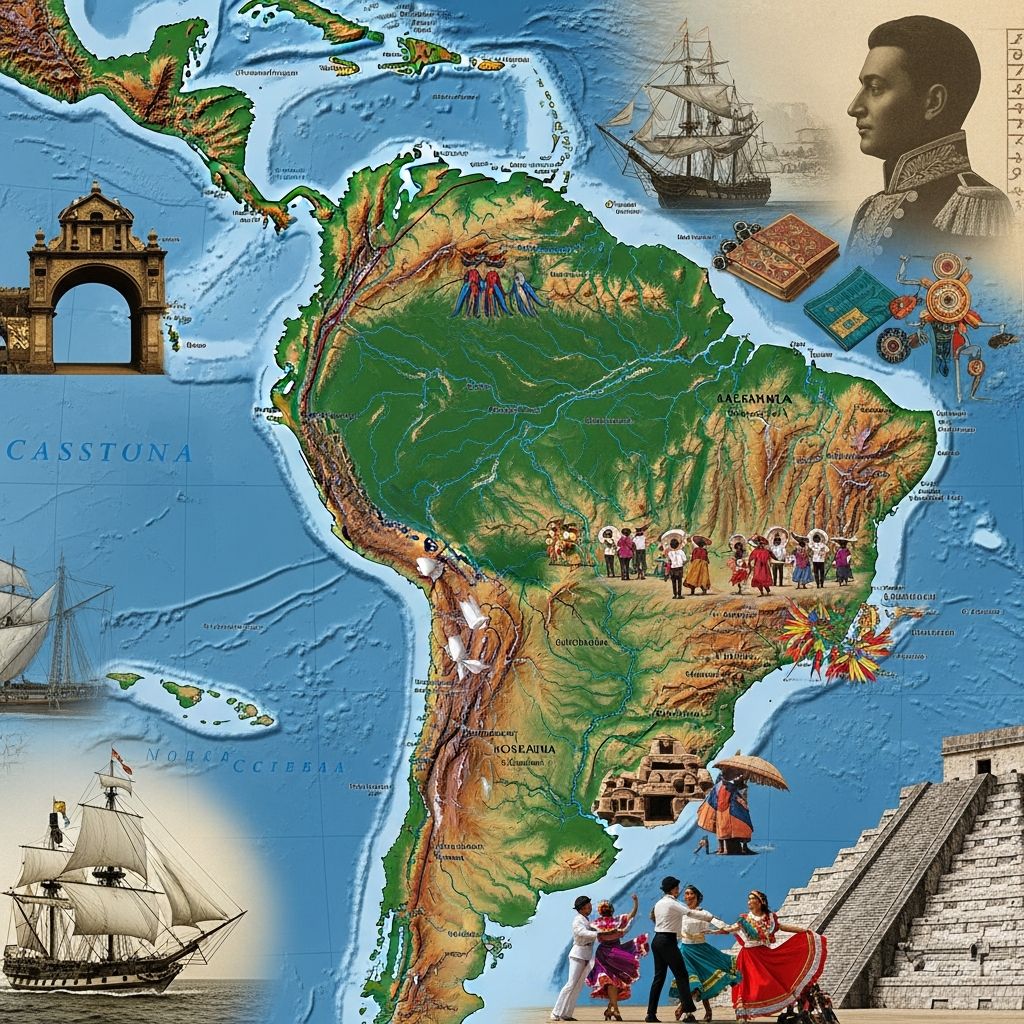
Latin America represents a vibrant cultural and linguistic region spanning multiple continents, primarily defined by the predominance of Romance languages derived from Latin, such as Spanish, Portuguese, and French. This area includes all of South America, Mexico, Central America, and various Caribbean islands, home to over 600 million people with shared colonial histories yet immense diversity.
Defining the Boundaries: A Cultural Rather Than Purely Geographic Concept
The term \”Latin America\” emerged in the 19th century to highlight nations with Iberian (Spanish and Portuguese) colonial roots, distinguishing them from Anglo-Saxon influences in North America. Unlike purely geographic labels like \”South America,\” which refers strictly to the continent south of Panama containing 12 sovereign states, Latin America is a conceptual grouping based on language, history, and culture.
Strict definitions limit it to 20 countries where Romance languages dominate and colonial ties to Iberia or France exist: Mexico, Central American nations (Costa Rica, El Salvador, Guatemala, Honduras, Nicaragua, Panama), South American countries (Argentina, Bolivia, Brazil, Chile, Colombia, Ecuador, Paraguay, Peru, Uruguay, Venezuela), and Caribbean states (Cuba, Dominican Republic, Haiti). Broader interpretations by organizations like the United Nations and World Bank include 33 countries and territories in Latin America and the Caribbean (LAC), incorporating English-speaking (e.g., Jamaica, Trinidad and Tobago), Dutch-speaking (Suriname), and other influenced areas due to geographic proximity and shared contemporary challenges.
This inclusivity acknowledges that while core Latin America centers on Spanish and Portuguese speakers, peripheral regions share ecological, economic, and social ties. Mexico stands unique as the sole North American entry, bridging the U.S. border to its north and Guatemala to its south.
Geographic Diversity: From Tropical Islands to Andean Peaks
Latin America’s geography defies uniformity, encompassing four major ecological zones: Mesoamerica (southern Mexico and Central America), the Caribbean archipelago, the Andean highlands, and the Southern Cone pampas. This diversity shapes climates, economies, and lifestyles—from the Amazon rainforest’s humid expanse in Brazil to the arid Atacama Desert in Chile, and coral-ringed islands in the West Indies.
Central America, often called Middle America alongside Mexico, features seven countries: Belize, Costa Rica, El Salvador, Guatemala, Honduras, Nicaragua, and Panama. Volcanic activity, narrow isthmuses, and Pacific-Atlantic divides define this bridge between continents. South America dominates with vast river systems like the Amazon and Orinoco, towering Andes (home to peaks over 20,000 feet), and expansive plains ideal for agriculture.
The Caribbean adds island nations and territories, blending volcanic origins with limestone formations, fostering biodiversity hotspots and hurricane-prone coasts. French Guiana, Guyana, and Suriname extend the region’s northern South American fringe, mixing continental and tropical island traits.
| Subregion | Countries/Territories (Examples) | Main Features |
|---|---|---|
| Mesoamerica | Mexico, Guatemala, Honduras | Ancient Mayan sites, volcanoes, diverse climates |
| Caribbean | Cuba, Jamaica, Haiti, Dominican Republic | Islands, tourism, hurricanes, multicultural histories |
| Andean Region | Peru, Bolivia, Ecuador, Colombia | High mountains, indigenous cultures, mining |
| Southern Cone | Argentina, Chile, Uruguay | Pampas grasslands, wine production, temperate weather |
Historical Foundations: Conquest, Independence, and Identity Formation
European arrival began with Christopher Columbus in 1492, followed by explorers like Amerigo Vespucci, leading to Spanish and Portuguese domination from the late 15th to 18th centuries. Indigenous empires—Aztec in Mexico, Inca in the Andes—faced conquest, resulting in massive population declines from disease and conflict, profound cultural shifts, and mestizo (mixed European-Indigenous) societies.
Independence waves in the early 19th century, led by figures like Simón Bolívar and José de San Martín, freed most nations from Iberian rule. The label \”Latin America\” gained traction then, promoted by French intellectuals to counter U.S. expansionism via the Monroe Doctrine, emphasizing a shared Romance-language heritage against Protestant Anglo influences.
This history forged unity amid diversity: Roman Catholicism predominates, blending with Indigenous and African spiritualities; economies shifted from colonial extraction (silver, sugar) to modern exports like soy, copper, and oil.
Linguistic Landscape: The Romance Language Legacy
Spanish and Portuguese dominate, spoken by over 90% of the population, with French in Haiti and French Guiana. Indigenous tongues like Quechua (Peru, Bolivia), Guarani (Paraguay), and Nahuatl (Mexico) persist, often co-official. Creole languages in the Caribbean mix European, African, and Indigenous elements.
- Spanish: Official in 18 countries, with regional variants (e.g., Rioplatense in Argentina, Caribbean Spanish).
- Portuguese: Brazil’s language, influencing music and cuisine across borders.
- French: Haiti and overseas territories, alongside Creole.
- Others: English/Dutch in inclusions like Guyana, Suriname for LAC grouping.
This linguistic bond underpins the region’s identity, distinguishing it globally as Romance-language centric outside Europe.
Cultural Fusion: Blending Traditions Across Borders
Latin American culture synthesizes Indigenous, European, African, and Asian elements. Festivals like Brazil’s Carnival or Mexico’s Día de los Muertos exemplify syncretism. Music genres—salsa (Caribbean), tango (Argentina), samba (Brazil)—reflect African rhythms fused with European forms.
Cuisine varies: Andean potatoes and quinoa, Mexican corn-based tacos, Brazilian feijoada (African-influenced stew). Art from Diego Rivera’s murals to Frida Kahlo’s surrealism captures colonial scars and resilience. Soccer unites nations, with Brazil’s five World Cups symbolizing passion.
Despite common threads, subregional differences abound: Andean Indigenous prominence vs. Caribbean Afro-Latin vibrancy.
Modern Realities: Economies, Societies, and Global Role
With 600+ million people, Latin America is urbanizing rapidly—over 80% live in cities like São Paulo (22 million) and Mexico City (21 million). Economies range from Brazil’s industrial giant (GDP ~$2 trillion) to resource-dependent nations like Venezuela (oil).
Challenges include inequality (highest globally), political instability, migration to the U.S., and climate vulnerabilities. Strengths: youthful demographics, biodiversity (Amazon holds 20% of global forests), renewable energy potential.
Regionally, Mercosur and Pacific Alliance foster trade; CELAC unites leaders sans U.S./Canada.
Frequently Asked Questions (FAQs)
Is Mexico part of Latin America?
Yes, Mexico is included as a North American country with Spanish as its primary language and deep colonial ties.
What separates Latin America from South America?
South America is geographic (12 countries south of Panama); Latin America is cultural, adding Mexico, Central America, and Caribbean Romance-language areas.
How many countries are in Latin America?
Strictly 20; LAC totals 33 including non-Romance areas like Jamaica and Guyana.
What languages define Latin America?
Primarily Spanish, Portuguese, and French, stemming from Latin roots via colonization.
Why is Brazil included despite speaking Portuguese?
Portuguese is a Romance language, sharing Iberian colonial history with Spanish-speaking neighbors.
References
- What Is Latin America? — Hispanic Outlook in Higher Education. 2023. https://www.hispanicoutlook.com/articles/what-latin-america
- Latin America — Wikipedia. 2026-04-04. https://en.wikipedia.org/wiki/Latin_America
- Latin America | Geography and Cartography — EBSCO Research Starters. 2024. https://www.ebsco.com/research-starters/geography-and-cartography/latin-america
- History of Latin America | Meaning, Countries, Map, & Facts — Encyclopædia Britannica. 2026-03-15. https://www.britannica.com/place/Latin-America
- The Difference Between South America and Latin America — Totally Latin America. 2023. https://www.totallylatinamerica.com/multi-destinations/the-difference-between-south-america-and-latin-america/
- Does “Latin America” Exist? — American Historical Association. 2022-01-01. https://www.historians.org/resource/does-latin-america-exist/
- Latin America | Facts, Culture & Religion — Study.com. 2024. https://study.com/learn/lesson/video/latin-american-culture-traditions.html

- Integrated M.A. in Applied Linguistics, University of Hyderabad
- 5+ years in editorial, instructional, SEO, and research-based writing
Sneha is a relationships and lifestyle writer with a strong foundation in applied linguistics and certified training in relationship coaching. She brings over five years of writing experience to theskillvault, crafting thoughtful, research-driven content that empowers readers to build healthier relationships, boost emotional well-being, and embrace holistic living. Her writing and insights reflect the belief that beauty, happiness, and wellness…