
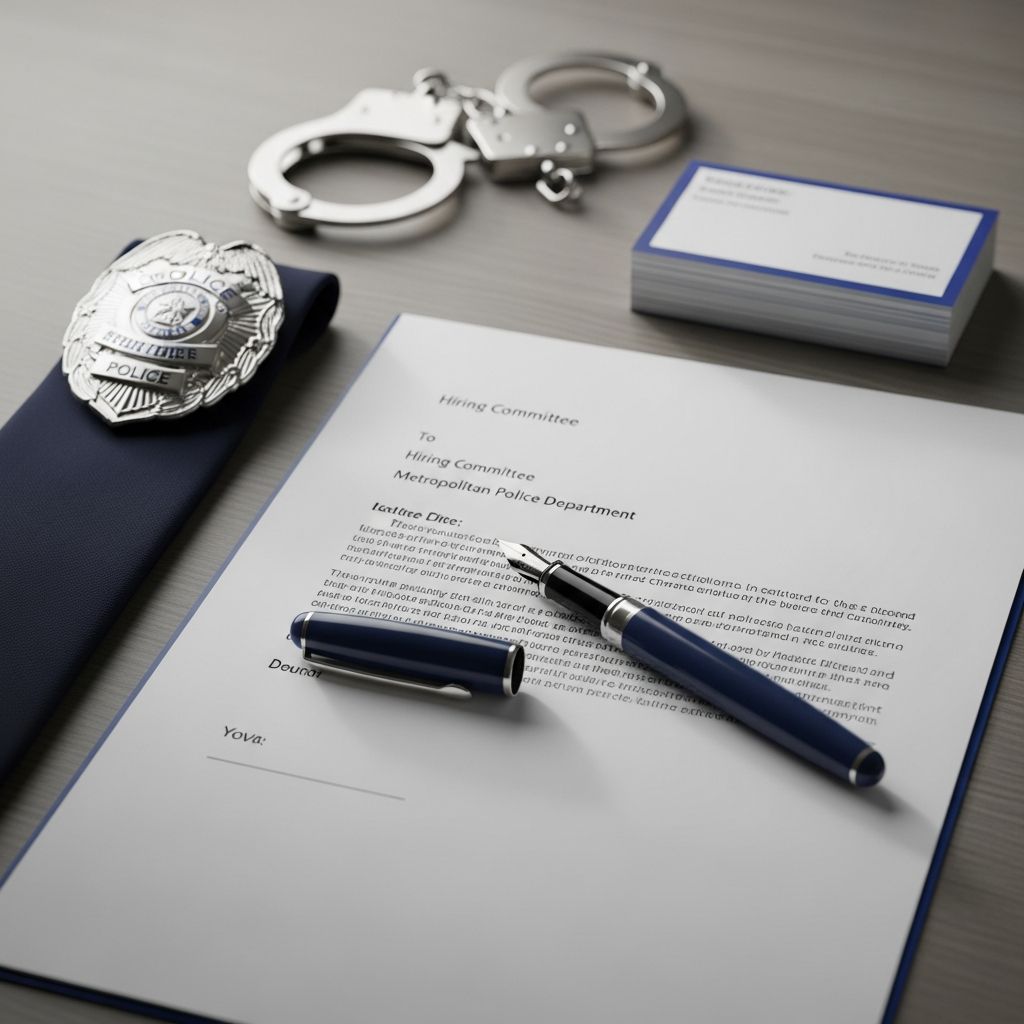
Law enforcement hiring is competitive, and agencies increasingly expect a strong, tailored cover letter alongside your resume. A well-written letter shows not only your investigative or patrol experience, but also your judgment, ethics, and commitment to public safety, all of which are core competencies for modern police work according to national standards for law enforcement training and professionalism.
Why Your Law Enforcement Cover Letter Matters
For many agencies, the cover letter is the first writing sample they see from you. It can help hiring panels quickly assess whether you:
- Understand the agency’s mission and community priorities
- Communicate clearly and professionally in writing
- Reflect core values like integrity, accountability, and respect
- Bring relevant training, certifications, and experience
- Can exercise sound judgment and discretion in high-stakes situations
Because written reports are central to policing and corrections, a clear and organized cover letter also signals that you can produce accurate documentation, which is one of the critical skills emphasized in law enforcement basic training curricula.
Key Elements of an Effective Law Enforcement Cover Letter
A strong letter is targeted, concise, and aligned with the job posting. Most successful law enforcement cover letters include the following elements:
- Professional header with your contact information and the agency’s details
- Specific greeting to the chief, sheriff, or hiring supervisor whenever possible
- Focused opening paragraph stating the role you are applying for and why
- 1–2 body paragraphs highlighting concrete achievements and relevant training
- Closing paragraph summarizing your value and inviting further contact
- Formal sign-off consistent with a business letter format
Understanding the Needs of Law Enforcement Employers
Before you start writing, review the job announcement and, when available, the agency’s mission statement or strategic plan. Many law enforcement organizations highlight similar priorities:
- Constitutional policing and protection of civil rights
- Use of evidence-based strategies and problem-oriented policing
- Community engagement and building public trust
- De-escalation, crisis response, and respect for vulnerable populations
- Collaboration with other agencies and community partners
Use your cover letter to connect your background to these themes, showing that you understand modern expectations for the profession.
Structuring Your Law Enforcement Cover Letter
While you should customize every letter, the structure below works well for most sworn and non-sworn positions.
1. Header and Contact Details
Include professional details at the top of the page:
- Full name and current rank or title (if applicable)
- City and state, phone number, and a professional email address
- Optional: LinkedIn profile or portfolio of relevant work (e.g., community initiatives)
- Date and the full name and address of the agency
Using a straightforward, business-like layout reflects the formal communication style expected in law enforcement documentation.
2. Greeting That Shows Preparation
Whenever possible, address your letter to a specific person:
- Preferred: “Dear Chief [Last Name],” or “Dear Sheriff [Last Name],”
- Acceptable if name is unknown: “Dear Hiring Manager,” or “Dear Selection Panel,”
Taking the time to identify the appropriate contact can demonstrate initiative and attention to detail.
3. A Focused, Purposeful Opening Paragraph
Your first paragraph should make it immediately clear:
- Which specific position you are applying for
- How you learned about the opening
- One or two key strengths that match the role (e.g., patrol experience, investigative expertise, language skills, or community policing background)
Keep this section brief; the goal is to encourage the reader to continue rather than list every accomplishment at once.
4. Body Paragraphs That Prove Your Value
Use one or two paragraphs to connect your experience directly to the duties in the posting. Wherever possible, quantify your impact and show how you meet or exceed agency standards.
Potential areas to highlight include:
- Patrol or investigative results (e.g., cases cleared, reductions in incidents)
- Experience with crisis intervention, de-escalation, or mental health calls
- Community engagement efforts, such as neighborhood meetings or youth programs
- Specialized training (firearms, defensive tactics, DUI enforcement, cybercrime)
- Leadership roles, training others, or coordinating multi-agency operations
- Report writing, evidence handling, and compliance with legal and departmental procedures
Use concise bullet points if they make your accomplishments easier to scan.
5. Professional Closing Paragraph
End your letter with a short paragraph that:
- Reinforces your interest in the agency and the role
- Summarizes the value you bring in one sentence
- Politely invites further discussion or an interview
- Thanks the reader for their time and consideration
Use a standard sign-off such as “Sincerely,” followed by your full name.
What to Emphasize for Different Law Enforcement Roles
Different positions within the justice system call for slightly different emphases in your cover letter. The table below highlights what many agencies commonly look for in several broad categories of roles.
| Role Type | Key Focus Areas | What to Highlight in Your Letter |
|---|---|---|
| Patrol / Police Officer | Visible presence, rapid response, community relations | Experience handling calls for service, traffic enforcement, and proactive patrol; examples of de-escalation and constitutional policing; community outreach or problem-solving initiatives. |
| Detective / Investigator | Case management, evidence, interviews | Clearance rates or investigative outcomes; experience with interviews, search warrants, and inter-agency coordination; attention to legal standards for evidence collection. |
| Corrections / Detention | Facility safety, inmate management, rehabilitation support | Skills in conflict management, maintaining order, and working with diverse populations; adherence to use-of-force policies; contributions to reentry or rehabilitation programming. |
| Community Policing / Outreach | Public trust, partnerships, problem-solving | Experience collaborating with community groups; designing or leading outreach programs; measurable improvements in local concerns such as disorder or fear of crime. |
| Specialized Units (K-9, SWAT, Traffic, Cyber) | Technical skill, advanced training | Specialized certifications, scenario-based training, and operational successes; ability to train others and follow strict protocols. |
Showcasing Training, Certifications, and Continuous Learning
Modern agencies value applicants who engage in continuous professional development, reflecting widely recognized best practices for law enforcement training and accountability.
In your cover letter, briefly mention:
- Completion of state basic law enforcement academy or corrections academy
- Advanced courses (e.g., crisis intervention, cultural competency, leadership)
- Firearms, defensive tactics, or specialized equipment certifications
- Relevant degrees or coursework in criminal justice, psychology, or related fields
- Participation in scenario-based or evidence-based training programs
You do not need to list every course—select those most relevant to the position and explain, briefly, how they support the agency’s mission.
Writing Style and Formatting Tips for Law Enforcement Applicants
Because law enforcement reports must be clear, factual, and well-organized, your cover letter should follow the same principles.
- Length: Aim for about 250–400 words, or three to four short paragraphs, unless the posting specifies otherwise.
- Language: Use direct, professional language; avoid slang or overly casual phrasing.
- Tone: Confident but not boastful; grounded in facts and specific examples.
- Formatting: Standard business font; consistent margins and spacing for easy reading.
- Proofreading: Carefully check spelling, grammar, and names. Error-free writing supports your credibility.
Clear and accurate writing reflects the report-writing skills that are central to the daily work of law enforcement personnel.
Common Mistakes to Avoid
A thoughtful cover letter can be undermined by a few avoidable errors. Pay attention to these issues before you submit:
- Using a generic letter for every application instead of tailoring it to the specific agency
- Repeating your resume line-by-line instead of adding context and insights
- Focusing only on personal reasons for wanting the job, without showing what you offer the agency
- Making unsupported claims like “excellent officer” without concrete examples
- Over-sharing sensitive details about ongoing cases or confidential operations
- Leaving out key qualifications that are clearly required in the posting
Simple Checklist Before You Submit
Use this quick checklist to review your letter:
- The position title and agency name are correct throughout
- You have addressed the letter to the correct person or hiring body
- You clearly state why you are interested in this agency in particular
- You provide at least two specific, relevant examples of past performance
- You mention any critical certifications or training required in the posting
- There are no spelling or grammatical errors
- Your contact information is accurate and easy to find
Frequently Asked Questions About Law Enforcement Cover Letters
Q: Do I need a cover letter if the posting does not mention one?
Unless the announcement specifically says not to send a cover letter, including a concise, well-targeted letter can help you stand out by demonstrating professionalism and communication skills.
Q: How can I show integrity and ethics in my cover letter?
You do not need to state that you are ethical; instead, describe situations where you followed policy, reported issues appropriately, or protected the rights of community members, which reflects the ethical standards emphasized by national law enforcement guidelines.
Q: What if I am new to law enforcement with no experience?
Focus on your academy performance, ride-alongs, internships, volunteer work, or military and security experience. Emphasize transferable skills such as teamwork, discipline, conflict management, and communication, all of which are valued in entry-level public safety roles.
Q: Should I mention physical fitness or firearms skills?
If the posting lists physical or firearms qualifications, briefly mention that you meet or exceed those standards and are committed to maintaining them, but keep the focus on your overall ability to perform the job professionally and safely.
Q: Can I reuse the same cover letter for different agencies?
You can start from a common base, but you should always adapt each letter to the agency’s community, mission, and priorities, and adjust which examples you highlight so they align with the particular role.
References
- Principles of Good Policing: Avoiding Violence Between Police and Citizens — U.S. Department of Justice, Office of Community Oriented Policing Services. 2003-01-01. https://cops.usdoj.gov/RIC/Publications/cops-p011
- Final Report of the President’s Task Force on 21st Century Policing — President’s Task Force on 21st Century Policing, Office of Community Oriented Policing Services. 2015-05-01. https://cops.usdoj.gov/RIC/Publications/cops-p341-pub.pdf
- Police Response to Persons with Mental Illnesses — Council of State Governments Justice Center. 2010-01-01. https://csgjusticecenter.org/publications/police-responses-to-people-with-mental-illnesses
- Core Principles for Reducing Recidivism and Improving Other Outcomes for Youth in the Juvenile Justice System — Council of State Governments Justice Center. 2014-07-01. https://csgjusticecenter.org/publications/core-principles-for-reducing-recidivism-for-youth

- Integrated M.A. in Applied Linguistics, University of Hyderabad
- 5+ years in editorial, instructional, SEO, and research-based writing
Sneha is a relationships and lifestyle writer with a strong foundation in applied linguistics and certified training in relationship coaching. She brings over five years of writing experience to theskillvault, crafting thoughtful, research-driven content that empowers readers to build healthier relationships, boost emotional well-being, and embrace holistic living. Her writing and insights reflect the belief that beauty, happiness, and wellness…