
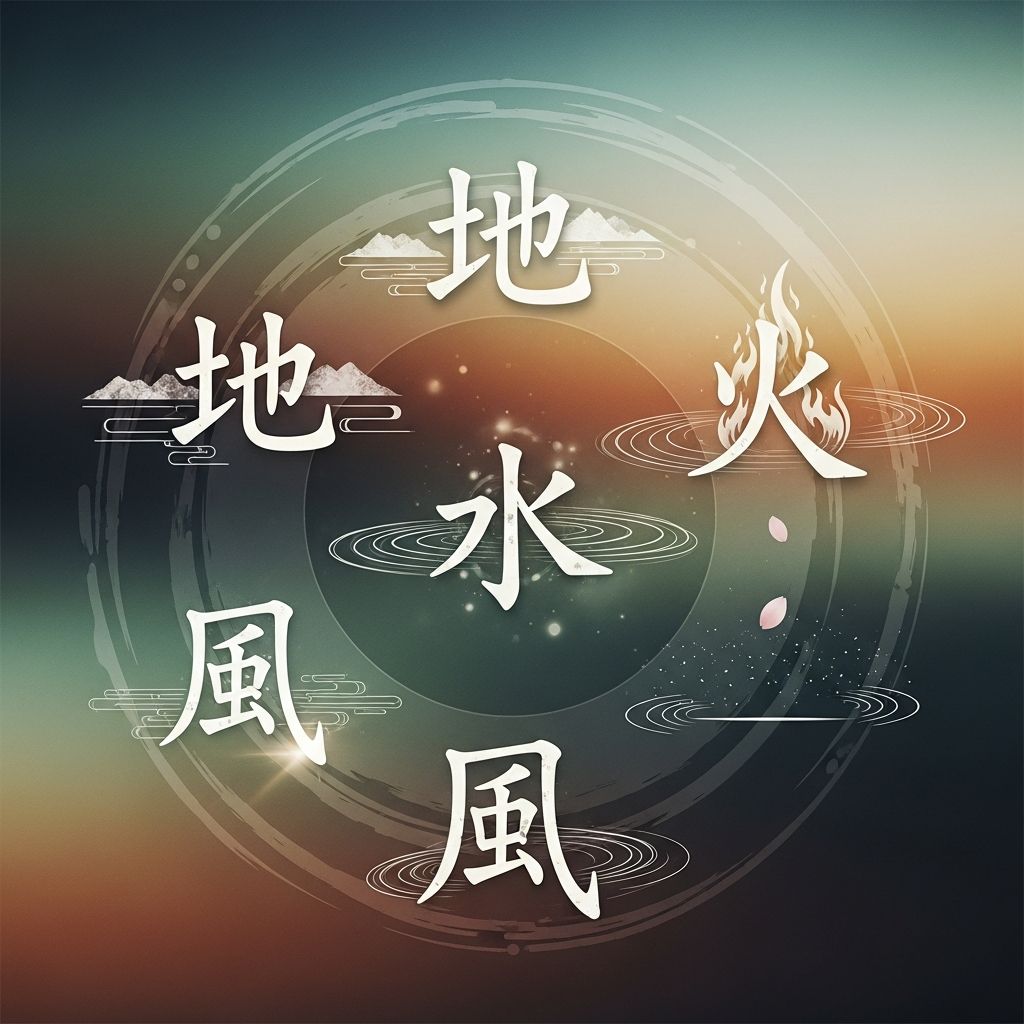
The five elements, known as gogyo (五行) in Japanese or Wu Xing in Chinese, form a cornerstone of East Asian philosophy, influencing everything from traditional medicine to martial arts and calendar systems. These elements—wood, fire, earth, metal, and water—aren’t just natural forces; they represent dynamic processes of change, generation, and control. Learning their kanji characters offers a gateway into Japanese language, culture, and cosmology. This guide provides step-by-step writing instructions, pronunciations, historical context, and practical applications, helping learners master these essential symbols.
Origins and Philosophical Foundations of Gogyo
The concept of the five elements traces back to ancient China during the Warring States Period (476-221 BC), where classical texts described them as fundamental movements in nature rather than static materials. In Japanese, gogyo integrates into Shinto, Buddhism, Aikido, and everyday terminology like days of the week. Wood symbolizes growth and expansion, fire ascent and transformation, earth stability and nurturing, metal contraction and refinement, and water flow and adaptability.
These elements interact through two primary cycles: the generating cycle, where wood fuels fire, fire creates earth (ash), earth yields metal, metal collects water, and water nourishes wood; and the controlling cycle, where wood parts earth, earth dams water, water extinguishes fire, fire melts metal, and metal chops wood. This balance mirrors natural self-regulation and human physiology, as noted in texts like the Yellow Emperor’s Canon of Internal Medicine.
Essential Tools for Kanji Practice
Before diving into strokes, gather genkouyoushi paper (traditional squared practice sheets), a fine-tipped brush or pen, and red ink for corrections. Practice from top to bottom, left to right, ensuring thin horizontal/vertical lines and thicker endpoints. Consistency builds muscle memory for fluid writing.
- Brush grip: Hold lightly like a pencil, index finger extended for control.
- Posture: Sit upright, paper angled 45 degrees.
- Speed: Slow for accuracy, faster for style later.
Wood (木 – Ki): The Element of Growth
The kanji for wood, 木 (ki), depicts a sturdy tree with branching limbs. On’yomi: moku, boku; Kunyomi: ki, ko. It appears in words like 木曜日 (mokuyoubi – Thursday) and 森林 (shinrin – forest).
Stroke order (8 strokes):
- Central vertical line, top to bottom.
- Left slanting branch, top-left to bottom-right.
- Right slanting branch, top-right to bottom-left.
- Short left horizontal at base.
- Short right horizontal at base.
- Extend left branch downward.
- Extend right branch downward.
- Final base horizontal connector.
Visualize a tree’s trunk splitting into roots and crown. In gogyo, wood drives expansive energy, promoting springtime renewal.
Fire (火 – Hi): The Spark of Transformation
火 (hi) illustrates flames leaping upward. On’yomi: ka; Kunyomi: hi, ho. Found in 火曜日 (kayoubi – Tuesday) and 炎 (honoo – blaze).
Stroke order (4 strokes):
- Left dot, falling rightward.
- Right dot, falling leftward.
- Central rising vertical flick.
- Bottom horizontal crossbar.
Fire embodies upward, illuminating energy, central to summer and passion. Its simplicity belies its power in compound kanji like 灯火 (touka – lamp fire).
| Kanji | Meaning | Strokes |
|---|---|---|
| 火 | Fire | 4 |
| 炎 | Flame | 8 |
| 燃 | Burn | 16 |
Earth (土 – Tsuchi): The Nurturing Center
土 (tsuchi) shows soil piled high. On’yomi: do, to; Kunyomi: tsuchi, tsi. Key in 土曜日 (doyoubi – Saturday) and 土地 (tochi – land).
Stroke order (3 strokes):
- Top horizontal, left to right.
- Left falling diagonal.
- Right falling diagonal, curving up.
Earth provides stability, transition between seasons, and fertility, moderating other elements.
Metal (金 – Kin): Strength and Precision
金 (kin) represents ore refined in a mold. On’yomi: kin, kon; Kunyomi: kane, kana. In 金曜日 (kinyoubi – Friday) and 金 (kane – money/gold).
Stroke order (8 strokes):
- Roof: two horizontals with central vertical.
- Bottom: king’s jewel (二 + dot).
- Detailed: top dot, middle horizontals, base lines.
Metal contracts inward, symbolizing autumn harvest and discipline.
Water (水 – Mizu): Fluidity and Depth
水 (mizu) mimics flowing water with cascading drops. On’yomi: sui; Kunyomi: mizu, mi. Seen in 水曜日 (suiyoubi – Wednesday) and 海 (umi – sea).
Stroke order (4 strokes):
- Left zigzag vertical.
- Middle short vertical.
- Right zigzag vertical.
- Bottom horizontal.
Water flows downward, embodying winter’s storage and wisdom, as in Bruce Lee’s metaphor.
Interconnections: Cycles in Action
Understanding cycles enhances kanji mastery:
- Generating: Wood → Fire → Earth → Metal → Water → Wood.
- Controlling: Wood → Earth → Water → Fire → Metal → Wood.
These apply in Aikido techniques, where movements emulate elemental flows, and medicine, balancing bodily energies.
Daily Applications and Cultural Ties
Elements permeate Japanese life: weekdays (e.g., 火曜日 for fire day), calendar lore, and ukiyo-e art like Kuniyoshi’s Buyu Gogyo heroes embodying each. In Shiatsu and macrobiotics, they guide health.
Practice Drills for Fluency
Write each kanji 50 times daily, then compounds:
- 木火土金水 (all five).
- 五行 (gogyo).
Quiz yourself on readings and cycles. Apps like Kanji Study aid digital practice.
Frequently Asked Questions (FAQs)
What is the difference between gogyo and four elements?
Gogyo includes five (adding earth/metal), focusing on phases vs. Greek static substances.
How do weekdays relate to elements?
星期: Sun (day), Moon, Fire (Tue), Water (Wed), Wood (Thu), Gold (Fri), Earth (Sat).
Can beginners learn these kanji?
Yes, with 3-8 strokes each, they’re JLPT N5 level, ideal starters.
Are there videos for stroke order?
Resources like YouTube demos show precise writing.
Advanced: Calligraphy and Artwork
Elevate skills with shodo (calligraphy). 五行 scrolls adorn homes, blending art and philosophy. Practice variations: kaisho (block), gyosho (semi-cursive).
In summary, mastering these kanji reveals Japan’s elemental worldview. Dedicate time, and you’ll wield symbols of cosmic balance.
References
- Earth, Wind, Fire, Water, Void – How to write Japanese 5 elements — YouTube. Accessed 2026. https://www.youtube.com/watch?v=L_ZeHfupqfQ
- Writing and pronouncing the Five Elements — Drawing and Painting Studio. Accessed 2026. https://drawingandpaintingstudio.com/writing-and-pronouncing-the-five-elements
- The 5 elements in Aikido: Gogyo (五行) — Ventura Aikido. Accessed 2026. https://www.venturaaikido.com/post/the-5-elements-in-aikido-gogyo-%E4%BA%94%E8%A1%8C
- Genuine Five Elements in Chinese & Japanese Kanji Artwork — Oriental Outpost. Accessed 2026. https://www.orientaloutpost.com/shufa.php?q=Five+Elements
- Heroes for the Five Elements – 武勇五行 — Kuniyoshi Project. Accessed 2026. http://www.kuniyoshiproject.com/Heroes%20for%20the%20Five%20Elements.htm

Medha Deb is an editor with a master's degree in Applied Linguistics from the University of Hyderabad. She believes that her qualification has helped her develop a deep understanding of language and its application in various contexts. Medha specializes in the areas of beauty, health, sports, and wellness and is committed to ensuring that the content on the website is…