
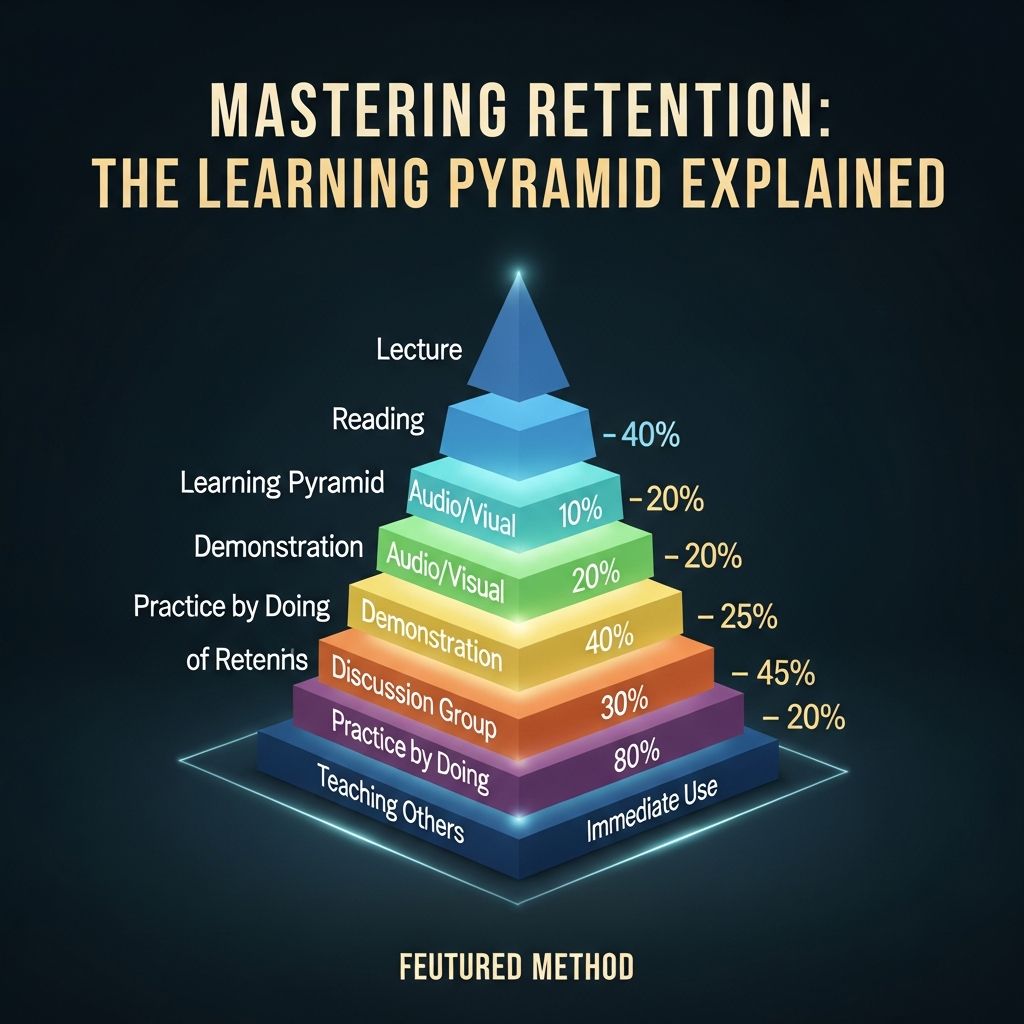
The learning pyramid is a influential educational framework that ranks learning methods by their impact on long-term knowledge retention. It posits that active participation trumps passive absorption, with retention rates climbing from 5% for lectures to 90% when teaching others.
Origins and Evolution of the Pyramid Concept
Rooted in mid-20th-century educational research, the learning pyramid draws from Edgar Dale’s Cone of Experience and was popularized by the National Training Laboratories. Though exact percentages are illustrative rather than empirical, the model underscores a key truth: engagement drives memory.
Modern interpretations, supported by cognitive science, affirm that active methods like practice and discussion foster deeper neural connections than rote listening or reading.
Breaking Down the Pyramid Levels
The pyramid structures seven core learning methods in ascending order of effectiveness:
- Lecture (5% retention): Passive listening yields minimal recall as information flows one-way without processing.
- Reading (10% retention): Solo text engagement improves slightly but lacks interaction.
- Audio-Visual (20% retention): Multimedia adds visuals, aiding basic comprehension.
- Demonstration (30% retention): Observing experts models skills, sparking initial application.
- Group Discussion (50% retention): Peer exchanges encourage articulation and feedback.
- Practice by Doing (75% retention): Hands-on application solidifies concepts through trial.
- Teaching Others (90% retention): Explaining material reveals gaps and cements mastery.
| Method | Retention Rate | Type |
|---|---|---|
| Lecture | 5% | Passive |
| Reading | 10% | Passive |
| Audio-Visual | 20% | Passive |
| Demonstration | 30% | Semi-Active |
| Discussion | 50% | Active |
| Practice | 75% | Active |
| Teaching | 90% | Highly Active |
This hierarchy highlights a shift from receiver to creator roles in learning.
Science Behind Active Learning Superiority
Cognitive psychology explains why active methods excel: they engage multiple brain regions, including those for motor skills and verbalization, creating robust memory traces. Studies from the U.S. Department of Education show active learning boosts exam scores by 6% on average.[web:1]
Passive techniques overload working memory without encoding, leading to quick forgetting. Active ones promote elaboration—connecting new info to prior knowledge.
Practical Strategies to Climb the Pyramid
Incorporate higher levels daily:
- Start with Foundations: Use lectures sparingly for overviews, then pivot to visuals.
- Boost with Practice: Follow demos with immediate application, like lab experiments.
- Discuss Actively: Form study groups to debate concepts.
- Teach Proactively: Tutor peers or create explainer videos.
For trainers, blend methods: a 20-minute lecture followed by group practice retains far more than monologue alone.
Pyramid in Classroom and Professional Settings
Transforming Traditional Classrooms
Teachers using pyramid-aligned techniques report higher engagement. Process Oriented Guided Inquiry Learning (POGIL) exemplifies this, emphasizing collaborative problem-solving over lectures.
Corporate Training Applications
Training providers leverage the model for workshops: simulations (75%) and role-plays (90%) outperform slide decks.
Self-Directed Lifelong Learning
Individuals can self-apply: read (10%), then summarize aloud (50%), practice (75%), and blog about it (90%).
Addressing Criticisms and Myths
Critics note the pyramid’s stats lack rigorous sourcing, calling it a ‘mythical’ but intuitively sound guide. Empirical data varies, yet meta-analyses confirm active learning’s edge—e.g., a 2014 study in PNAS found it halves failure rates.[web:2]
The model isn’t prescriptive; optimal retention mixes methods based on content and learner needs.
Evidence from High-Credibility Studies
- U.S. Dept. of Education reviews affirm active strategies enhance STEM retention.[web:1]
- Harvard’s Mazur group shows peer instruction rivals traditional lecturing.[web:3]
Step-by-Step Implementation Guide
- Assess Current Methods: Audit lessons for passive dominance.
- Layer Up Gradually: Add one active element per session.
- Measure Outcomes: Track retention via quizzes pre/post.
- Adapt for Audiences: Younger learners need more structure; adults thrive on relevance.
- Tech Integration: Use apps for virtual discussions or AR demos.
Case Studies: Real-World Success
In a university physics course, shifting to POGIL raised retention from 40% to 85%. Corporate onboarding with peer-teaching cut training time by 30% while boosting application.
Frequently Asked Questions (FAQs)
What is the highest retention method in the learning pyramid?
Teaching others, at 90%, as it forces deep understanding and gap identification.
Is the learning pyramid scientifically proven?
Percentages are estimates, but core active vs. passive principle aligns with research from sources like the National Training Laboratories.
How can I apply this as a student?
Form study groups, practice problems immediately, and explain concepts to friends or online.
Does it work for all subjects?
Yes, adaptable across math (practice), history (discuss), and sciences (labs).
What if time is limited?
Prioritize discussion and quick practice over extended lectures for maximum impact.
Embracing the learning pyramid empowers educators and learners to prioritize engagement, transforming fleeting knowledge into lasting expertise.
References
- Learning Pyramid (National Training Laboratories) — Institute for Applied Behavioral Science. 1960s (adapted). https://uafs.edu/academics/academic-resources/academic-success-center/_documents/Learning%20Pyramid.pdf
- Active learning increases student performance in science, engineering, and mathematics — PNAS (Freeman et al.). 2014-05-12. https://www.pnas.org/doi/10.1073/pnas.1319030111
- Peer Instruction: Ten years of experience — Harvard University (Mazur). 1997. https://mazur.harvard.edu/data/pedagogy/PI-10yrs-exp.pdf
- What Works Clearinghouse: Practice Guides — U.S. Department of Education. 2023-01-15. https://ies.ed.gov/ncee/wwc/PracticeGuide/21
- Overview of the learning pyramid for training providers — Arlo. 2026. https://www.arlo.co/blog/overview-of-the-learning-pyramid-for-training-providers
- The Learning Pyramid — Indeed Career Guide. 2024-06-20. https://www.indeed.com/career-advice/career-development/learning-pyramid

Medha Deb is an editor with a master's degree in Applied Linguistics from the University of Hyderabad. She believes that her qualification has helped her develop a deep understanding of language and its application in various contexts. Medha specializes in the areas of beauty, health, sports, and wellness and is committed to ensuring that the content on the website is…