
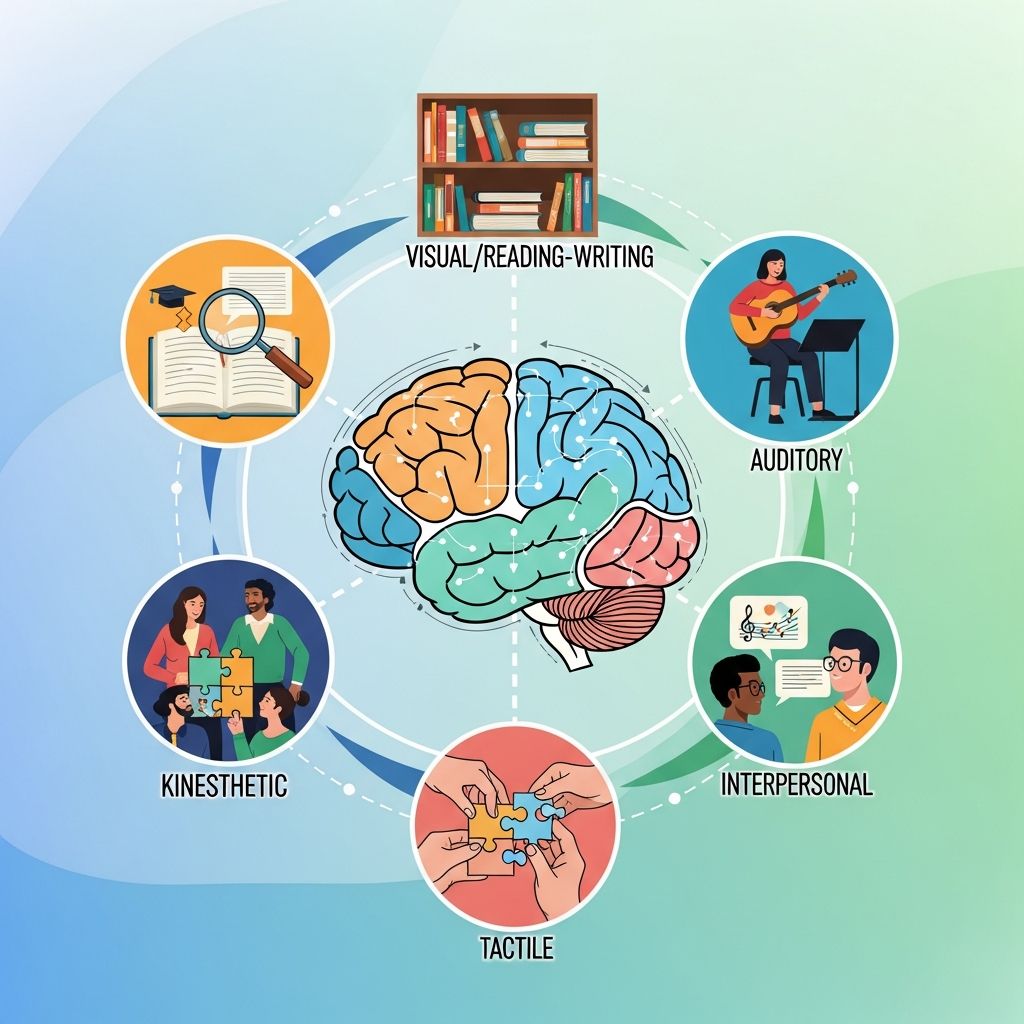
Understanding how students process information is fundamental to effective teaching. Two prominent concepts in education—learning styles and multiple intelligences—often get conflated, yet they represent distinct approaches to cognition and instruction. Learning styles focus on sensory preferences like visual, auditory, or kinesthetic input, while multiple intelligences, proposed by Howard Gardner, describe varied cognitive strengths such as linguistic or spatial abilities. This article delves into their differences, research findings, and practical applications to help educators tailor learning experiences.
Defining Learning Styles: Sensory Pathways to Knowledge
Learning styles categorize how individuals prefer to receive and interact with information through their senses. Common types include:
- Visual learners: These students grasp concepts best through images, diagrams, charts, and spatial arrangements. They excel when information is presented graphically.
- Auditory learners: They process data effectively by listening, such as through lectures, discussions, or audio recordings. Rhythm, tone, and verbal repetition aid their retention.
- Kinesthetic or tactile learners: Hands-on activities, movement, and physical manipulation help them learn. Building models or role-playing suits them best.
Research indicates students often exhibit a blend of these preferences rather than a single dominant style. For instance, a study on secondary school students found tactile and auditory preferences were most common, with moderate positive correlations across styles. However, tailoring instruction solely to these styles lacks robust empirical support, as preferences do not consistently predict improved outcomes.
Howard Gardner’s Theory of Multiple Intelligences
In the 1980s, psychologist Howard Gardner challenged the notion of a singular IQ by introducing the theory of multiple intelligences (MI). He argued that intelligence manifests in at least eight independent yet interconnected domains, each representing unique ways humans solve problems or create products.
| Intelligence Type | Description | Example Strengths |
|---|---|---|
| Linguistic | Sensitivity to language, words, and communication | Writers, poets, debaters |
| Logical-Mathematical | Reasoning, numbers, patterns, and logic | Scientists, mathematicians, programmers |
| Spatial (Visual-Spatial) | Visualizing and manipulating spatial patterns | Architects, artists, pilots |
| Bodily-Kinesthetic | Control of physical movement and touch | Athletes, dancers, surgeons |
| Musical | Rhythm, pitch, melody, and sound | Composers, musicians, sound engineers |
| Interpersonal | Understanding and interacting with others | Teachers, counselors, politicians |
| Intrapersonal | Self-awareness and introspection | Philosophers, therapists, entrepreneurs |
| Naturalistic | Recognizing patterns in nature and environment | Biologists, farmers, environmentalists |
Gardner’s framework posits everyone possesses all intelligences to varying degrees, and education should nurture underdeveloped ones. Studies confirm naturalistic, visual, and kinesthetic intelligences often score highest among certain groups, like rural secondary students.
Key Differences Between Learning Styles and Multiple Intelligences
A frequent misunderstanding equates MI with learning styles, but Gardner explicitly distinguishes them. Learning styles concern sensory modalities—how information enters the brain—while MI addresses cognitive processing domains—how it’s understood and applied.
- Learning styles are narrow (VAK model), MI is broad (8+ types).
- Sensory preferences don’t dictate intelligence profiles; a visual learner might excel in logical-mathematical tasks.
- MI promotes holistic development; learning styles risk pigeonholing students.
Scientific scrutiny reveals learning styles as preferences without proven learning advantages, unlike MI’s emphasis on diverse demonstrations of mastery. For example, providing varied content access boosts engagement regardless of style.
Research Insights: What the Evidence Shows
Empirical studies illuminate connections and limitations. A Turkish investigation of secondary students using the Perceptual Learning-Style Preference Questionnaire and Multiple Intelligence Inventory found tactile/auditory dominance in styles and high naturalistic/visual/kinesthetic intelligences. Gender differences emerged, with moderate correlations between most MI types and styles.
Broader reviews affirm: multi-modal instruction enhances outcomes, not style-matching. Hattie (2011) notes multiple content access improves learning; Darling-Hammond (2010) supports varied assessments for accurate evaluation. Critiques highlight learning styles’ neuromyth status, advocating variability over rigid categorization.
Gender and contextual factors influence profiles—e.g., village students favor naturalistic MI—underscoring personalized approaches.
Practical Classroom Strategies for Multiple Intelligences
To leverage MI, educators can diversify methods without over-relying on unproven styles.
Instructional Adaptations
- Incorporate pluralization: Teach concepts via multiple pathways (e.g., lecture, video, experiment) to activate various intelligences.
- Group dynamics: Pair students by complementary strengths for collaborative projects.
- Tech integration: Use apps for simulations (spatial), podcasts (musical/linguistic), or virtual labs (naturalistic).
Differentiated Assessments
Replace uniform tests with options:
- Portfolio for intrapersonal reflection.
- Presentations for interpersonal skills.
- Performances for bodily-kinesthetic expression.
Northern Illinois University recommends aligning activities with subject matter to build weaker intelligences, fostering confidence.
Debunking Myths and Overcoming Challenges
Myth: Match teaching to styles for optimal learning. Reality: Variability in scaffolds (visual, auditory, etc.) benefits all, not style-specific tailoring. Gardner warns against labeling that limits potential.
Challenges include assessment time and teacher training. Solutions: Start small with one unit’s MI-infused activities and professional development on evidence-based differentiation.
Benefits for Diverse Learners
MI-responsive teaching boosts motivation, engagement, and inclusivity, especially for neurodiverse or underrepresented students. Research shows detailed student profiling informs targeted growth. Parents aware of children’s profiles can reinforce home learning.
Frequently Asked Questions (FAQs)
What are the 8 types of multiple intelligences?
Linguistic, logical-mathematical, spatial, bodily-kinesthetic, musical, interpersonal, intrapersonal, and naturalistic.
Do learning styles really exist?
They represent preferences, but evidence doesn’t support better outcomes from style-matched instruction.
How can teachers assess multiple intelligences?
Use inventories, observations, and varied tasks; avoid over-labeling.
Is multiple intelligences theory scientifically proven?
It’s influential for practice, supported by diverse instruction benefits, though not universally quantifiable like IQ.
Can adults benefit from MI theory?
Yes, for professional development, self-improvement, and lifelong learning.
References
- An Investigation between Multiple Intelligences and Learning Styles — ERIC. 2018. https://files.eric.ed.gov/fulltext/EJ1170867.pdf
- Gardner’s Theory Of Multiple Intelligences — Simply Psychology. 2023-10-13. https://www.simplypsychology.org/multiple-intelligences.html
- Learning Styles vs Multiple Intelligences and Variability — Novak Education. 2022. https://www.novakeducation.com/blog/learning-styles-vs-multiple-intelligences
- Multiple Intelligences: What Does the Research Say? — Edutopia. 2018-09-06. https://www.edutopia.org/multiple-intelligences-research
- Learning Styles vs Multiple Intelligences Myth — HMH Blogs. 2023. https://www.hmhco.com/blog/learning-styles-vs-multiple-intelligences
- Howard Gardner’s Theory of Multiple Intelligences — Northern Illinois University. 2023. https://www.niu.edu/citl/resources/guides/instructional-guide/gardners-theory-of-multiple-intelligences.shtml

- Integrated M.A. in Applied Linguistics, University of Hyderabad
- 5+ years in editorial, instructional, SEO, and research-based writing
Sneha is a relationships and lifestyle writer with a strong foundation in applied linguistics and certified training in relationship coaching. She brings over five years of writing experience to theskillvault, crafting thoughtful, research-driven content that empowers readers to build healthier relationships, boost emotional well-being, and embrace holistic living. Her writing and insights reflect the belief that beauty, happiness, and wellness…