
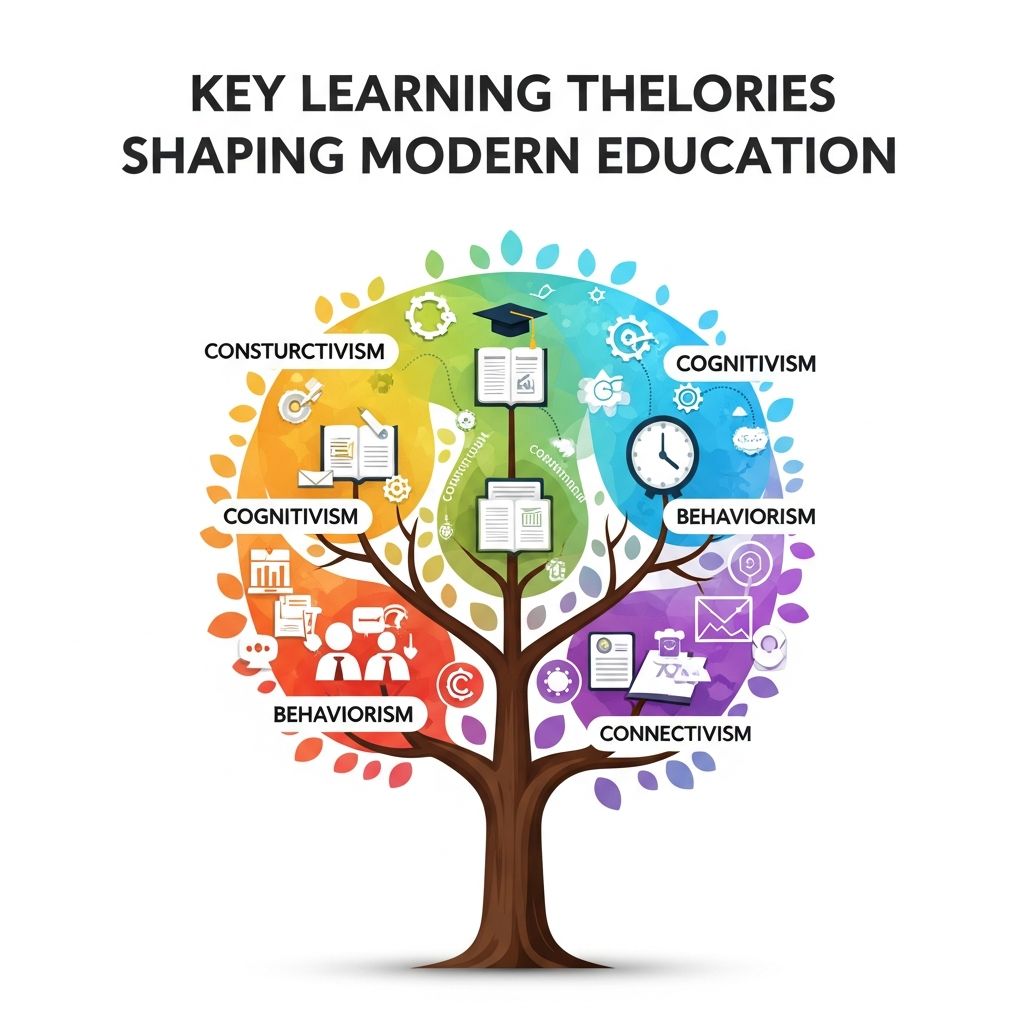
Learning theories provide foundational frameworks for understanding how students acquire knowledge, develop skills, and adapt to educational environments. These theories, developed over decades by psychologists and educators, inform curriculum design, instructional strategies, and assessment methods. By grasping their core principles, teachers can tailor approaches to meet diverse learner needs, fostering deeper comprehension and long-term retention.
Foundations of Educational Learning Theories
Educational learning theories categorize how individuals process information and construct understanding. Broadly grouped into behaviorism, cognitivism, and constructivism, with extensions like humanism and connectivism, these models shift focus from external behaviors to internal processes and social contexts. Each theory addresses different aspects of cognition, motivation, and interaction, enabling educators to select or blend strategies for optimal results.
Historically, these ideas evolved from early 20th-century experiments to contemporary digital-age adaptations. For instance, behaviorism dominated mid-century classrooms with rote drills, while modern practices integrate constructivist elements like project-based learning. Understanding these shifts helps educators navigate today’s diverse, technology-rich settings.
Behaviorism: Shaping Habits Through Reinforcement
Behaviorism posits that learning occurs through observable responses to environmental stimuli, emphasizing conditioning over internal thoughts. Pioneered by figures like Ivan Pavlov and B.F. Skinner, it views all behaviors as learned via association or consequence.
Pavlov’s classical conditioning demonstrated how a neutral stimulus, paired repeatedly with a reflexive one, elicits the same response—think of a bell signaling food for dogs. Skinner’s operant conditioning expanded this, using rewards (positive reinforcement) or removals (negative reinforcement) to strengthen behaviors, and punishments to weaken them. In classrooms, this translates to sticker charts for good conduct or token economies where points redeem privileges.
- Positive Reinforcement: Praising correct answers to encourage repetition.
- Negative Reinforcement: Removing homework for consistent effort to boost motivation.
- Punishment: Time-outs for disruptions, though overused it risks demotivation.
Critics argue behaviorism ignores cognitive depth, but it excels in skill-building like math drills or habit formation. Recent applications include gamified apps with badges for progress.
Cognitivism: Unlocking Mental Processes
Cognitivism shifts attention to internal mechanisms—memory, perception, and problem-solving—treating the mind as an information processor. Jean Piaget’s stages of cognitive development outline how children advance from sensorimotor exploration (birth-2 years) to formal operations (abstract thinking, adolescence).
Piaget identified assimilation (fitting new info into existing schemas) and accommodation (adjusting schemas for new info) as key. Jerome Bruner complemented this with discovery learning, where students actively explore concepts. Classroom impacts include scaffolding—gradual support withdrawal—and cognitive load management to avoid overload.
| Piaget’s Stages | Age Range | Key Characteristics |
|---|---|---|
| Sensorimotor | 0-2 years | Object permanence, sensory exploration |
| Preoperational | 2-7 years | Symbolic thinking, egocentrism |
| Concrete Operational | 7-11 years | Logical operations on concrete objects |
| Formal Operational | 12+ years | Abstract hypothesis testing |
This theory underpins techniques like mind maps for schema building and spaced repetition for memory consolidation.
Constructivism: Building Knowledge Actively
Constructivism asserts learners actively build knowledge from experiences, integrating new ideas with prior understanding. Lev Vygotsky’s social constructivism highlights the Zone of Proximal Development (ZPD)—the gap between independent capability and guided potential—while Jean Piaget focused on individual discovery.
John Dewey advocated experiential learning through real-world application. Teachers facilitate via inquiry projects, discussions, and collaborative tasks. For example, students debating historical events construct nuanced views through peer dialogue.
- Social Elements: Group work mimicking Vygotsky’s emphasis on cultural tools.
- Experiential: Labs or field trips for hands-on reflection.
- Spiral Curriculum (Bruner): Revisiting concepts at increasing complexity.
Evidence shows constructivist methods boost critical thinking, though they require strong prior knowledge foundations.
Humanism: Prioritizing the Whole Learner
Humanism centers the learner’s emotional and personal growth, viewing education as self-actualization. Abraham Maslow’s hierarchy of needs—from physiological basics to self-actualization—stresses fulfilling lower needs for higher learning. Carl Rogers promoted student-centered facilitation, fostering autonomy.
In practice, this means safe, empathetic classrooms with choice in topics and self-assessment. It counters rigid structures, emphasizing intrinsic motivation over extrinsic rewards.
Maslow’s model:
- Physiological (food, shelter)
- Safety
- Love/Belonging
- Esteem
- Self-Actualization
Applications include mentorship programs and wellness-integrated curricula, proven to reduce dropout rates.
Connectivism: Learning in the Digital Era
Connectivism, suited to information-age learning, sees knowledge as networked via technology and communities. George Siemens described it as forming connections across digital nodes—social media, databases, forums—rather than internal storage.
Learners curate personal learning networks (PLNs), discerning reliable info amid abundance. Educators model digital literacy, using tools like wikis or MOOCs. This theory addresses rapid knowledge obsolescence, prioritizing adaptability.
Integrating Theories for Effective Teaching
No single theory suffices; blended approaches yield best outcomes. A lesson might start with behaviorist drills, shift to cognitivist problem-solving, incorporate constructivist groups, ensure humanist support, and end with connectivist online sharing.
For diverse classrooms, consider cultural responsiveness—adapting Vygotsky’s social elements to community contexts. Data from peer-reviewed studies affirm hybrid models enhance engagement across ages.
Practical Strategies Across Theories
| Theory | Classroom Strategy | Expected Outcome |
|---|---|---|
| Behaviorism | Token rewards | Immediate compliance |
| Cognitivism | Concept mapping | Improved retention |
| Constructivism | Project-based learning | Deeper understanding |
| Humanism | Student-led conferences | Boosted motivation |
| Connectivism | Online collaborations | Networked knowledge |
Assess via rubrics blending objective tests (behaviorist) with portfolios (constructivist).
Frequently Asked Questions (FAQs)
What is the most effective learning theory?
No single theory dominates; effectiveness depends on context, learner needs, and goals. Blends often work best, as supported by educational research.
How does Vygotsky’s ZPD apply in teaching?
Teachers provide targeted scaffolding within the ZPD, gradually fading support to build independence through peer or guided activities.
Can behaviorism be used in higher education?
Yes, for skill acquisition like lab protocols, though paired with cognitivist reflection for deeper learning.
What role does technology play in connectivism?
Technology enables diverse connections, turning learners into knowledge navigators via platforms like forums and AI tools.
How do humanist principles address mental health?
By prioritizing emotional safety and self-directed goals, humanism supports well-being, aligning with Maslow’s needs hierarchy.
This exploration equips educators to refine practices, ultimately empowering students for lifelong learning.
References
- Key Theories of Learning in Education and Their Impact — Eton University. 2023. https://www.eton-university.us/post/understanding-learning-theories-key-theories-of-learning-in-education-and-their-impact
- Learning Theories: Five Theories of Learning in Education — National University. 2023. https://www.nu.edu/blog/theories-of-learning/
- Five Educational Learning Theories — Western Governors University. 2023. https://www.wgu.edu/blog/five-educational-learning-theories2005.html
- 4 Major Learning Theories in Education — Arkansas State University. 2023. https://degree.astate.edu/online-programs/education/master-of-science/curriculum-and-instruction/4-major-learning-theories/
- 15 Learning Theories in Education (A Complete Summary) — Education Corner. 2023. https://www.educationcorner.com/learning-theories-in-education/
- Educational Learning Theories — University of Phoenix. 2023. https://www.phoenix.edu/articles/education/educational-learning-theories.html
- Understanding the 5 Theories of Learning: A Guide for Educators — Capella University. 2023. https://www.capella.edu/blog/education/types-of-learning-theories/
- Learning Theories — NCBI Bookshelf (StatPearls). 2023-10-01. https://www.ncbi.nlm.nih.gov/books/NBK562189/

- Integrated M.A. in Applied Linguistics, University of Hyderabad
- 5+ years in editorial, instructional, SEO, and research-based writing
Sneha is a relationships and lifestyle writer with a strong foundation in applied linguistics and certified training in relationship coaching. She brings over five years of writing experience to theskillvault, crafting thoughtful, research-driven content that empowers readers to build healthier relationships, boost emotional well-being, and embrace holistic living. Her writing and insights reflect the belief that beauty, happiness, and wellness…