
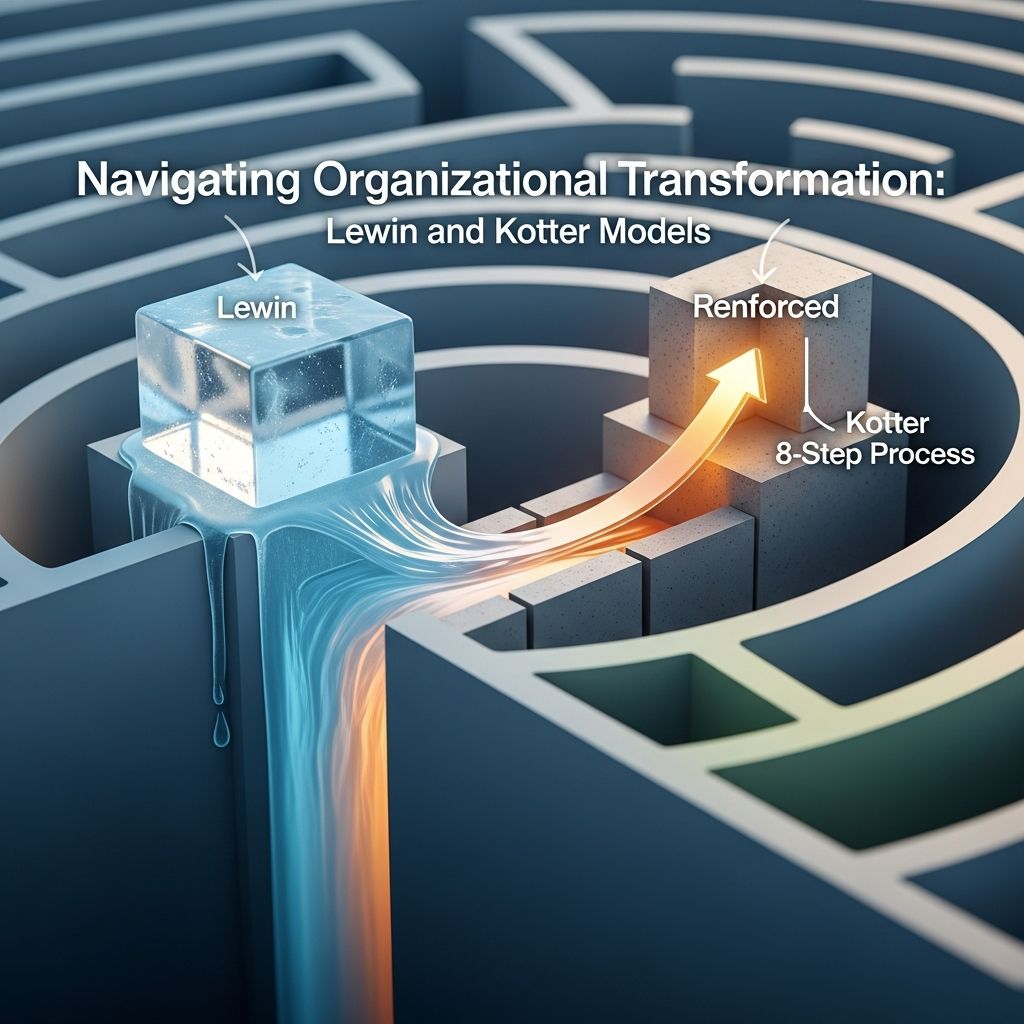
Understanding Change Management Frameworks
Organizations face constant pressure to evolve, adapt, and transform in response to market demands, technological advancement, and internal growth objectives. The ability to successfully guide an organization through change separates thriving enterprises from those that struggle with implementation failures. Change management, as a discipline, provides structured methodologies to navigate these transitions effectively. Two of the most influential frameworks in this field emerged from the work of Kurt Lewin and John Kotter, each offering distinct approaches to understanding and implementing organizational transformation.
The choice between different change management models significantly impacts an organization’s ability to achieve its transformation goals. While various frameworks exist in the marketplace, Lewin’s foundational model and Kotter’s comprehensive approach remain the most widely studied and implemented strategies worldwide. Understanding the nuances of each framework enables leaders and change agents to select or adapt methodologies that align with their specific organizational context, timeline, and complexity requirements.
The Foundation: Lewin’s Three-Stage Framework
Kurt Lewin’s model represents one of the earliest and most enduring contributions to change management theory. Introduced in the mid-twentieth century, this framework distills the change process into three distinct psychological and organizational phases that address how individuals and systems transition from established patterns to new behaviors and structures.
Stage One: The Unfreezing Process
The unfreezing stage represents the preparatory phase where organizations work to destabilize existing conditions and create readiness for transformation. During this phase, leaders must help organizational members recognize that current approaches are inadequate or misaligned with future objectives. This recognition involves creating what psychologists call cognitive dissonance—a tension between present reality and desired future state. Effective unfreezing requires transparent communication about why change is necessary, what problems the current system creates, and what opportunities exist through transformation. The goal is to replace organizational inertia with motivation to embrace new approaches.
Stage Two: The Change Implementation Phase
Once unfreezing establishes readiness, the organization moves into active transformation. This phase involves introducing new processes, structures, technologies, or behavioral patterns. Individuals and teams learn new skills, adopt revised workflows, and begin operating according to updated organizational standards. Change during this stage is rarely linear or uniform across departments. Different parts of the organization may progress at varying speeds, requiring ongoing support, training, and adjustment. The transition phase demands sustained effort and resources to help stakeholders adapt to new realities.
Stage Three: Reinforcement and Stabilization
The final refreeze stage proves critical to ensuring change becomes permanently embedded in organizational culture. This phase involves reinforcing new behaviors through positive feedback, recognition, and rewards. Leaders must actively demonstrate commitment to the new direction through their own actions and decisions. Without deliberate reinforcement, organizations risk reverting to familiar old patterns, essentially unfreezing progress and returning to original states. The refreeze stage transforms temporary changes into permanent features of organizational identity.
The Comprehensive Approach: Kotter’s Eight-Step Model
John Kotter, drawing on extensive research into organizational leadership and change, developed a more granular framework specifically designed for large-scale organizational transformations. Published in his 1996 seminal work “Leading Change,” Kotter’s eight-step model addresses the specific challenges organizations encounter during major change initiatives, particularly those involving technology implementation, restructuring, or cultural transformation.
Initial Phases: Creating the Foundation for Change
Kotter’s first step establishes a sense of urgency by helping organizational members understand why change is essential. Unlike Lewin’s unfreezing, which focuses on destabilizing the current state, Kotter emphasizes creating compelling business cases that make change feel inevitable and necessary. The second step involves forming a guiding coalition—a team of influential leaders and change champions who will shepherd the transformation. This explicit acknowledgment of team-based change marks a fundamental departure from implicit assumptions in earlier models. The third step requires articulating a clear, inspiring vision that describes what success looks like and why the transformation matters beyond mere operational improvements. This vision provides direction and meaning to the change effort.
Mobilization and Implementation Phases
Steps four through six focus on generating momentum and enabling action. Kotter emphasizes communicating the vision extensively through multiple channels and forums, ensuring widespread understanding and buy-in. Removing barriers and empowering stakeholders to implement change acknowledges that structural, systemic, and interpersonal obstacles can derail even well-intentioned efforts. Creating short-term wins provides tangible evidence that change is working, building confidence and momentum. These victories, no matter their scale, demonstrate progress and encourage continued commitment when transformation fatigue might otherwise set in.
Consolidation and Embedding Phases
The final two steps address sustainability challenges. Consolidating gains prevents organizations from declaring victory prematurely and slipping back into old patterns. Embedding change into organizational culture—through hiring practices, organizational structures, reward systems, and leadership messaging—ensures the transformation persists beyond the change initiative itself. Kotter’s framework recognizes that change must become “how we do things here” to achieve lasting impact.
Comparative Analysis: Key Differences and Distinctions
| Dimension | Lewin’s Model | Kotter’s Model |
|---|---|---|
| Number of Stages | Three stages | Eight steps |
| Complexity Level | Simple and accessible | Detailed and comprehensive |
| Target Scope | General organizational change | Large-scale organizational transformation |
| Team Involvement | Implicit; assumes individual change agents | Explicit requirement for guiding coalition and team-based approach |
| Timeframe | Shorter duration (typically months) | Extended duration (typically one year or more) |
| Short-term Benefits | Not specifically addressed | Explicitly incorporates quick wins and momentum building |
| Communication Focus | Limited guidance on communication strategy | Extensive emphasis on vision communication and storytelling |
Detailed Examination of Critical Differences
Granularity and Actionability
Lewin’s model provides elegant simplicity that makes it easy to understand and remember. However, this simplicity can create ambiguity when organizations attempt implementation. Change agents must interpret what activities occur during unfreezing versus change versus refreeze, potentially leading to inconsistent application. Kotter’s model offers substantially more prescriptive guidance, detailing specific activities and outcomes expected at each step. This granularity reduces interpretation variance but increases the complexity of managing a multi-step process.
Organizational Dynamics and Collaboration
A fundamental difference lies in how each model conceptualizes the change process itself. Lewin’s framework implies that a change agent or small group manages the transformation, perhaps with some general organizational support. Kotter explicitly mandates forming a guiding coalition and later a volunteer army—recognizing that large-scale change requires broad organizational participation and distributed leadership. Research confirms that change efforts with engaged leadership teams and broad employee involvement achieve higher success rates than those relying on centralized change management.
Momentum and Psychological Reinforcement
Kotter’s emphasis on creating short-term wins addresses a critical psychological factor that Lewin’s model largely overlooks. Change initiatives, particularly those requiring extended timeframes, encounter motivation challenges. Celebrating incremental successes provides concrete evidence of progress, maintains stakeholder engagement, and builds confidence that the full transformation can succeed. This deliberate momentum-building strategy reflects deeper understanding of change psychology and organizational behavior.
Evaluating Practical Effectiveness and Application
Contextual Suitability
Determining which model fits best depends on several organizational factors. For small-scale operational improvements, departmental reorganizations, or localized process changes, Lewin’s model provides sufficient structure without excessive complexity. An organization implementing a new communication system in a single department, for instance, can effectively navigate unfreezing, change, and refreeze phases without elaborate eight-step choreography.
Conversely, enterprise-wide transformations involving cultural shift, technology platform migrations, or fundamental business model changes benefit from Kotter’s comprehensive framework. The complexity of coordinating multiple departments, managing resistance, maintaining momentum over extended periods, and embedding change into organizational systems demands more detailed guidance and structured stakeholder engagement.
Integration and Hybrid Approaches
Rather than viewing these models as mutually exclusive, many organizations effectively integrate elements of both frameworks. Lewin’s three-stage model provides the overarching psychological and organizational progression, while Kotter’s eight steps detail the specific activities within and between those stages. The unfreezing stage might incorporate Kotter’s first three steps, the change phase includes steps four through seven, and refreeze aligns with step eight.
Critical Strengths and Inherent Limitations
Lewin’s Advantages and Constraints
The primary strength of Lewin’s framework lies in its simplicity and psychological insight. The model recognizes that change involves moving from established equilibrium through transition to new equilibrium—a truth reflected in nearly all contemporary change management theories. Its accessibility makes it valuable for introducing change management concepts to organizations new to formal change processes. However, critics argue the model oversimplifies complex organizational dynamics, provides insufficient guidance on implementation specifics, and underestimates the extended timeframes required for genuine cultural transformation in large systems.
Kotter’s Advantages and Constraints
Kotter’s model excels at providing detailed, actionable guidance specifically tailored to large organizational transformations. Its emphasis on vision, guiding coalitions, and momentum building reflects empirical research into what actually makes major changes succeed. However, the eight-step process can feel rigid or prescriptive in contexts requiring flexibility. Additionally, organizations sometimes struggle understanding the sequencing of steps and how to address unforeseen challenges that emerge outside the prescribed framework. The model also demands substantial resource commitment and executive sponsorship, which not all organizations can sustain.
Real-World Application Considerations
Scale and Organizational Size
Small to mid-sized organizations with relatively flat structures often find Lewin’s model adequate for their transformation needs. The model’s straightforward approach aligns with organizational decision-making patterns and resource constraints. Larger enterprises with complex hierarchies, multiple business units, and diverse stakeholder interests typically require Kotter’s more detailed framework to successfully coordinate change across the organization.
Change Timeline and Urgency
Lewin’s model suits transformations that must be completed within months—perhaps a departmental restructuring, process automation in a specific function, or system replacement in a limited scope. Kotter’s framework accommodates transformations requiring twelve to twenty-four months or longer, allowing time for the vision to permeate the organization, for momentum to build, and for cultural embedding to occur.
Stakeholder Complexity and Resistance
Organizations facing significant resistance or requiring broad buy-in benefit from Kotter’s explicit focus on coalition building, communication, and empowerment. When change threatens established power structures, requires significant behavioral shifts, or involves technology adoption with steep learning curves, the eight-step approach provides more tools for addressing these challenges effectively.
Frequently Asked Questions
Q: Can Lewin’s model work for large organizational transformations?
A: While theoretically possible, Lewin’s model provides insufficient detail for managing complex, large-scale changes. Organizations attempting this typically find themselves reverting to Kotter’s principles to address practical challenges that Lewin’s framework doesn’t directly address.
Q: Is Kotter’s model overkill for minor operational changes?
A: Yes, applying all eight steps to small-scale changes introduces unnecessary complexity and resource expenditure. Lewin’s three-stage approach is more appropriate for limited-scope transformations, with organizations potentially borrowing specific Kotter principles as needed.
Q: How do these models account for continuous change in dynamic industries?
A: Both models assume change has a defined beginning and end, leading to static equilibrium. Contemporary organizations increasingly recognize that change is continuous. Organizations are adapting both frameworks to include ongoing feedback loops and iterative adjustments rather than assuming change concludes when initiatives end.
Q: What role does employee resistance play in each framework?
A: Lewin addresses resistance during unfreezing by destabilizing commitment to current approaches. Kotter reframes resistance as an engagement opportunity, using coalition building and communication to transform potential resistors into change advocates.
Q: Can organizations combine elements of both models effectively?
A: Absolutely. Many successful organizations use Lewin’s three-stage structure as an overarching framework while incorporating Kotter’s eight-step detail within those stages, providing conceptual clarity alongside practical implementation guidance.
Strategic Recommendations for Model Selection
Organizations should evaluate their change initiative against several dimensions before committing to either model. Consider the scope—does the change affect individual departments or the entire enterprise? Assess the timeline—must implementation occur within months or over years? Evaluate complexity—does the change require significant cultural shift or primarily operational adjustments? Examine stakeholder dynamics—how much resistance is likely and how diverse are affected populations? Finally, consider organizational change maturity—has the organization successfully implemented formal change processes previously?
The most sophisticated approach involves viewing Lewin and Kotter not as competing methodologies but as complementary frameworks addressing different aspects of organizational transformation. Lewin’s model provides the psychological and organizational perspective—the why and what of change progression. Kotter’s model provides the practical roadmap—the how and when of implementation activities. Together, they offer organizations both conceptual understanding and actionable guidance for navigating the complex journey of transformational change.
References
- Change Theory: Compared Lewin’s and Kotter’s Approaches — Nursing Bird. https://nursingbird.com/change-theory-compared-lewins-and-kotters-approaches/
- Lewin Change Management Model vs. Kotter 8-Step Process — WalkMe. https://www.walkme.com/blog/lewin-vs-kotter/
- Change Management Models: Lewin, Kotter, ADKAR Compared — Sideways6 Ideas. https://ideas.sideways6.com/article/change-management-models-compared-lewin-kotter-adkar
- Top Change Management Models Explained: Kotter, Lewin, and More — 180 Ops. https://www.180ops.com/blog/top-change-management-models-explained-kotter-lewin-and-more
- Where Do Models for Change Management, Improvement and Implementation Science Fit in the Pursuit of Quality in Healthcare? — PubMed Central. https://pmc.ncbi.nlm.nih.gov/articles/PMC7966357/

- Integrated M.A. in Applied Linguistics, University of Hyderabad
- 5+ years in editorial, instructional, SEO, and research-based writing
Sneha is a relationships and lifestyle writer with a strong foundation in applied linguistics and certified training in relationship coaching. She brings over five years of writing experience to theskillvault, crafting thoughtful, research-driven content that empowers readers to build healthier relationships, boost emotional well-being, and embrace holistic living. Her writing and insights reflect the belief that beauty, happiness, and wellness…