
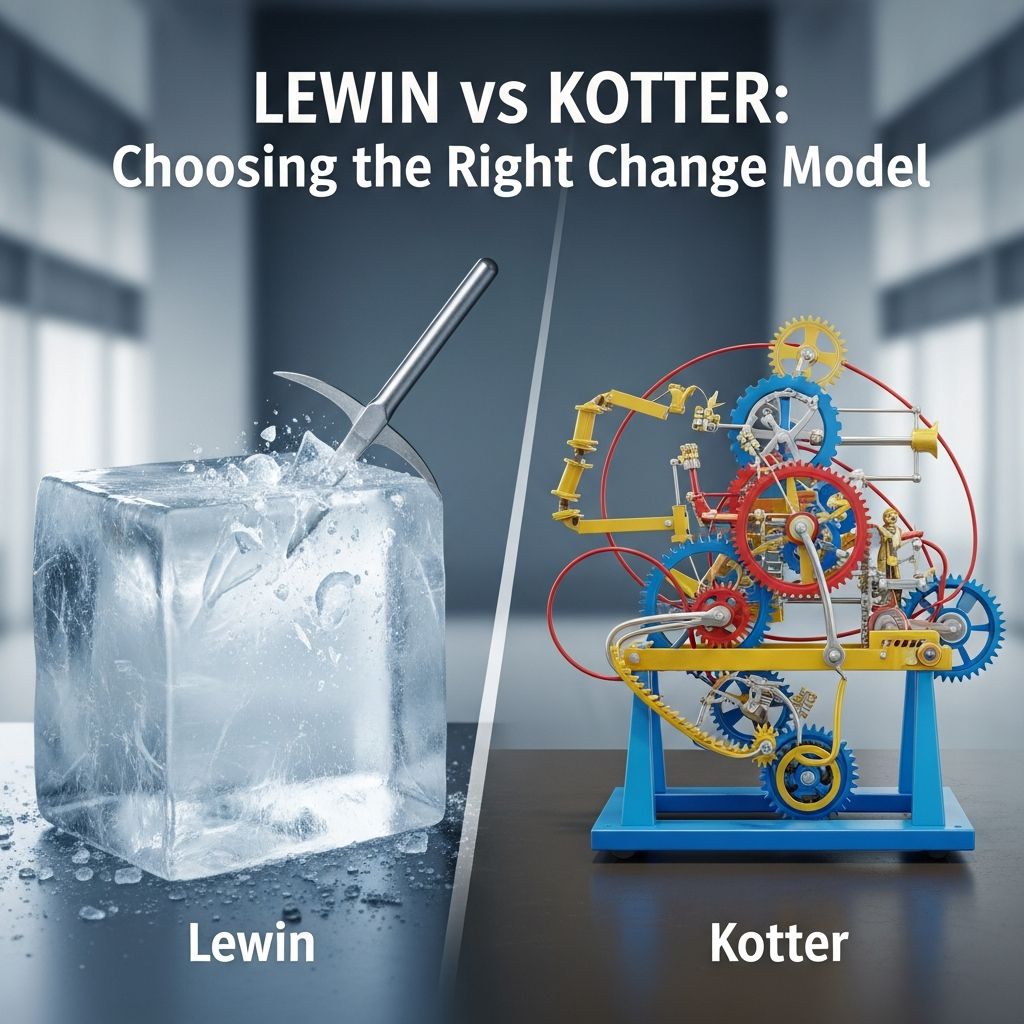
Organizations rarely fail because they lack ideas; they struggle because they cannot implement change in a disciplined, people-centered way. Two of the most influential approaches for doing this are Kurt Lewin’s 3-step model and John Kotter’s 8-step process for leading change. Both offer structured guidance, but they solve different problems and work best in different situations.
Why Change Management Models Matter
Research in sectors like healthcare shows that formal change models such as Lewin and Kotter are among the most frequently used frameworks to guide improvement initiatives. They help:
- Create a shared language and roadmap for change.
- Clarify who does what, when, and why.
- Reduce confusion and resistance by setting expectations.
- Provide milestones to measure progress and celebrate wins.
Without such models, change efforts are more likely to stall, drift, or be quietly reversed after initial enthusiasm fades.
Overview of Lewin and Kotter Models
| Aspect | Lewin’s 3-Step Model | Kotter’s 8-Step Process |
|---|---|---|
| Core idea | Change is a journey from one stable state to another through three stages. | Major change requires a disciplined, leadership-driven, 8-step journey. |
| Number of stages | 3 (Unfreeze, Change, Refreeze) | 8 (from urgency to anchoring in culture) |
| Level of detail | High-level, conceptual, simple. | Operational, step-by-step, detailed. |
| Main emphasis | Psychological readiness and stabilization of new behavior. | Leadership, communication, and building momentum. |
| Best suited for | Moderate, well-bounded changes or as a high-level guide. | Large, multi-layered, strategic transformations. |
Lewin’s Change Management Model Explained
Developed in the mid-20th century by social psychologist Kurt Lewin, this model describes change as moving from one stable equilibrium to another through three phases: Unfreeze, Change, and Refreeze.
1. Unfreeze: Preparing People and Systems
Unfreezing is about loosening the grip of the current state. Organizations focus on helping people recognize why the status quo is no longer adequate.
Typical actions in the Unfreeze stage include:
- Sharing data, evidence, or feedback that exposes gaps in performance.
- Discussing external pressures like regulation, competition, or technology shifts.
- Identifying and challenging assumptions that keep current practices in place.
- Engaging stakeholders early to surface fears and concerns.
The goal is to reduce resistance by making the need for change visible and emotionally compelling.
2. Change: Moving Toward New Behaviors
Once people are unfrozen, the organization introduces and pilots new ways of working. This stage involves learning, experimentation, and adjustment.
Common activities include:
- Designing and testing new processes, structures, or tools.
- Providing training and coaching to build new skills.
- Using feedback loops to refine solutions based on user experience.
- Actively managing resistance through dialogue and support.
Progress here is often non-linear: teams may move back and forth between old and new methods before the new patterns stick.
3. Refreeze: Stabilizing the New State
Refreezing focuses on embedding the new behaviors so they become the “normal” way of working.
Organizations typically:
- Incorporate new practices into policies, procedures, and job descriptions.
- Align incentives and performance measures with the new ways of working.
- Reinforce desired behaviors through recognition and feedback.
- Document and share lessons learned to avoid sliding back.
The metaphor of refreezing has been criticized in fast-changing environments, but the underlying idea—stabilize what works—remains widely used.
Strengths and Limitations of Lewin’s Model
- Strengths
- Easy to explain and remember, making it accessible to non-specialists.
- Emphasizes psychological readiness and the human side of change.
- Useful as an overarching mental model across many contexts.
- Limitations
- High-level: offers limited operational detail about how to manage each stage.
- Refreeze can suggest static stability, which is less realistic in rapidly evolving environments.
- Less explicit about leadership roles, communication strategies, or governance.
Kotter’s 8-Step Process for Leading Change
John Kotter introduced his 8-step model in the 1990s as a practical roadmap for large-scale organizational change. It breaks the change journey into eight logical steps designed to build urgency, alignment, and sustained momentum over time.
1. Establish a Sense of Urgency
Kotter argues that many change efforts fail because organizations underestimate how much urgency is needed to overcome complacency. Leaders:
- Use data, market analysis, or customer insights to demonstrate the risks of inaction.
- Highlight opportunities that can only be captured through change.
- Communicate frankly about threats, but connect them to a hopeful path forward.
2. Build a Guiding Coalition
Successful change requires a cross-functional group with enough authority, credibility, and energy to drive the effort.
- Include senior leaders, middle managers, and informal influencers.
- Clarify shared objectives and ways of working.
- Model the behaviors expected from the wider organization.
3. Form a Strategic Vision and Initiatives
The coalition shapes a clear picture of the future and the strategic moves needed to reach it.
- Define a concise vision that people can remember and repeat.
- Translate the vision into a small number of key initiatives.
- Ensure alignment with overall organizational strategy.
4. Enlist a Volunteer Army
Change accelerates when a critical mass of employees understand, support, and participate in the effort.
- Communicate the vision broadly in simple, consistent language.
- Invite people at all levels to contribute ideas and energy.
- Use stories and examples to show what the change will look like in practice.
5. Enable Action by Removing Barriers
Obstacles—whether structural, procedural, or cultural—can quickly stall progress. Kotter emphasizes eliminating these frictions.
- Adjust structures or processes that conflict with the change.
- Clarify decision rights so teams know what they can change.
- Support managers in dealing with local resistance constructively.
6. Generate Short-Term Wins
Short-term, visible successes build credibility and confidence.
- Plan for quick wins that are meaningful but achievable.
- Publicly recognize teams and individuals who contribute.
- Use each win to demonstrate that the change is working.
7. Sustain Acceleration
After the first wins, organizations may be tempted to declare victory too early. Kotter stresses using the momentum to drive deeper changes.
- Launch additional projects aligned with the vision.
- Continuously remove remaining barriers and bottlenecks.
- Refresh communication and engagement efforts to avoid fatigue.
8. Institute Change in the Culture
The final step is ensuring that new behaviors and practices become part of organizational culture so they survive leadership changes and external shocks.
- Link new behaviors to improved performance and outcomes.
- Adjust recruitment, onboarding, and promotion criteria to reflect the new way of working.
- Embed the change into stories, symbols, and everyday routines.
Strengths and Limitations of Kotter’s Model
- Strengths
- Provides detailed, step-by-step guidance suitable for complex changes.
- Emphasizes leadership, communication, and building coalitions.
- Widely used and studied across sectors, including healthcare and business.
- Limitations
- Can be time-consuming and resource-intensive for smaller changes.
- Perceived as top-down if not combined with genuine employee involvement.
- The sequence may appear linear, although real-world change often requires iteration.
Lewin vs Kotter: Key Differences
Both models provide structure but approach change from different angles. The table below highlights some practical contrasts.
| Dimension | Lewin | Kotter |
|---|---|---|
| Primary focus | Psychological transition and stability. | Leadership-driven transformation and momentum. |
| Complexity | Simple, conceptual. | Detailed, operational. |
| Scale of change | Well-suited to bounded or incremental changes. | Designed for large-scale, cross-organizational shifts. |
| Guidance level | High-level phases. | Specific actions and leadership tasks. |
| Use in practice | Often used as an overarching framework. | Frequently applied as a project roadmap. |
When to Use Which Model
Choosing between Lewin and Kotter depends on the scope, urgency, and complexity of your change, as well as your organizational culture.
Lewin’s Model is Especially Useful When:
- The change is relatively focused (e.g., one process, one department).
- You need a simple, shared mental model for non-experts.
- Your primary challenge is shifting mindsets and habits, not redesigning the entire organization.
- You plan to supplement Lewin with more detailed project management methods.
Kotter’s Model is Especially Useful When:
- You are driving transformation that affects multiple units or geographies.
- Strong, visible leadership is required to overcome entrenched interests.
- You need explicit steps for communication, coalition-building, and cultural integration.
- The time frame spans many months or years, requiring staged momentum.
Combining Lewin and Kotter in Practice
In real organizations, leaders often blend models rather than applying one in isolation. A practical integration might look like:
- Use Lewin’s stages as the macro-structure:
- Unfreeze = Kotter’s urgency and guiding coalition (steps 1–2).
- Change = Kotter’s vision, communication, barrier removal, and wins (steps 3–7).
- Refreeze = Kotter’s cultural anchoring (step 8).
- Use Kotter for implementation detail:
- Within each Lewin stage, apply the relevant Kotter steps as a project plan.
- Use Kotter’s emphasis on short-term wins to strengthen Lewin’s refreezing.
- Add measurement and learning:
- Track indicators for readiness, adoption, and performance at each stage.
- Build feedback loops so learning informs the next wave of change.
Practical Tips for Leaders Applying These Models
Regardless of which model you choose, leaders can increase their chances of success by focusing on a few practical disciplines informed by research and practice.
- Clarify the “why” in plain language: People support what they understand; connect change to tangible risks and opportunities.
- Invest early in stakeholders: Map who is affected, who can influence outcomes, and who must be part of the guiding coalition.
- Balance top-down and bottom-up: Combine clear direction from leadership with genuine involvement from employees.
- Make progress visible: Use dashboards, stories, and recognition to show that change is delivering results.
- Anchor behaviors, not slogans: Align roles, incentives, and routines so that the new way of working is easier than the old.
Frequently Asked Questions (FAQs)
Q1: Is Lewin’s model outdated in today’s fast-changing environment?
Lewin’s language of “refreezing” can sound outdated, but many experts still consider the three stages useful as a high-level guide for structuring change. Organizations can reinterpret “refreeze” as stabilizing new practices long enough to deliver value before the next planned adaptation.
Q2: Can I skip steps in Kotter’s 8-step process?
Research suggests that treating Kotter’s steps as optional often weakens results, especially if urgency or a guiding coalition is neglected. Some adaptation is normal, but systematically bypassing early steps tends to produce shallow or short-lived change.
Q3: Which model is better for small organizations or teams?
Smaller organizations may find Lewin’s simpler framework easier to adopt, enhancing it with selected practices from Kotter such as creating urgency and celebrating short-term wins. Kotter’s full 8-step sequence can still be used, but may feel heavy if the change is limited in scope.
Q4: How do Lewin and Kotter relate to other models like ADKAR?
Lewin and Kotter primarily address change at the organizational level, whereas frameworks such as ADKAR focus more on individual awareness, desire, knowledge, ability, and reinforcement. Many organizations layer these models, using Lewin or Kotter for overall direction and ADKAR-like tools to support individuals through the transition.
Q5: What is the most important factor in choosing a model?
The critical factor is fit: choose the model (or combination) that matches your change’s scale, complexity, time frame, and culture, and then apply it consistently. The discipline of using a coherent framework often matters more than the specific brand of model.
References
- 9 Change Management Models to Compare — Prosci. 2023-05-10. https://www.prosci.com/blog/change-management-models
- Where Do Models for Change Management, Improvement and Implementation Meet? — Nilsen P, Seing I, Ericsson C, et al., International Journal of Environmental Research and Public Health. 2020-02-25. https://pubmed.ncbi.nlm.nih.gov/32110816/
- Comparison of Change Management Models and Suggestions for a More Efficient Model — Uusi-Rauva E, Journal of Management and Strategy. 2023-03-15. https://www.sciedupress.com/journal/index.php/jms/article/view/24924
- Lewin’s Change Management Model vs. Kotter’s 8-Step Process — WalkMe. 2024-01-05. https://www.walkme.com/blog/lewin-change-management-model/
- Which Change Management Model Is the Best for Your Organization? — SafeStart. 2022-08-18. https://safestart.com/news/which-change-management-model-is-the-best-for-your-organization/
- Top Change Management Models Explained: Kotter, Lewin, and More — 180ops. 2023-11-02. https://www.180ops.com/blog/top-change-management-models-explained-kotter-lewin-and-more

- Integrated M.A. in Applied Linguistics, University of Hyderabad
- 5+ years in editorial, instructional, SEO, and research-based writing
Sneha is a relationships and lifestyle writer with a strong foundation in applied linguistics and certified training in relationship coaching. She brings over five years of writing experience to theskillvault, crafting thoughtful, research-driven content that empowers readers to build healthier relationships, boost emotional well-being, and embrace holistic living. Her writing and insights reflect the belief that beauty, happiness, and wellness…