
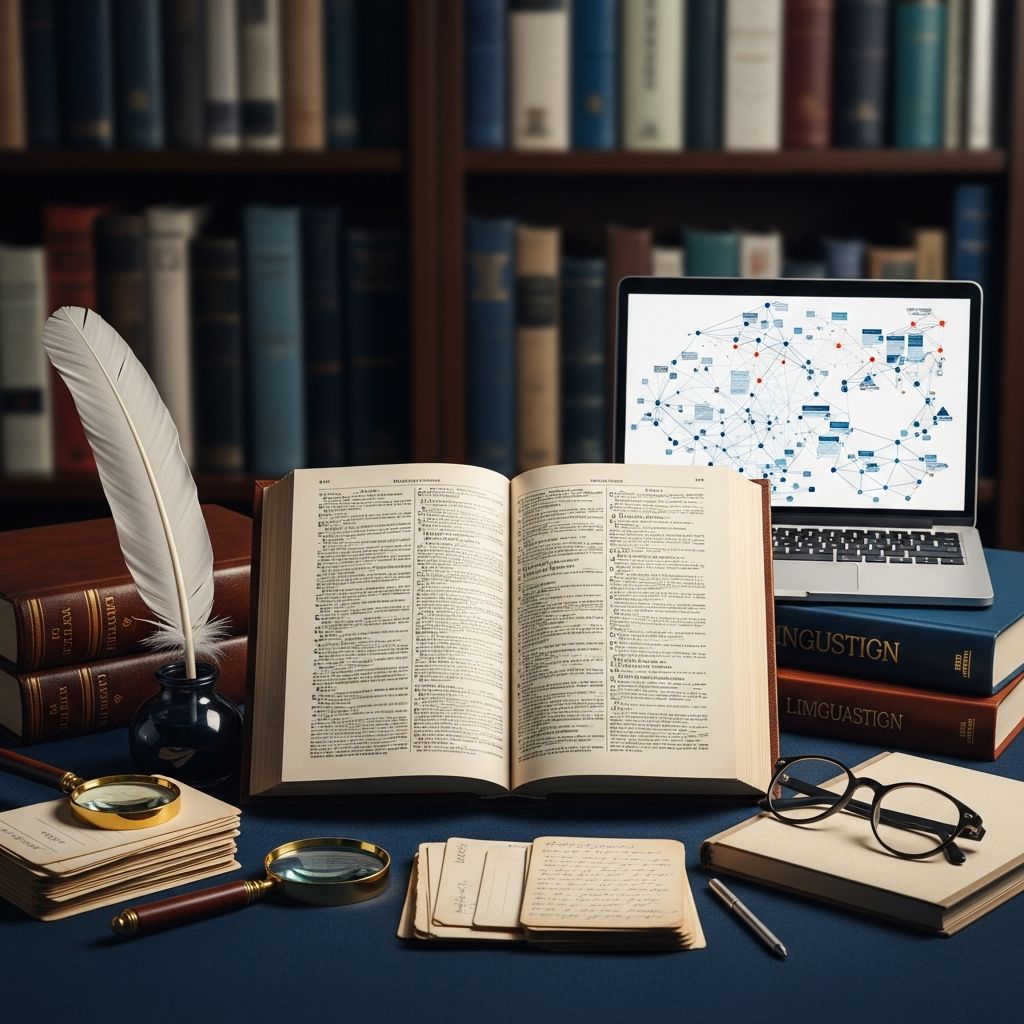
Lexicography represents the foundational practice and scholarly pursuit dedicated to documenting and analyzing the vocabulary of languages through dictionaries and related resources. It encompasses both the hands-on creation of reference works and the deeper investigation into how words interconnect semantically and structurally.
Defining the Essence of Lexicography
At its core, lexicography involves the systematic compilation, editing, and principles guiding dictionary production. Distinct from lexicology, which examines word origins, evolution, and usage in isolation, lexicography focuses on organizing this knowledge into accessible formats for public use. Dictionaries emerging from this field cover aspects like spelling, pronunciation, meanings, and syntactic behaviors, serving diverse user needs from everyday lookup to specialized research.
- Key Focus Areas: General dictionaries describe broad language use, while specialized ones target domains like law or medicine.
- Output Forms: Traditional print books, digital apps, and databases all stem from lexicographic efforts.
The discipline ensures that lexical data is not just collected but structured for optimal retrieval, addressing how users seek information in varied contexts.
Practical Lexicography: The Art of Building Dictionaries
Practical lexicography is the craftsmanship of assembling dictionaries, involving meticulous data gathering, verification, and presentation. Lexicographers monitor language evolution by scouring vast texts—books, periodicals, digital corpora, and social platforms—to capture emerging terms and shifts in usage.
Upon spotting novel vocabulary or senses, practitioners log citations into databases, recording context, source, and date. This corpus builds the evidential base for entries. Selection principles guide what makes the final cut, tailored to the dictionary’s audience: learners might prioritize simple definitions, while experts seek etymologies and collocations.
| Type | Primary Users | Key Features |
|---|---|---|
| Monolingual | Native speakers | Definitions, synonyms, usage examples |
| Bilingual | Language learners | Translations, equivalents, cultural notes |
| Specialized | Professionals | Domain-specific terms, technical illustrations |
This process demands balancing comprehensiveness with usability, ensuring entries are concise yet informative.
Theoretical Lexicography: Metalexicography Insights
Theoretical lexicography, or metalexicography, dissects the lexicon’s inner workings. It analyzes semantic (meaning), syntagmatic (contextual combinations), and paradigmatic (substitutional) relations among words. Scholars develop models for dictionary structures, user information needs, and access methods in both print and electronic media.
Metalexicographers evaluate existing dictionaries, proposing enhancements like better sense distinctions or navigation aids. This branch bridges linguistics and information science, theorizing how lexical data should link to fulfill specific situational demands, such as quick decoding or creative encoding.
- Semantic Analysis: Explores polysemy and homonymy resolution.
- Structural Theories: Designs entry layouts for efficiency.
- User-Centric Models: Studies lookup behaviors to refine access.
Historical Foundations of Lexicographic Practice
Lexicography’s roots trace to ancient bilingual word lists in Mesopotamia and glossaries in classical Greece and Rome. The modern era dawned with 17th-century efforts like the Académie Française’s dictionary, emphasizing standardization amid printing’s rise.
Samuel Johnson’s 1755 A Dictionary of the English Language marked a milestone, offering comprehensive coverage with illustrative quotations. Noah Webster’s 1828 American dictionary adapted British models to U.S. spelling and usage, fostering national identity. These pioneers established citation-based evidence, a hallmark still central today.
20th-century advancements included the Oxford English Dictionary (OED), a historical record drawing on millions of citations to track word histories. Its ongoing revisions reflect language dynamism.
Modern Tools and Digital Transformations
Today’s lexicographers leverage massive corpora—billions of words from diverse sources—analyzed via computational linguistics. Tools like corpus query software identify frequency, collocations, and neologisms swiftly.
Digital dictionaries offer hyperlinked entries, audio pronunciations, and interactive searches, surpassing print limitations. Online platforms enable real-time updates, capturing slang from social media or technical terms from academia. Challenges include verifying ephemeral online usage and ensuring inclusivity across dialects.
| Aspect | Digital | |
|---|---|---|
| Portability | Physical book | Any device, offline access |
| Updates | Periodic editions | Instant revisions |
| Searchability | Alphabetical scan | Full-text, semantic search |
| Multimedia | Limited | Audio, video, images |
Lexicography in Specialized Domains
Beyond general language, specialized lexicography serves fields like law, medicine, and computing. Legal dictionaries clarify terminology with case citations; medical ones integrate anatomical diagrams and pharmacological data.
In biblical studies, lexicography deciphers ancient Hebrew and Greek, relying on context, cognates, and interpretive traditions due to absent native informants. These works demand domain expertise, blending linguistic rigor with subject knowledge.
Challenges Facing Contemporary Lexicographers
Globalization and digital communication accelerate vocabulary change, with internet slang and emojis posing documentation hurdles. Dialectal variations challenge monolingual biases, urging inclusive approaches.
Ethical issues arise in representing contested usages, like slurs or evolving gender terms. Theoretical debates question sense granularity versus user comprehension.
Frequently Asked Questions (FAQs)
What distinguishes lexicography from lexicology?
Lexicography produces dictionaries, while lexicology studies words’ structure, history, and relations independently.
Is lexicography solely about English dictionaries?
No, it applies universally, with thriving traditions in languages like Chinese, Arabic, and Swahili.
How do lexicographers decide word inclusion?
Based on corpus evidence of frequency and currency, guided by the dictionary’s purpose and audience.
What role does technology play in modern lexicography?
It enables vast data analysis, real-time updates, and user-interactive features.
Can anyone become a lexicographer?
Typically requires linguistics training, research skills, and attention to detail.
The Future Horizon of Lexicography
Emerging AI assists in pattern detection but cannot replace human judgment in nuance capture. Multilingual global dictionaries and VR-enhanced learning tools loom on the horizon. Lexicography remains vital, preserving linguistic heritage while adapting to communicative evolution.
This field not only records language but shapes its perception, influencing education, law, and culture profoundly.
References
- Lexicography – Wikipedia — Wikipedia contributors. 2023-10-15. https://en.wikipedia.org/wiki/Lexicography
- What is Lexicography? — ProQuest. 2014-01-01. https://www.proquest.com/docview/1288088212/301A9DE115F443FPQ/4
- Lexicography | Meaning, Types of Dictionaries, & Linguistics — Encyclopædia Britannica. 2023-11-20. https://www.britannica.com/technology/lexicography
- LEXICOGRAPHY Definition & Meaning — Merriam-Webster. 2023-12-05. https://www.merriam-webster.com/dictionary/lexicography
- What Is Lexicography? — Bible Odyssey (Society of Biblical Literature). 2017-05-10. https://www.bibleodyssey.org/articles/what-is-lexicography/
- What is and isn’t lexicography — Lexiconista. 2022-08-15. https://www.lexiconista.com/what-is-and-isnt-lexicography/

- Integrated M.A. in Applied Linguistics, University of Hyderabad
- 5+ years in editorial, instructional, SEO, and research-based writing
Sneha is a relationships and lifestyle writer with a strong foundation in applied linguistics and certified training in relationship coaching. She brings over five years of writing experience to theskillvault, crafting thoughtful, research-driven content that empowers readers to build healthier relationships, boost emotional well-being, and embrace holistic living. Her writing and insights reflect the belief that beauty, happiness, and wellness…