
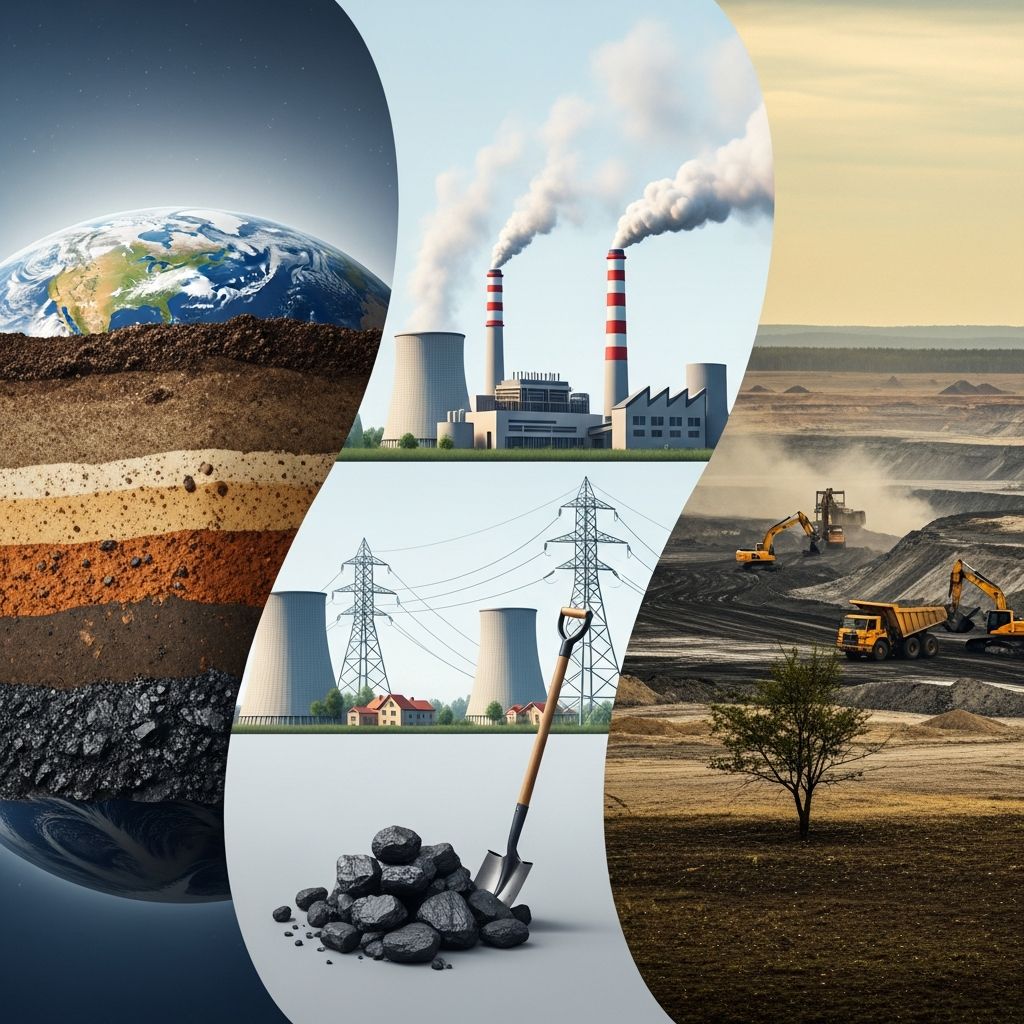
Lignite, often called brown coal, represents the youngest and lowest grade of coal in the fossil fuel hierarchy. Formed from compressed plant matter over millions of years, it serves as a primary energy source in several nations despite its inefficiencies and pollution challenges.
Geological Origins and Physical Characteristics
Lignite develops in swampy, low-oxygen environments where peat—partially decayed vegetation—accumulates and undergoes gradual transformation under heat and pressure. This process, known as coalification, progresses from peat to lignite, then sub-bituminous coal, bituminous coal, and finally anthracite. Lignite forms at depths and temperatures too low for higher ranks, typically 1-3 kilometers underground at 50-100°C.
Physically, lignite appears brownish-black with a fibrous, woody texture. It contains high moisture levels, often 25-75% by weight, which reduces its energy density to about 10-20 MJ/kg—roughly half that of bituminous coal. This wetness causes it to crumble easily, complicating transport and storage. Its low sulfur content, usually under 1%, offers a minor advantage over other coals.
- High moisture: Leads to lower combustion efficiency and higher transportation costs.
- Low carbon content: Around 60-70% on a dry basis, versus 80-90% in bituminous coal.
- Abundant deposits: Found in thick, near-surface seams ideal for open-pit mining.
Major Global Production Regions
Lignite mining concentrates in areas with vast, accessible deposits. Germany leads Europe with operations in the Rhineland and Lusatia basins, producing over 150 million tons annually for power plants. In the United States, North Dakota’s Fort Union Formation holds the world’s largest lignite reserve, yielding 40 million tons yearly, primarily for regional electricity.
Other key producers include China, with extensive fields in Inner Mongolia; Australia, via Victoria’s Latrobe Valley; and Turkey, Indonesia, and Kosovo. Surface mining dominates due to shallow seams, enabling low-cost extraction but requiring massive land disturbance—up to 100 meters deep in some sites.
| Country | Annual Production (Million Tons) | Main Uses |
|---|---|---|
| Germany | 150+ | Electricity (95%) |
| USA (North Dakota) | 40 | Power, synthetics |
| China | 500+ | Power generation |
| Australia | 60 | Domestic energy |
These regions leverage lignite’s abundance and proximity to power stations, minimizing transport needs.
Energy Generation and Industrial Applications
Lignite fuels about 8% of global coal-based electricity, prized for reliability and affordability in landlocked areas. Power plants burn it directly after minimal processing, often via pulverized coal or cyclone boilers scaled for its properties. In North Dakota, it powers 2 million homes and supports synthetic gas, fertilizers like urea and ammonia, and enhanced oil recovery.
Its low cost stems from surface mining (under $10/ton) and low sulfur, reducing scrubber needs. However, high moisture demands larger facilities and more fuel volume—up to twice that of bituminous coal for equivalent output. Efficiency hovers at 30-35%, versus 40% for higher coals, due to drying losses.
Beyond electricity, lignite produces activated carbon, soil amendments, and chemicals. Modern plants integrate fluidized-bed combustion for better efficiency and lower NOx emissions.
Environmental and Health Consequences
Lignite combustion emits the highest CO2 per energy unit among coals—about 1.1-1.3 tons/MWh, 20-30% more than bituminous and 3-7 times gas. Expanding EU mines could add 118 million tons CO2 yearly, rivaling Spain’s total.
Air pollutants include NOx, SO2, particulate matter (PM), and mercury. NOx and SO2 form smog and acid rain; PM links to respiratory diseases. European coal plants, including lignite, caused 22,000 premature deaths in 2010 from pollution traveling across borders. In Kosovo, lignite’s trace metals (arsenic, chromium, nickel) in PM exacerbate risks, potentially avoidable by renewables, saving 2,300 lives.
Mercury emissions match bituminous coal despite higher content, posing neurological threats. High moisture worsens efficiency, increasing fuel needs and emissions. Mining disrupts ecosystems, contaminating water with ash leachate.
- CO2: 99% of fuel carbon converts to CO2.
- PM/Trace metals: Heightens cancer, heart disease risks.
- Mining impact: Habitat loss, groundwater pollution.
Technological Mitigation Strategies
Addressing lignite’s drawbacks involves pre-combustion drying (reduces moisture by 50%, boosting efficiency 5-10%), advanced boilers, and flue-gas desulfurization. Carbon capture and storage (CCS) traps 90% CO2, though costly and energy-intensive. Fluidized-bed tech cuts NOx by 50%.
Co-firing with biomass lowers net emissions. However, these raise costs 20-50%, challenging lignite’s economic edge. Regulations like EU mercury limits (post-2019) push upgrades.
Economic Factors and Future Outlook
Lignite’s viability ties to low mining costs and energy security, but carbon pricing and renewables erode it. Germany’s phase-out targets zero lignite by 2038; U.S. output declines with gas/renewables. Globally, production fell 5% yearly pre-2020, projected to drop further as solar/wind costs plummet.
Transitioning means retraining miners and investing in storage tech. Lignite may persist in developing nations but faces phase-downs under Paris Agreement goals.
Frequently Asked Questions (FAQs)
What makes lignite different from other coals?
Lignite has higher moisture (25-75%), lower energy (10-20 MJ/kg), and brownish color versus blacker, drier higher-rank coals.
Is lignite mining environmentally friendly?
No—open-pit operations cause land disruption, dust, and water contamination, compounded by high emissions from burning.
Can lignite be used cleanly?
Technologies like drying, CCS, and scrubbers help, but full mitigation remains inefficient and expensive compared to renewables.
Which countries rely most on lignite power?
Germany, China, USA (North Dakota), Poland, and Turkey generate significant electricity from lignite.
What are health risks from lignite pollution?
PM, NOx, SO2, and metals link to asthma, cancer, heart disease, and premature deaths, affecting local and distant areas.
References
- Lignite-Fired Energy Generation — ETPA. 2023. https://www.etpa.nl/knowledge-base/technology/lignite-fired-energy-generation
- Five reasons why expanding brown coal mines might be a problem — Greenpeace Unearthed. 2014-08-28. https://unearthed.greenpeace.org/2014/08/28/five-reasons-expanding-brown-coal-mines-might-problem/
- Trace Metal Content of Coal Exacerbates Air Pollution-Related Health Risks: The Case of Lignite Coal in Kosovo — RAEL Berkeley. 2018-02. https://rael.berkeley.edu/2018/02/press-release-trace-metal-content-of-coal-exacerbates-air-pollution-related-health-risks-the-case-of-lignite-coal-in-kosovo/
- 1.7 LIGNITE COMBUSTION — U.S. Environmental Protection Agency (EPA). 2020-09. https://www.epa.gov/sites/default/files/2020-09/documents/1.7_lignite_combustion.pdf
- What is Lignite? — Lignite.com. Accessed 2026. https://lignite.com/what-is-lignite/
- Coal and the environment — U.S. Energy Information Administration (EIA). Accessed 2026. https://www.eia.gov/energyexplained/coal/coal-and-the-environment.php

- Integrated M.A. in Applied Linguistics, University of Hyderabad
- 5+ years in editorial, instructional, SEO, and research-based writing
Sneha is a relationships and lifestyle writer with a strong foundation in applied linguistics and certified training in relationship coaching. She brings over five years of writing experience to theskillvault, crafting thoughtful, research-driven content that empowers readers to build healthier relationships, boost emotional well-being, and embrace holistic living. Her writing and insights reflect the belief that beauty, happiness, and wellness…