
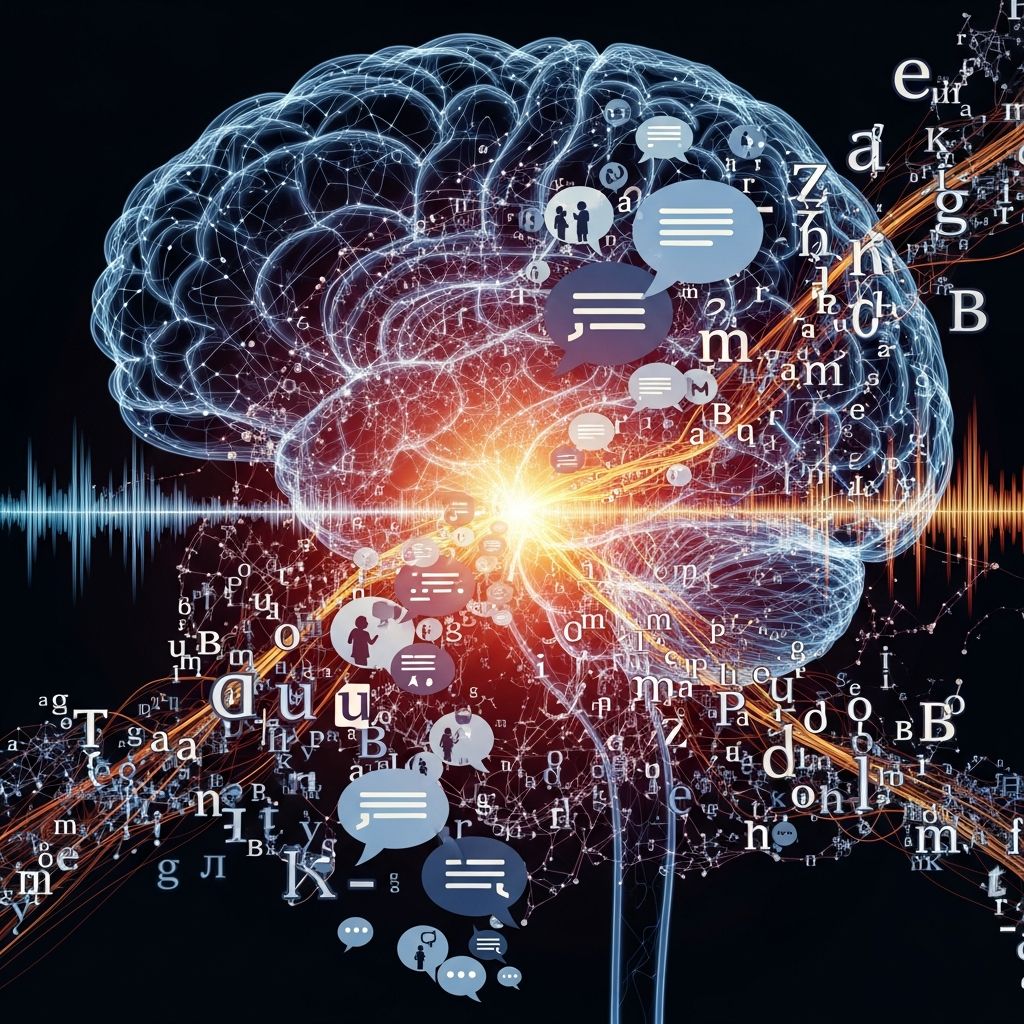
In the field of linguistics, understanding how humans produce and comprehend language requires distinguishing between abstract knowledge and observable behavior. Linguistic performance captures the dynamic, real-world application of language skills, encompassing everything from fluent speech to slips of the tongue. Introduced by Noam Chomsky, this concept highlights the gap between what speakers know and what they actually say or understand in everyday contexts.
Defining Linguistic Performance in Modern Linguistics
Linguistic performance refers to the tangible output of language use, including spoken or written expressions influenced by external factors like fatigue, distraction, or emotional state. Unlike idealized models, it accounts for imperfections such as hesitations, repetitions, and grammatical slips that occur during communication.
At its core, performance manifests in concrete situations: a conversation, a public speech, or reading a text. It represents the execution of linguistic abilities, where speakers deploy their internalized rules amid real-time pressures. This observable layer of language provides linguists with data to study how theoretical knowledge translates into practice.
Competence vs. Performance: Chomsky’s Foundational Distinction
Noam Chomsky’s 1965 work, Aspects of the Theory of Syntax, formalized the competence-performance dichotomy, revolutionizing generative grammar. Competence denotes the subconscious, ideal knowledge of a language’s grammatical rules—what a native speaker intuitively ‘knows’ without explicit instruction. Performance, conversely, is the flawed implementation of this knowledge in actual use.
| Aspect | Competence | Performance |
|---|---|---|
| Definition | Idealized mental grammar | Actual language production/comprehension |
| Nature | Abstract, subconscious rules | Observable, error-prone behavior |
| Influences | Universal grammar principles | Memory limits, distractions, physiology |
| Example | Knowing sentence structures | Saying ‘I seen it’ instead of ‘I saw it’ |
This table illustrates the key contrasts, showing how performance often deviates from competence due to non-linguistic factors.
Historical Roots and Theoretical Evolution
The competence-performance split echoes earlier ideas, such as Ferdinand de Saussure’s langue (systematic language knowledge) versus parole (individual acts of speech). Chomsky adapted this to emphasize psychological reality, positioning linguistics as a cognitive science branch.
In the 1980s, Chomsky refined it further with I-language (internalized, individual knowledge) and E-language (external, communal usage), underscoring performance’s role in bridging personal cognition and social interaction. These evolutions highlight performance’s centrality in psycholinguistics, where empirical studies measure how brains process language in real time.
Speech Errors: Windows into Performance Dynamics
Speech errors, or slips of the tongue, exemplify performance limitations. Despite intact competence, speakers produce unintended forms like ‘brakefast’ for ‘breakfast’ or word substitutions. These slips reveal underlying processes: phonological blends, lexical accesses, or syntactic planning gone awry.
- Anticipation errors: Inserting a later sound early, e.g., ‘She licked the sauce pan clean’ instead of ‘saucepan.’
- Perseveration: Repeating a prior sound, e.g., ‘He took the tea and schugar.’
- Exchanges: Swapping elements, e.g., ‘You want to patent your patent.’
Psycholinguists analyze these to model speech production stages: conceptualization, formulation, articulation. Errors prove that performance filters competence through cognitive bottlenecks.
Performance in Language Acquisition and Development
Child language development starkly illustrates the competence-performance gap. Young learners demonstrate emerging competence through mean length of utterance (MLU), a metric of syntactic complexity, yet their performance includes hesitations and overgeneralizations like ‘goed’ for ‘went’.
In early stages, performance lags competence due to motor skill immaturity or processing limits. As children mature, performance approximates competence, though gaps persist in high-stress scenarios. This informs educational strategies, emphasizing practice to align output with knowledge.
Psycholinguistic Applications and Research Methods
Psycholinguistics employs performance data via experiments like picture-naming tasks or eye-tracking during reading. These reveal comprehension latencies, disfluencies, or repair strategies, linking behavior to neural mechanisms.
Neuroimaging studies, such as fMRI, correlate performance variability with brain activity in Broca’s and Wernicke’s areas, validating Chomsky’s framework empirically. Performance metrics also assess bilingualism, aphasia recovery, or AI language models’ human-likeness.
Non-Linguistic Factors Shaping Performance
Performance is modulated by extraneous variables:
- Cognitive load: Multitasking increases errors.
- Physiological states: Fatigue or intoxication impairs fluency.
- Social context: Audience design alters speech patterns.
- Memory constraints: Working memory limits complex sentence production.
These factors underscore why performance never fully mirrors competence, providing a realistic lens for language analysis.
Implications for Language Teaching and Technology
In education, recognizing performance challenges guides pedagogy. Drills target error-prone areas, while feedback bridges knowledge gaps. For second-language learners, performance anxiety often masks competence, necessitating low-stakes practice.
In AI, natural language processing (NLP) models train on performance data to simulate human-like output, incorporating error patterns for robustness. This advances chatbots, translation tools, and speech recognition.
Critiques and Contemporary Debates
Critics argue Chomsky’s idealization overlooks sociolinguistic variability, favoring usage-based models where performance shapes competence iteratively. Connectionist approaches model performance via neural networks, challenging strict modularity.
Nonetheless, the distinction endures, underpinning fields from forensics (speaker identification via performance idiosyncrasies) to clinical diagnostics (performance deficits signaling disorders).
Frequently Asked Questions (FAQs)
What is the main difference between linguistic competence and performance?
Competence is the internalized knowledge of language rules, while performance is its actual, often imperfect, use in real situations.
Who introduced the concept of linguistic performance?
Noam Chomsky introduced it in his 1965 book Aspects of the Theory of Syntax.
Why do speech errors occur despite linguistic competence?
Errors stem from non-linguistic factors like memory limits, distractions, or processing slips, not deficits in knowledge.
How is linguistic performance studied in psycholinguistics?
Through experiments analyzing speech production, comprehension tasks, error corpora, and neuroimaging.
Can performance improve to match competence perfectly?
No, external factors always introduce variability, though practice minimizes discrepancies.
Broader Impacts on Cognitive Science
The performance-competence framework extends to other domains, akin to Marr’s levels of analysis in vision: competence as computational theory, performance as algorithmic implementation. It influences AI ethics, emphasizing that machine ‘performance’ lacks human competence depth.
In clinical settings, performance assessments diagnose conditions like dyslexia or autism, where output belies intact knowledge. Therapeutic interventions thus target performance enhancers, such as paced reading or mnemonic aids.
Cross-culturally, performance varies: high-context cultures favor indirect speech, modulating overt competence expression. This enriches global linguistics, promoting inclusive models.
References
- Performance (linguistics) – Lancaster Glossary of Child Development — Lancaster University. Accessed 2026. https://www.lancaster.ac.uk/fas/psych/glossary/performance_-linguistics/
- Linguistic performance – Wikipedia — Wikipedia contributors. Accessed 2026. https://en.wikipedia.org/wiki/Linguistic_performance
- (Lecture-13), What is Linguistic Performance by Noam Chomsky — YouTube (Learning English Language channel). Accessed 2026. https://www.youtube.com/watch?v=tKL0gmUZBL0
- Linguistic performance – Definition, Meaning & Synonyms — Vocabulary.com. Accessed 2026. https://www.vocabulary.com/dictionary/linguistic%20performance
- What is Linguistic Performance | IGI Global Scientific Publishing — IGI Global. Accessed 2026. https://www.igi-global.com/dictionary/advancing-elementary-level-students-linguisticcultural-proficiencies-through-childrens-literature/85016

- Integrated M.A. in Applied Linguistics, University of Hyderabad
- 5+ years in editorial, instructional, SEO, and research-based writing
Sneha is a relationships and lifestyle writer with a strong foundation in applied linguistics and certified training in relationship coaching. She brings over five years of writing experience to theskillvault, crafting thoughtful, research-driven content that empowers readers to build healthier relationships, boost emotional well-being, and embrace holistic living. Her writing and insights reflect the belief that beauty, happiness, and wellness…