
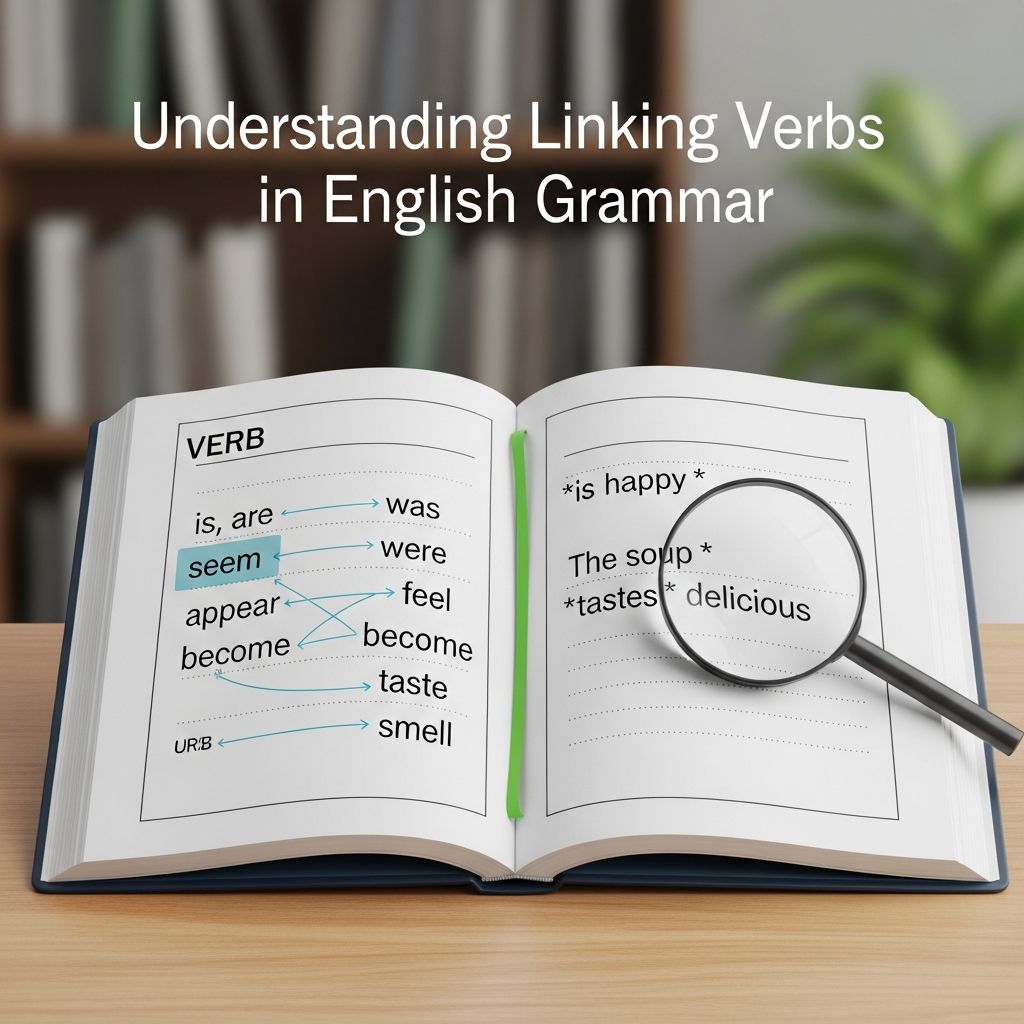
The Foundation of Linking Verbs
Verbs form the backbone of English sentences, serving as the driving force behind communication. While most people associate verbs with action—running, jumping, or speaking—a significant category of verbs operates differently. These are linking verbs, also known as copulae or copulas, which function as connectors rather than action descriptors. Understanding linking verbs is essential for anyone seeking to master English grammar and improve their writing clarity.
A linking verb serves a fundamental purpose: it bridges the gap between the subject of a sentence and information that describes or identifies that subject. Rather than conveying what the subject does, linking verbs reveal what the subject is or what characteristics it possesses. This distinction fundamentally separates linking verbs from their more commonly discussed counterparts, action verbs.
Distinguishing Linking Verbs from Action Verbs
The primary distinction between linking verbs and action verbs lies in their function within a sentence. Action verbs depict activities or movements—a person can walk, sing, eat, or swim. These verbs demonstrate what the subject is actively doing. Linking verbs, conversely, do not represent actions at all. Instead, they express a state of being or existence.
Consider these examples to clarify the difference:
- Action verb: “The cat runs across the yard.” (The verb “runs” shows an action the cat performs.)
- Linking verb: “The cat is orange.” (The verb “is” connects the subject to a descriptive quality.)
- Action verb: “She walked to the store.” (The verb “walked” demonstrates an action.)
- Linking verb: “She seems tired.” (The verb “seems” connects the subject to her state.)
All verbs in English can be categorized into these two primary groups. However, the classification of certain verbs depends on context and usage. Some verbs can function as either action or linking verbs depending on how they appear in a sentence.
Common Linking Verbs and Their Applications
Several linking verbs appear frequently in English writing and speech. The most prevalent is the verb “be” and its various forms—am, is, are, was, were, been, and being. This verb appears in countless sentences, providing the foundation for linking verb usage.
Beyond “be,” other common linking verbs include:
- Become: Used to indicate change or transformation (“She became a doctor.”)
- Seem: Expresses appearance or perception (“He seems happy.”)
- Appear: Similar to “seem,” suggesting how something looks (“The situation appears resolved.”)
- Feel: Describes emotional or physical states (“I feel anxious.”)
- Look: Conveys visual appearance (“The garden looks beautiful.”)
- Taste: Indicates flavor perception (“This coffee tastes bitter.”)
- Sound: Describes auditory perception (“Your voice sounds familiar.”)
- Smell: Relates to olfactory experiences (“The flowers smell wonderful.”)
- Remain: Suggests continuation of a state (“She remained skeptical.”)
- Stay: Indicates persistence of a condition (“The weather stayed cold.”)
- Grow: Shows gradual change (“The tree grows taller.”)
- Turn: Expresses transformation (“The leaves turned red.”)
- Prove: Establishes truth about something (“Her theory proved correct.”)
Each of these verbs functions to connect a subject with descriptive or identifying information, rather than showing the subject performing an action.
Subject Complements: The Essential Component
Every linking verb requires what grammarians call a subject complement This is a word or phrase that either identifies or describes the subject of the sentence. Subject complements are mandatory in sentences containing linking verbs; without them, the sentence would lack meaning or completeness.
Subject complements can take two primary forms:
Predicate Nominatives (Predicate Nouns)
These are nouns or noun phrases that rename or identify the subject. When a predicate nominative appears, it essentially means the same thing as the subject:
- “Maria is an architect.” (The noun phrase “an architect” identifies who Maria is.)
- “My brother became a musician.” (The noun phrase “a musician” identifies what role the subject assumes.)
- “This establishment remains the finest restaurant in the city.” (The noun phrase identifies the nature of the establishment.)
Predicate Adjectives
These are adjectives or adjectival phrases that describe qualities or characteristics of the subject:
- “The ocean appears calm today.” (The adjective “calm” describes the ocean’s current state.)
- “Her presentation seemed professional.” (The adjective “professional” characterizes the quality of the presentation.)
- “The puzzle feels complicated.” (The adjective “complicated” describes how the puzzle seems.)
The presence of a subject complement after a linking verb is the key identifier that distinguishes linking verbs from action verbs in many sentences.
Identifying Linking Verbs: Practical Techniques
Recognizing linking verbs in written text can be challenging, particularly with sensory verbs that sometimes function as action verbs instead. Several reliable techniques help identify whether a verb is functioning as a linking verb in a specific sentence.
The “Is” or “Are” Replacement Method
One straightforward approach involves replacing the potentially linking verb with “is” or “are.” If the sentence maintains its logical sense and grammatical structure, the original verb is likely a linking verb:
- Original: “The argument sounds valid.”
- Replacement: “The argument is valid.”
- Result: The sentence still makes perfect sense, confirming “sounds” functions as a linking verb.
The Equals Sign Substitution Method
Another effective technique involves replacing the verb with an equals sign (=). If the resulting statement doesn’t sound awkward, the verb almost certainly functions as a linking verb:
- Original: “This music tastes good.”
- Substitution: “This music = good.”
- Result: The equation sounds natural, indicating “tastes” is serving as a linking verb.
The State of Being vs. Action Assessment
A third method examines whether the verb describes a state of being or an action. If the verb primarily describes how the subject exists, feels, or appears rather than what it does, it functions as a linking verb:
- “The daisies smell wonderful.” (The daisies aren’t actively doing anything; they simply possess an odor quality, making “smell” a linking verb.)
- “She looked angry at the meeting.” (This describes her state or appearance, not an action she performed.)
Sensory Verbs: The Ambiguous Category
Sensory verbs present a particular challenge in English grammar because they can function as either linking verbs or action verbs depending on context. Verbs such as “look,” “feel,” “smell,” “taste,” “sound,” and “appear” may describe either a state of being or an actual action.
When these verbs describe a condition or quality of the subject, they function as linking verbs:
- “The fabric feels soft.” (Describes a quality of the fabric.)
- “The garden smells fragrant.” (Describes how the garden smells, not an action.)
When these same verbs describe an actual action the subject performs, they function as action verbs:
- “She felt the fabric carefully.” (The subject performed an action of touching.)
- “The dog smelled the ground.” (The subject performed an action of sniffing.)
The distinction depends on whether a direct object (the receiver of the action) follows the verb. If a direct object is present, the verb is likely functioning as an action verb. If only a subject complement follows, it’s functioning as a linking verb.
The Grammatical Nature of Linking Verbs
From a grammatical perspective, linking verbs are classified as intransitive verbs. Intransitive verbs do not require a direct object to complete their meaning. Unlike transitive verbs—which need an object to receive the action—linking verbs need only a subject complement to create a complete thought.
Additionally, linking verbs must follow subject-verb agreement rules and be properly conjugated for tense. The form of the linking verb must match both the subject (in number and person) and the time frame (present, past, future, etc.) being discussed:
- “I am happy.” (First person singular present)
- “They are happy.” (Third person plural present)
- “He was happy.” (Third person singular past)
- “She will be happy.” (Third person singular future)
Why Linking Verbs Matter
Understanding linking verbs enhances writing quality and grammatical accuracy. Clear identification of linking verbs helps writers construct sentences that effectively communicate descriptive information about subjects. Linking verbs also appear frequently in everyday English, making them impossible to avoid in either written or spoken communication.
Furthermore, mastering linking verbs prevents common grammatical errors. Many writing mistakes occur when people confuse linking verbs with action verbs or fail to provide appropriate subject complements. Recognition of these verbs and their requirements leads to more polished, professional writing.
Practical Applications in Writing
Linking verbs serve crucial functions across various writing contexts. In descriptive writing, they allow authors to paint vivid pictures of subjects by connecting them to detailed adjectives. In academic writing, they help establish facts and definitions. In creative writing, they enable character development and scene setting.
Consider how linking verbs enhance different types of sentences:
- Descriptive: “The sunset was breathtaking and majestic.”
- Definitional: “A metaphor is a figure of speech comparing two unlike things.”
- Characterization: “She appeared confident despite her nervousness.”
- Scene-setting: “The old mansion seemed haunted and desolate.”
Frequently Asked Questions About Linking Verbs
Q: Can a linking verb have a direct object?
A: No. By definition, linking verbs do not take direct objects. They require subject complements instead. If a verb has a direct object, it is functioning as an action verb, not a linking verb.
Q: Is “be” always a linking verb?
A: Yes. The verb “be” in all its forms (am, is, are, was, were, been, being) consistently functions as a linking verb. However, “be” can also function as an auxiliary (helping) verb when paired with other verbs to form verb phrases.
Q: How do I know if “look” is a linking verb or an action verb?
A: Test the sentence by replacing “look” with “is.” If the sentence still makes sense, “look” is functioning as a linking verb. Also check if the verb has a direct object; if it does, it’s an action verb.
Q: Can linking verbs be used in all tenses?
A: Yes. Linking verbs can be conjugated for all tenses (present, past, future, perfect, progressive, etc.), just like action verbs. The form of the linking verb must agree with the subject and indicate the appropriate time frame.
Q: What’s the difference between a linking verb and an auxiliary verb?
A: A linking verb connects a subject to a subject complement and stands alone as the main verb. An auxiliary (helping) verb works with another main verb to create a verb phrase that conveys tense, mood, or voice.
References
- What Is a Linking Verb? — The Blue Book of Grammar and Punctuation. 2024. https://www.grammarbook.com/blog/verbs/what-is-a-linking-verb/
- What Is a Linking Verb? Definition & Examples — Scribbr. 2024. https://www.scribbr.com/verbs/linking-verb/
- Linking Verbs: What Are They & How To Use Them — English College. 2024. https://www.englishcollege.com/post/how-recognize-linking-verb-what-examples
- Linking Verbs: Definition, Examples, & Exercises — Albert.io. 2024. https://www.albert.io/blog/linking-verbs/
- Action Verbs and Linking Verbs – How to Use Verbs — Gallaudet University Student Success. 2024. https://gallaudet.edu/student-success/tutorial-center/english-center/grammar-and-vocabulary/how-to-use-verbs/action-verbs-and-linking-verbs/
- Linking Verbs: Definition and Examples — Grammarly. 2024. https://www.grammarly.com/blog/parts-of-speech/linking-verbs/
- Linking Verb — Merriam-Webster Dictionary. 2024. https://www.merriam-webster.com/dictionary/linking%20verb

Medha Deb is an editor with a master's degree in Applied Linguistics from the University of Hyderabad. She believes that her qualification has helped her develop a deep understanding of language and its application in various contexts. Medha specializes in the areas of beauty, health, sports, and wellness and is committed to ensuring that the content on the website is…