
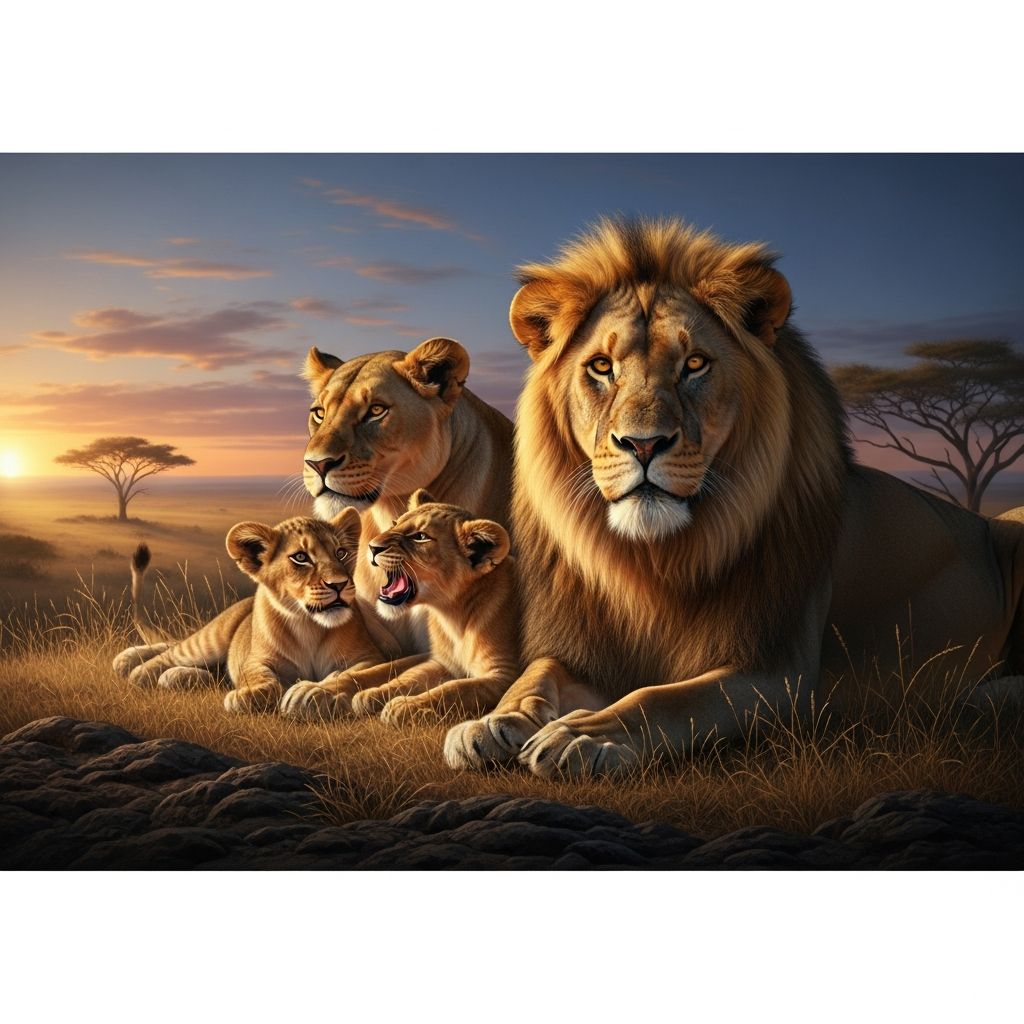
The Social Organization of Lions: Nature’s Most Collaborative Cats
Lions possess a uniqueness that distinguishes them from all other members of the feline family. Unlike tigers, leopards, and cheetahs that are solitary hunters, lions have evolved into highly social animals that live together in coordinated family groups called prides. This remarkable adaptation represents one of nature’s most sophisticated examples of cooperative living among carnivores, enabling these apex predators to thrive in environments where resources are scattered and competition is fierce. The pride structure serves as the foundation for lion survival, providing security, enabling efficient hunting, and establishing territorial control across the African savanna.
What Constitutes a Lion Pride?
A lion pride functions as an extended family unit rather than a random gathering of individuals. Prides typically range in size from 15 to 40 individual lions, though some sources indicate the range can be as small as 2 or as large as 40 members. This variation in pride size reflects differences in environmental resources, prey availability, and territorial circumstances across different regions of Africa.
The composition of a pride follows a predictable pattern. The core of any pride consists of related female lions—mothers, daughters, sisters, aunts, and cousins—who form the permanent foundation of the group. These related females typically remain together throughout their entire lives, creating a matriarchal nucleus that ensures continuity and stability. Alongside the female members are the dependent cubs that represent the next generation. Additionally, prides include one to three male lions who have joined from outside the pride, typically forming coalitions that protect the group’s territory and breeding interests.
The Role of Female Lions: Hunters and Nurturers
Female lions serve as the economic and social backbone of pride society. These remarkable animals assume responsibility for the most critical survival functions, operating under a matriarchal framework where they maintain decision-making authority and coordinate group activities. The lionesses’ contributions span multiple essential domains that directly impact pride survival.
Hunting represents the primary responsibility of female lions. Working as coordinated teams, lionesses employ sophisticated hunting strategies that capitalize on their numerical advantage and tactical cooperation. They use ambush techniques and synchronized movements to bring down prey significantly larger than individual hunters could manage, such as zebras, wildebeest, and buffalo. This cooperative hunting approach enables prides to secure sufficient nutrition despite the challenging African savanna environment where prey populations fluctuate seasonally.
Beyond hunting, lionesses bear complete responsibility for cub rearing and socialization. These maternal instincts extend beyond their biological offspring to include collective caregiving responsibilities. Multiple females within a pride participate in nursing, protecting, and educating young lions, distributing these demands across several individuals rather than concentrating them on a single mother. This shared parenting approach significantly improves cub survival rates by ensuring consistent care and protection while allowing hunters to leave the den without abandoning vulnerable young.
Lionesses also teach essential life skills to developing cubs, including hunting techniques, social hierarchies, appropriate behaviors within the pride structure, and self-defense capabilities. Cubs learn through observation, play-based interaction, and direct instruction from adult females, gradually acquiring the competencies necessary for adult survival.
The Role of Male Lions: Protectors and Territory Defenders
Male lions function as the protective force within pride society, tasked with defending territory against rival prides and maintaining control over breeding opportunities. The path to achieving this role requires extraordinary effort and often involves violent confrontation. Unlike females who inherit pride membership through birth, males must actively establish their position through combat and coalition-building.
Young males typically remain with their birth pride only until they reach sexual maturity, generally between 18 and 24 months of age. At this developmental stage, the presence of young males creates potential breeding competition with the pride’s established males, making their continuation in the pride socially unacceptable. The resident males expel these adolescent males from the pride, forcing them into a challenging nomadic phase.
Dispersing males often band together with brothers, cousins, or unrelated males encountered during their wanderings, forming coalitions of up to six individuals. These alliances prove critical for survival, as a solitary male face substantially reduced chances of long-term viability. The coalitions remain stable over extended periods, sometimes persisting for the entire lives of the members, with members maintaining strong emotional bonds and awareness of each other’s locations.
Male lions spend years as nomads before successfully establishing themselves within a pride. The typical timeline involves males reaching 5 to 7 years of age before achieving sufficient strength, experience, and coalition support to successfully challenge and overtake the resident males of an existing pride. When multiple coalitions or solitary males clash over pride control, these encounters can be brutally violent, with victorious coalitions sometimes killing or severely injuring defeated rivals.
Communication and Social Bonding
Lions employ multiple communication methods to maintain social cohesion and coordinate activities across their pride. Vocalizations represent the most dramatic form of communication, with the iconic roar serving multiple functions within pride society. The roar of a male lion can be heard from distances of at least 5 kilometers, making it an extraordinarily effective territorial announcement that warns rival prides and lone males to maintain distance from claimed territory.
Remarkably, lions possess sophisticated cognitive abilities that enable them to accurately assess the size of rival groups based on their roars. This acoustic analysis allows prides to make strategic decisions about whether to engage with potential adversaries or avoid conflict, essentially evaluating numerical odds before committing to territorial disputes. This behavioral flexibility reflects a level of social intelligence that enhances survival probability by reducing unnecessary risk.
Beyond vocalizations, lions communicate through body language and physical contact. Rubbing, grooming, and social touching reinforce bonds between pride members and establish social hierarchies. The pride maintains constant awareness of member locations and emotional states through these multiple communication channels, fostering the cohesive unity necessary for coordinated hunting and defense.
Territorial Behavior and Geographic Stability
Lions demonstrate strong territorial commitment, with prides typically occupying the same geographic ranges for many years, sometimes across entire lifespans. This territorial stability enables lions to develop intimate knowledge of their landscape, identifying the best hunting grounds, water sources, and shelter locations. The lionesses collectively defend their territory against incursions by other female groups with aggressive intensity comparable to that deployed by males against rival male coalitions.
The territorial system provides several adaptive advantages. It prevents overexploitation of local prey populations by limiting the number of predators utilizing specific areas. It enables prides to optimize their hunting efficiency by thoroughly knowing all prey movement patterns and seasonal variations within their range. Additionally, territorial commitment ensures that pride members have guaranteed access to resources, reducing the energy expenditure necessary for long-distance traveling to find food and water.
The Challenges of Pride Membership
Despite the benefits of pride living, membership entails significant challenges and dangers. Young male cubs face the existential threat of expulsion during adolescence, forcing them into a nomadic lifestyle that carries substantial mortality risk. The transition from cushy pride life to independent survival requires abrupt development of hunting skills and self-defense capabilities during a vulnerable developmental window.
Cubs of both sexes face threats from external predators including wild dogs, leopards, and hyenas that continuously target young lions as food sources. While pride membership provides protective advantages through numerical superiority and coordinated defense, no level of protection entirely eliminates these predatory threats.
The coalition-based territorial system creates violent conflict as young male coalitions attempt to overtake established prides. These battles result in injuries, deaths, and profound social disruptions that reshape pride composition and hierarchy. The brutal reality of this system ensures that only the most physically capable and strategically competent males successfully establish breeding rights, maintaining strong selection pressure that perpetuates male lion physical prowess.
Conservation Status and Population Decline
The ecological and social success of lions as pride-based predators has unfortunately failed to protect them from severe population pressures in recent centuries. Historical lion populations in Africa exceeded 200,000 individuals approximately one century ago, but contemporary estimates place the total African lion population at merely 21,000 individuals. This catastrophic decline of over 90 percent over a single century represents one of conservation biology’s most alarming trajectories.
Since 1995 alone, lion populations have declined by approximately 50 percent, pushing the species toward vulnerability to extinction according to major conservation organizations. Multiple factors contribute to this decline including habitat loss to human agricultural expansion, reduction of prey populations through overhunting, direct persecution by livestock farmers, disease transmission, and the illegal wildlife trade. The pride-based social structure that evolved to optimize survival in the African savanna provides no protection against anthropogenic threats operating at landscape and global scales.
The Evolutionary Advantages of Pride Living
The evolution of pride-based society in lions appears to reflect adaptation to specific environmental conditions characterizing the African savanna. The resource distribution in savanna ecosystems—with prey concentrated in specific locations, water sources scattered across vast distances, and shelter limited to particular habitats—created selective pressure favoring cooperation over solitary predation. The resulting pride system distributes hunting burden, child-rearing responsibilities, and territorial defense across multiple individuals, dramatically enhancing survival probability compared to solitary predation strategies.
This social evolution enabled lions to compete successfully against faster, more agile feline competitors including leopards and cheetahs. While individual lions lack the speed and agility of these competitors, coordinated prides can successfully hunt large prey through tactical cooperation, occupy prime territories through numerical advantage, and maintain breeding success through collective defense. The pride essentially compensates for individual limitations through collective capability.
Frequently Asked Questions
Q: How long do lions typically stay in a pride?
A: Female lions generally remain in their birth pride throughout their entire lives, forging lifelong bonds with related females. Male lions typically remain only until sexual maturity around 18-24 months, after which they disperse to form coalitions and eventually attempt to establish their own prides.
Q: Why do male lions form coalitions?
A: Male coalitions dramatically improve survival and reproductive success compared to solitary males. Coalitions provide mutual defense, shared hunting burden, collective territorial defense capability, and breeding protection. Without coalition support, individual males face severely reduced survival odds in the wild.
Q: What determines the size of a lion pride?
A: Pride size correlates primarily with prey availability and resource distribution. Prides in areas with abundant prey tend to be larger, while prides in resource-limited areas remain smaller. Environmental productivity essentially determines the maximum number of lions that can sustain themselves in any given territory.
Q: Do male lions actually hunt in prides?
A: No, female lions conduct the vast majority of hunting for prides. Male lions primarily focus on territorial defense and protecting the pride. Males may occasionally hunt, but the coordinated, efficient hunting operations that sustain pride nutrition are primarily female-driven activities.
Q: How do lions decide who holds leadership positions in a pride?
A: Prides operate under matriarchal structures where related females maintain decision-making authority and coordinate activities. Among males, dominance hierarchies develop through combat and coalition dynamics, with the strongest, most experienced coalitions typically controlling pride territories and breeding rights.
References
- How do lion prides work? — Wild and Free Foundation. Accessed April 2026. https://www.wildandfreefoundation.org/wff-logbook-blog/how-do-lion-prides-work
- Welcome To The Pride: The Social Lives Of Lions — Planet Wild. Accessed April 2026. https://planetwild.com/blog/the-social-lives-of-lions
- Lions and Their Unbreakable Bond with Their Prides — Lions Tigers and Bears. Accessed April 2026. https://lionstigersandbears.org/lions-and-their-unbreakable-bond-with-their-prides/
- Understanding the Vital Role of Females in a Lion Pride — Turpentine Creek. Accessed April 2026. https://www.turpentinecreek.org/the-queens-of-the-savanna-understanding-the-vital-role-of-females-in-a-lion-pride/
- Secrets of Lion Social Structure — Zoo Atlanta. Accessed April 2026. https://zooatlanta.org/secrets-of-lion-social-structure/
- Life in the Pride – the Social Structure of the Lion Family — Free School. Accessed April 2026. https://www.youtube.com/watch?v=0tpY3sH4YTU

- Integrated M.A. in Applied Linguistics, University of Hyderabad
- 5+ years in editorial, instructional, SEO, and research-based writing
Sneha is a relationships and lifestyle writer with a strong foundation in applied linguistics and certified training in relationship coaching. She brings over five years of writing experience to theskillvault, crafting thoughtful, research-driven content that empowers readers to build healthier relationships, boost emotional well-being, and embrace holistic living. Her writing and insights reflect the belief that beauty, happiness, and wellness…