
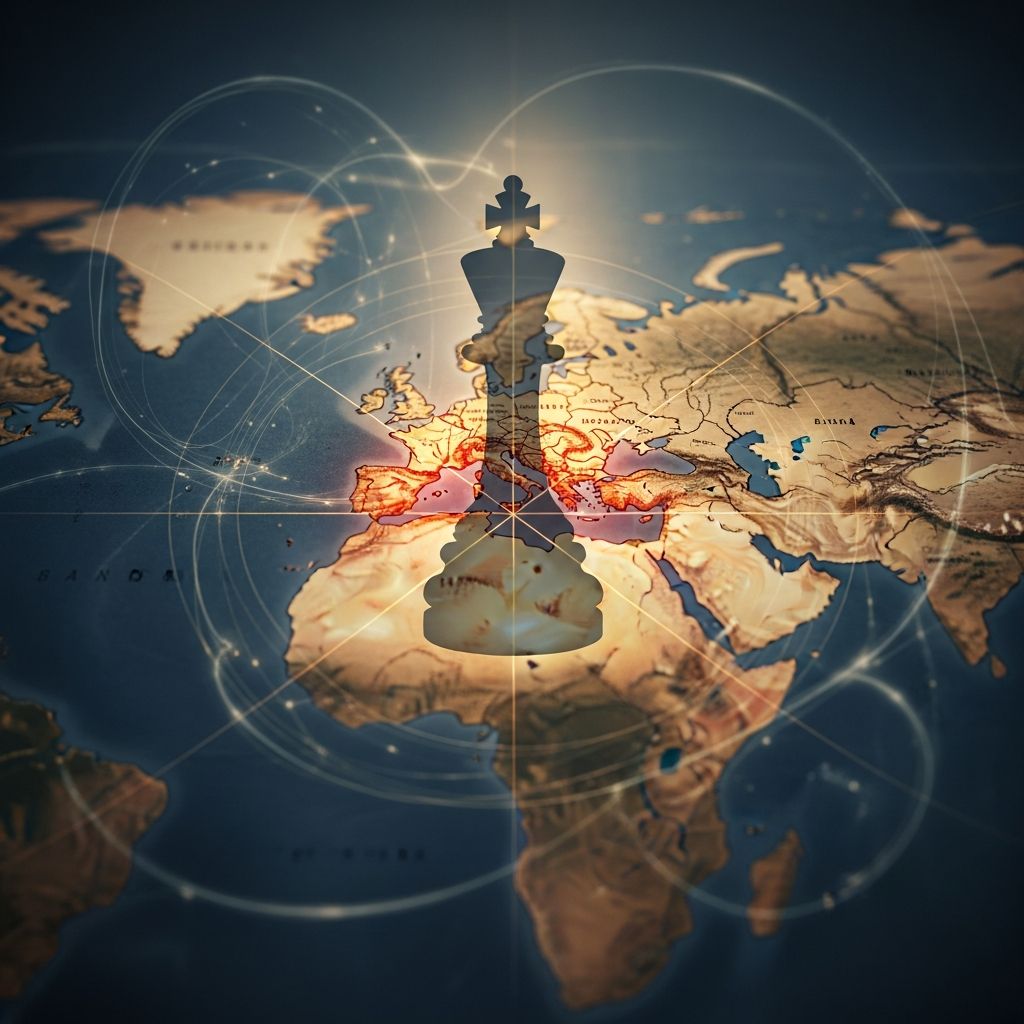
Halford John Mackinder’s Heartland Theory stands as a cornerstone of geopolitical thought, proposing that dominance over a central Eurasian region ensures global supremacy. This idea, first articulated in the early 20th century, reshaped understandings of power dynamics between land and sea forces.
Origins of a Revolutionary Geopolitical Vision
In 1904, British geographer Halford Mackinder presented ‘The Geographical Pivot of History’ to the Royal Geographical Society, introducing the concept of a ‘pivot area’ in Eurasia. This vast, landlocked territory, immune to naval assault, held the key to world control due to its resources, population, and strategic position. Mackinder argued that advancements in rail transport would enable rapid mobilization across this area, tipping the balance from sea powers to continental ones.
Mackinder refined his ideas in 1919 with ‘Democratic Ideals and Reality,’ renaming the pivot the ‘Heartland.’ He envisioned a world divided into interconnected zones where land power could eclipse maritime dominance. By 1943, in ‘The Round World and the Winning of the Peace,’ he adapted the theory to account for air power and global changes, yet its essence persisted.
Defining the Heartland: Eurasia’s Strategic Core
The Heartland encompasses roughly nine million square miles, stretching from the Volga River to eastern Siberia, the Himalayas to the Arctic Ocean. Characterized by Arctic and inland drainage, it features steppes ideal for mobility—from ancient horsemen to modern railroads and tanks.
- Natural Defenses: Surrounded by mountains, deserts, and oceans, except the western flank, making it the ‘greatest natural fortress’ .
- Resource Wealth: Abundant wheat fields, minerals, fuels, and manpower for industrial might.
- Mobility Advantage: Flat plains from Manchuria to Poland enable swift military campaigns.
Mackinder’s famous dictum captures its essence: ‘Who rules East Europe commands the Heartland; who rules the Heartland commands the World-Island; who rules the World-Island commands the World.’ The World-Island is Afro-Eurasia, home to most of humanity and resources.
Global Divisions in Mackinder’s Framework
Mackinder partitioned the world into three tiers:
| Zone | Description | Strategic Role |
|---|---|---|
| Heartland | Vast Eurasian interior | Ultimate power base, land invulnerable to sea attack |
| Inner or Marginal Crescent | Europe, Middle East, Asia’s edges | Buffer zones contesting Heartland access |
| Outer or Insular Crescent | Americas, Australia, Britain, Japan | Sea powers projecting naval force |
The Inner Crescent acts as a contested rimland, where sea powers must contain Heartland expansion. The Outer Crescent, with ocean access, historically challenged land powers but risked obsolescence with Heartland unification.
Historical Validations and Power Struggles
The theory gained traction during pivotal 20th-century events. Post-World War I, Soviet control over Eastern Europe fulfilled the first proposition, commanding the Heartland. Nazi Germany invoked it in Operation Barbarossa, aiming to seize the Heartland from the USSR, believing it would secure World-Island dominance.
The Cold War epitomized Mackinder’s vision: the USSR as Heartland power versus U.S.-led sea alliances. Containment policies targeted rimland states to encircle and isolate the core. Mackinder’s ideas influenced strategists like Karl Haushofer in Germany and U.S. policymakers.
Critiques and Limitations of the Theory
Despite its influence, the Heartland Theory faces scrutiny. It overemphasizes geography and transport, underplaying ideology, economics, and technology like airpower and missiles, which erode natural barriers. Critics note sea powers like the U.S. dominated without Heartland control, via alliances and projection.
Additionally, it assumes static power dynamics, ignoring nuclear deterrence and globalization that diffuse control. Mackinder’s revisions acknowledged airplanes connecting the Heartland to oceans, yet the theory’s land-centric bias persists as a flaw.
Contemporary Relevance in Modern Conflicts
The theory illuminates today’s geopolitics. Russia’s Ukraine invasion reflects Heartland imperatives: securing Eastern Europe to buffer against NATO. Control of the Eastern European Plain ensures Heartland security.
China’s Belt and Road Initiative echoes World-Island ambitions, linking Eurasia economically and potentially adding oceanic frontage—a Mackinder ‘peril’. Alliances between Russia and China challenge post-Cold War orders, as predicted by scholars like Colin Gray.
In the Indo-Pacific, rimland struggles pit U.S. sea power against continental threats. Pipelines and high-speed rail revive Heartland mobility themes.
Key Propositions Dissected
- Eastern Europe as Gatekeeper: The plains linking Heartland to Europe make it crucial; Soviet proxy rule validated this.
- Heartland to World-Island: Resources and armies project power across Afro-Eurasia.
- Global Command: Unified World-Island overwhelms peripheral islands.
Frequently Asked Questions (FAQs)
What is the core idea of Mackinder’s Heartland Theory?
The theory posits that controlling Eurasia’s Heartland grants dominance over the World-Island and thus the world, prioritizing land power.
How did Mackinder define the Heartland geographically?
As the area from Volga to Siberia, Himalayas to Arctic, with inland drainage shielding it from seas.
Did historical events prove the theory correct?
Partially: Soviet Eastern Europe control and Hitler’s invasion targeted it, but U.S. sea power prevailed without Heartland hold.
Is the theory relevant to current events like Ukraine?
Yes, Russia’s actions aim to secure Eastern Europe, echoing Mackinder’s first proposition.
What are main criticisms?
Over-relies on geography, ignores tech like air/missiles, and sea powers’ successes.
Evolving Geopolitics: Beyond Mackinder
Succeeding theorists like Spykman emphasized rimland control for containment. Today, cyber, space, and economic domains complicate Mackinder’s map. Yet, infrastructure like China’s rails and Russia’s pipelines underscore enduring Heartland logic.
The theory warns of autocratic Heartland alliances threatening freedom, a prescient note amid Russia-China ties. As climate change opens Arctic routes, Heartland access evolves.
In summary, Mackinder’s framework remains a vital lens for analyzing power, reminding strategists that geography shapes destiny, even in a multipolar world.
References
- Mackinder’s Heartland theory — Jagiroad College. 2023-11-06. https://jagiroadcollegelive.co.in/attendence/classnotes/files/1699110095.pdf
- Mackinder’s Heartland Theory (AP Human Geography) — YouTube. N/A. https://www.youtube.com/watch?v=OwSlRr1Hw70
- The Russo-Ukrainian War and Mackinder’s Heartland Thesis — Geopolitical Monitor. 2023-02-24. https://www.geopoliticalmonitor.com/the-ukraine-war-and-mackinders-heartland-thesis/
- Mackinder: Who rules Eastern Europe rules the World — IGES. N/A. https://iges.ba/en/analysis/geopolitics/mackinder-who-rules-eastern-europe-rules-the-world/
- Mackinder’s “heartland” – legitimation of US foreign policy — Copernicus. 2023. https://gh.copernicus.org/articles/78/183/2023/
- The Heartland Theory and the Present-Day Geopolitical Structure — Silk Road Studies. 2010. https://www.silkroadstudies.org/resources/pdf/Monographs/1006Rethinking-4.pdf
- The Geographical Pivot of History — Wikipedia (primary ref). 1904/2000. https://en.wikipedia.org/wiki/The_Geographical_Pivot_of_History

- Integrated M.A. in Applied Linguistics, University of Hyderabad
- 5+ years in editorial, instructional, SEO, and research-based writing
Sneha is a relationships and lifestyle writer with a strong foundation in applied linguistics and certified training in relationship coaching. She brings over five years of writing experience to theskillvault, crafting thoughtful, research-driven content that empowers readers to build healthier relationships, boost emotional well-being, and embrace holistic living. Her writing and insights reflect the belief that beauty, happiness, and wellness…