
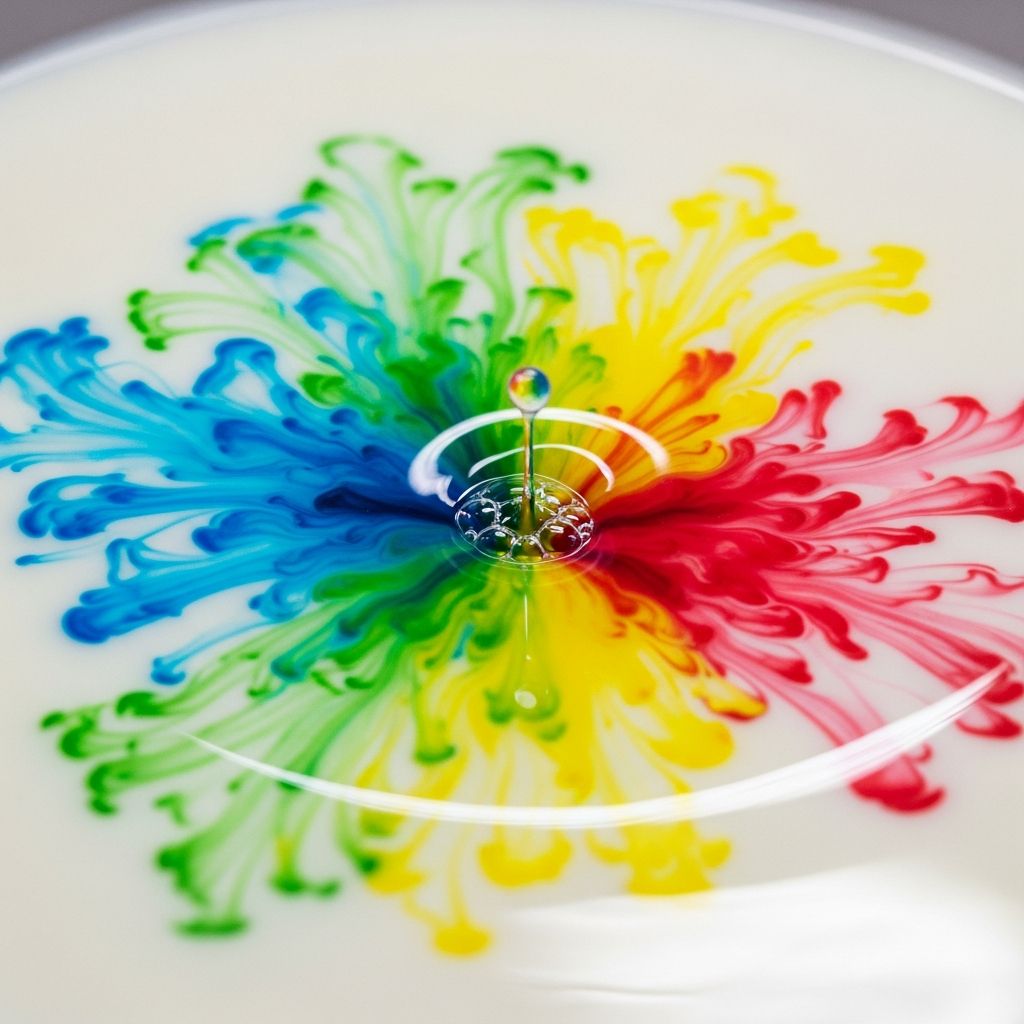
This captivating experiment transforms a shallow dish of milk into a canvas of swirling rainbows using everyday items like food coloring and dish soap. It offers a hands-on way to explore fundamental chemistry concepts, such as how molecules interact based on their polar or non-polar nature, making abstract ideas visible and exciting for children.
Why This Experiment Sparks Scientific Curiosity
At its core, the magic milk colors experiment demonstrates real-world chemistry without needing a lab. When drops of food coloring sit motionless on milk, adding a touch of soap unleashes a frenzy of motion, pushing colors across the surface in hypnotic patterns. This visual spectacle helps learners grasp how substances like fats in milk repel water until soap bridges the gap, mimicking the cleaning action we see daily with handwashing.
Ideal for ages 5 and up, it requires minimal preparation and cleanup, yet delivers profound insights into molecular behavior. Parents and educators use it to combat learning gaps during breaks, turning playtime into a lesson on observation, prediction, and experimentation.
Gathering Your Materials
Assemble these household staples to get started:
- A wide, shallow dish or plate (ceramic or glass works best for visibility)
- Whole milk or higher-fat milk (about 1/4 inch deep layer)
- Food coloring in at least four colors (red, blue, green, yellow for maximum effect)
- Liquid dish soap (any brand; avoid antibacterial if possible for purer results)
- Cotton swabs or Q-tips
- Optional: Pipette or dropper for precise coloring, paper towels for spills
Using whole milk maximizes the reaction because its higher fat content fuels more dramatic color movement. Skim milk yields subtler effects, making it great for comparisons.
Step-by-Step Instructions for Success
Follow these clear steps to replicate the mesmerizing display:
- Prepare the base: Pour milk into the dish to cover the bottom evenly, about 1/4 inch deep. Let it settle for 30 seconds to calm any surface ripples.
- Add colors: Place 1-2 drops of each food color near the center, spacing them close but not touching. Watch how they bead up without spreading—milk’s surface tension holds them in place.
- Control test: Dip a dry cotton swab into the milk at one colored spot. Note minimal or no movement; this baseline shows the untouched state.
- Introduce soap: Add a drop of dish soap to the swab’s opposite end. Touch it gently to the milk’s center or a color drop. Hold for 10-15 seconds and observe the explosion of swirling hues!
- Experiment further: Repeat with a fresh soapy swab in different spots. Colors keep dancing even after removal as soap spreads.
Safety note: This is non-toxic, but supervise young children to prevent spills or ingestion. Work on a protected surface.
The Chemistry Unveiled: Polar vs. Non-Polar Worlds
Milk is an emulsion—tiny fat globules suspended in water, plus proteins and minerals. Water molecules are polar, with positive and negative ends that attract like tiny magnets, creating strong bonds and high surface tension. Food coloring, also polar, sits atop without mixing deeply.
Fats in milk are non-polar, oil-like, and repel water. Dish soap molecules are amphiphilic: a hydrophilic (water-loving) head and hydrophobic (water-fearing) tail. When soap enters, its tails latch onto fat globules, heads bind water, forming micelles—spherical clusters that whisk fats away.
This migration disrupts surface tension, propelling soap molecules outward rapidly. Food coloring gets caught in the chaos, swirling like fireworks. Higher fat content means more micelles, bigger bursts.
| Milk Type | Fat Content | Color Movement Intensity |
|---|---|---|
| Skim | <1% | Low |
| 2% | 2% | Medium |
| Whole | 3-4% | High |
| Cream | >10% | Explosive |
Variations to Deepen Learning
Extend the fun with these tweaks:
- Milk comparisons: Test skim vs. whole vs. cream. Fat correlation to motion becomes evident.
- Water substitute: Replace milk with water—no show! Highlights fat’s necessity.
- Soap types: Try bar soap shavings or different liquids. Liquid excels due to quick dispersion.
- Temperature play: Warm milk reacts faster; cold slows it, linking to molecular energy.
- Half-and-half: Mix milk types mid-experiment for gradient effects.
These adaptations foster critical thinking: Why does cream outperform skim? Document observations in a journal for science fair potential.
Linking to Everyday Phenomena
This isn’t just spectacle—it’s practical science. Soap cleans greasy hands because its tails grab oils, letting water rinse them via micelles. Laundry detergents work identically on fabrics.
In nature, similar principles explain oil spills: dispersants act like soap to break slicks. Emulsions appear in mayonnaise (oil in vinegar) or butter, stabilized by similar forces.
Educational Benefits Across Age Groups
For preschoolers (ages 4-6): Emphasize sensory joy and cause-effect: “Soap makes colors dance!” Build vocabulary like “swirl” and “explode.”
Elementary (7-10): Introduce hypothesis: “Soap will scatter colors because…” Discuss polarity simply as “friends vs. strangers” in molecule terms.
Middle school (11+): Dive into micelles, surface tension math (force per length), and variables like fat percentage.
It combats summer slide by reinforcing observation skills, per educational research on hands-on STEM.
Troubleshooting Common Issues
- No movement? Use fresher milk or more soap; old milk has denatured proteins.
- Colors mix too soon? Ensure drops aren’t overlapping; gentler touches prevent premature spread.
- Weak reaction? Switch to whole milk—fat is key.
- Plate too small? Colors hit edges fast; opt for larger dishes.
Frequently Asked Questions
Is this experiment safe for toddlers?
Yes, with supervision. Food coloring and soap are edible-grade, but avoid direct tasting.
Why doesn’t it work with water?
Water lacks fats; no micelles form to drive motion.
Can I use gel food coloring?
Gel is thicker and may clump; liquid disperses best.
How does fat percentage affect results?
More fat equals more non-polar sites for soap, amplifying disruption.
What’s the best dish soap brand?
Any standard; Dawn is popular for strong surfactants.
Advanced Extensions for Budding Scientists
Quantify with timers: Measure swirl duration across milk types. Graph fat % vs. speed. Explore pH by adding vinegar—does acidity alter tension? Video under slow-motion to count micelle formations.
Connect to biology: Milk’s casein proteins stabilize fats, like cell membranes. This previews emulsions in food science or pharmacology.
Word count: 1678 (excluding metadata and references)
References
- Colors on the Move — American Chemical Society. 2023-05-15. https://www.acs.org/education/whatischemistry/adventures-in-chemistry/experiments/colors-move.html
- Color Changing Milk — Steve Spangler Science. 2024-01-10. https://stevespangler.com/experiments/milk-color-explosion/
- Rainbow Milk Experiment — Experiment Archive. 2023-08-22. https://www.experimentarchive.com/experiments/rainbow-milk/
- Magic Milk Science Experiment — Little Bins for Little Hands. 2024-02-01. https://littlebinsforlittlehands.com/magic-milk-a-classic-science-experiment-for-kids/
- Milk Rainbow — Connections Academy. 2023-06-12. https://www.connectionsacademy.com/support/resources/article/milk-rainbow/

- Integrated M.A. in Applied Linguistics, University of Hyderabad
- 5+ years in editorial, instructional, SEO, and research-based writing
Sneha is a relationships and lifestyle writer with a strong foundation in applied linguistics and certified training in relationship coaching. She brings over five years of writing experience to theskillvault, crafting thoughtful, research-driven content that empowers readers to build healthier relationships, boost emotional well-being, and embrace holistic living. Her writing and insights reflect the belief that beauty, happiness, and wellness…