
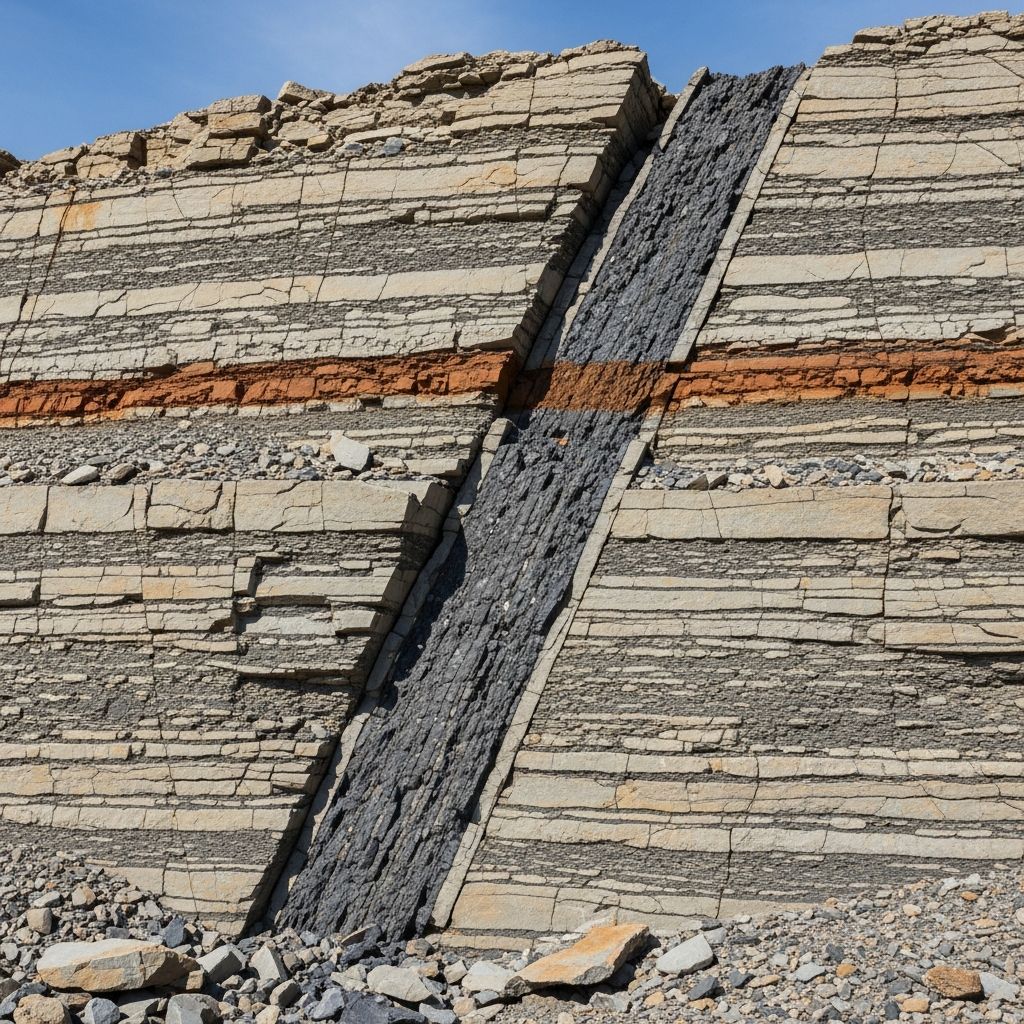
Magmatic dikes represent fundamental structures in igneous geology, acting as conduits for magma movement through the Earth’s crust. These sheet-like intrusions cut across existing rock layers, providing critical insights into volcanic processes and crustal dynamics.
The Fundamental Nature of Magmatic Dikes
Dikes are tabular bodies of igneous rock that intrude into fractures within pre-existing rock formations, typically oriented vertically or near-vertically. Unlike concordant intrusions like sills, which parallel bedding planes, dikes discordantly cross-cut sedimentary layers, foliations, or other structures, making them identifiable in field exposures. This cross-cutting relationship serves as a key principle in relative dating, indicating that the dike’s magma solidified after the host rock formed.
Common compositions include basalt, diabase (dolerite), and fine-grained granitic rocks, reflecting the magma’s source and cooling history. In basaltic provinces like Iceland or Hawaii, dikes dominate as primary feeders for surface volcanism. Their formation links subsurface magma reservoirs to eruptive activity, influencing hazard assessment in active volcanic regions.
Mechanisms Driving Dike Formation
Dike genesis begins deep in the crust where magma accumulates in chambers, generating overpressure that exceeds the surrounding rock’s strength. This pressure induces fracturing, creating pathways for magma ascent. The process, known as hydraulic fracturing or hydrofracturing, occurs when fluid pressure—here from buoyant, viscous magma—propagates cracks upward.
At shallow crustal levels, magma exploits tensile stresses, forming pure extension fractures filled by the intruding melt. Studies of exposed dikes in Iceland reveal that most form through this mechanism, with magma acting as a wedge to dilate fissures. Deeper, where rocks are hotter and more ductile, shear planes at 35-45 degrees to the dike walls accommodate intrusion via bulldozing or stoping, where wall rock fragments into the magma.
Buoyancy plays a pivotal role, as less dense magma rises through denser country rock. Propagation paths can zigzag around obstacles, such as alternating between vertical ascent and lateral shifts when encountering resistant layers, as observed in Hawaiian and Icelandic examples. En echelon arrangements—offset, parallel dikes—arise from stress field rotations with depth or localized shortening.
Physical Characteristics and Internal Structures
Upon solidification, dikes exhibit diagnostic features tied to their emplacement environment. Shallow dikes commonly develop fine-grained or glassy chilled margins, 1-5 cm thick, where rapid cooling against cold host rock quenches the magma. These contrast with coarser interiors, where slower cooling allows larger crystal growth.
Columnar jointing, perpendicular to margins, results from contraction during cooling, fracturing the rock into polygonal prisms. This is evident in many basaltic dikes, enhancing their aesthetic and structural appeal in outcrops. Wall rock often shows baking or metamorphism from heat conduction, with contact aureoles of altered minerals.
Thickness varies from centimeters to hundreds of meters; exceptional cases like the 120-m Medford dike in Maine or 500-m Gardar dike in Greenland suggest formation via stoping rather than pure dilation. Erosion along walls during rapid flow can widen dikes, while sluggish flow promotes solidification and narrowing.
Dikes in Volcanic Systems and Swarms
Dikes frequently radiate from central magma chambers in swarms, feeding fissures or volcanic edifices. In rift zones like Iceland’s Northern Volcanic Zone, dikes propagate laterally before surfacing, supplying eruptions. Most, however, stall at depth, arrested by stress barriers or insufficient buoyancy.
Shallow chambers act as ‘sinks,’ channeling deep magma via dikes to focused surface vents, building volcanic piles. Cross-cutting relationships in layered basalt sequences confirm dikes post-date lavas, intruding hundreds of meters thick piles. Clastic dikes, filled by sediment rather than magma, form similarly but in softer substrates.
| Dike Type | Key Features | Typical Setting |
|---|---|---|
| Magmatic (Basaltic) | Chilled margins, columnar joints, extension fractures | Volcanic rifts, hotspots (e.g., Iceland, Hawaii) |
| Granitic | Coarser grains, shear-plane margins | Continental crust, plutonic margins |
| Clastic | Sediment infill, no igneous texture | Sedimentary basins with fractures |
| Radial Swarm | En echelon, fanning from center | Above intrusions or volcanoes |
Broader Geological Implications
Dikes record tectonic stress orientations, with strikes aligning to minimum principal stress (σ3) directions. In extensional regimes, they trend perpendicular to rifts; compressional settings produce shorter, offset segments. Their presence maps ancient magma plumbing, aiding reconstruction of paleovolcanic arcs or flood basalt provinces.
Metasomatic dikes, altered by fluid-rock reactions, highlight volatile transport roles. In deeply eroded terrains, dike swarms trace Large Igneous Province events, like the Mackenzie swarm in Canada, spanning thousands of kilometers.
Observing Dikes in Nature: Case Studies
- Icelandic Exposures: Six-meter-thick basaltic dikes cut Miocene lava piles, showcasing zigzag paths and pure extension origins at 1.5 km paleodepth.
- Hawaiian Systems: Shallow dikes in porous clinker show minimal wall penetration, forming via chamber-induced fissuring without forceful injection.
- Makhtesh Ramon, Israel: Dramatic cross-cutting of sedimentary layers illustrates classic dike morphology.
These examples underscore dikes’ ubiquity in volcanic terrains, from active rifts to ancient shields.
Frequently Asked Questions (FAQs)
What distinguishes a dike from a sill?
A dike cuts across rock layers discordantly, while a sill parallels bedding as a concordant intrusion. Sills often feed from underlying dikes.
How do most dikes fail to reach the surface?
Stress contrasts, insufficient overpressure, or path deviations arrest ~98% of dikes subsurface, as per Icelandic studies.
Can dikes form without fracturing?
Rarely; most rely on hydraulic fracturing, though deep ductile stoping or diapirism occurs in plastic regimes.
Why do dikes show columnar jointing?
Cooling contraction perpendicular to margins creates tensile stresses, fracturing into columns.
Are all vertical sheet intrusions dikes?
Typically yes, but inclined sheets resemble dikes; true dikes are near-vertical and cross-cutting.
Modern Research and Volcanic Forecasting
Understanding dike paths is crucial for eruption prediction. Geophysical monitoring tracks migrating dikes via seismicity and deformation, as during Iceland’s 1980 and Hawaii’s 2011 events. Models simulate buoyancy-driven fingering, where leading fingers breach first, forming fissures.
Future studies integrate tomography and InSAR to map real-time propagation, enhancing hazard mitigation. Dikes thus bridge petrology, tectonics, and volcanology, illuminating Earth’s dynamic interior.
References
- Lite Geology 40: Dikes — New Mexico Bureau of Geology and Mineral Resources. 2010. https://geoinfo.nmt.edu/publications/periodicals/litegeology/40/lg_v40.pdf
- How dikes form their paths from the source to the surface — YouTube (Geophysical Institute, University of Alaska). 2019. https://www.youtube.com/watch?v=tFaz0blkYfs
- Dike (geology) — Wikipedia (sourced from geological literature). Accessed 2026. https://en.wikipedia.org/wiki/Dike_(geology)
- Igneous Dikes – an introduction, how they form, with examples — YouTube. 2020. https://www.youtube.com/watch?v=lJjbQcV9t04
- The Formation and Cooling of Dikes — Institute for Creation Research. 2015. https://www.icr.org/content/formation-and-cooling-dikes
- Reading: Dikes and Sills — Lumen Learning (Geo Open Textbook). Accessed 2026. https://courses.lumenlearning.com/geo/chapter/reading-dikes-and-sills/

Medha Deb is an editor with a master's degree in Applied Linguistics from the University of Hyderabad. She believes that her qualification has helped her develop a deep understanding of language and its application in various contexts. Medha specializes in the areas of beauty, health, sports, and wellness and is committed to ensuring that the content on the website is…