
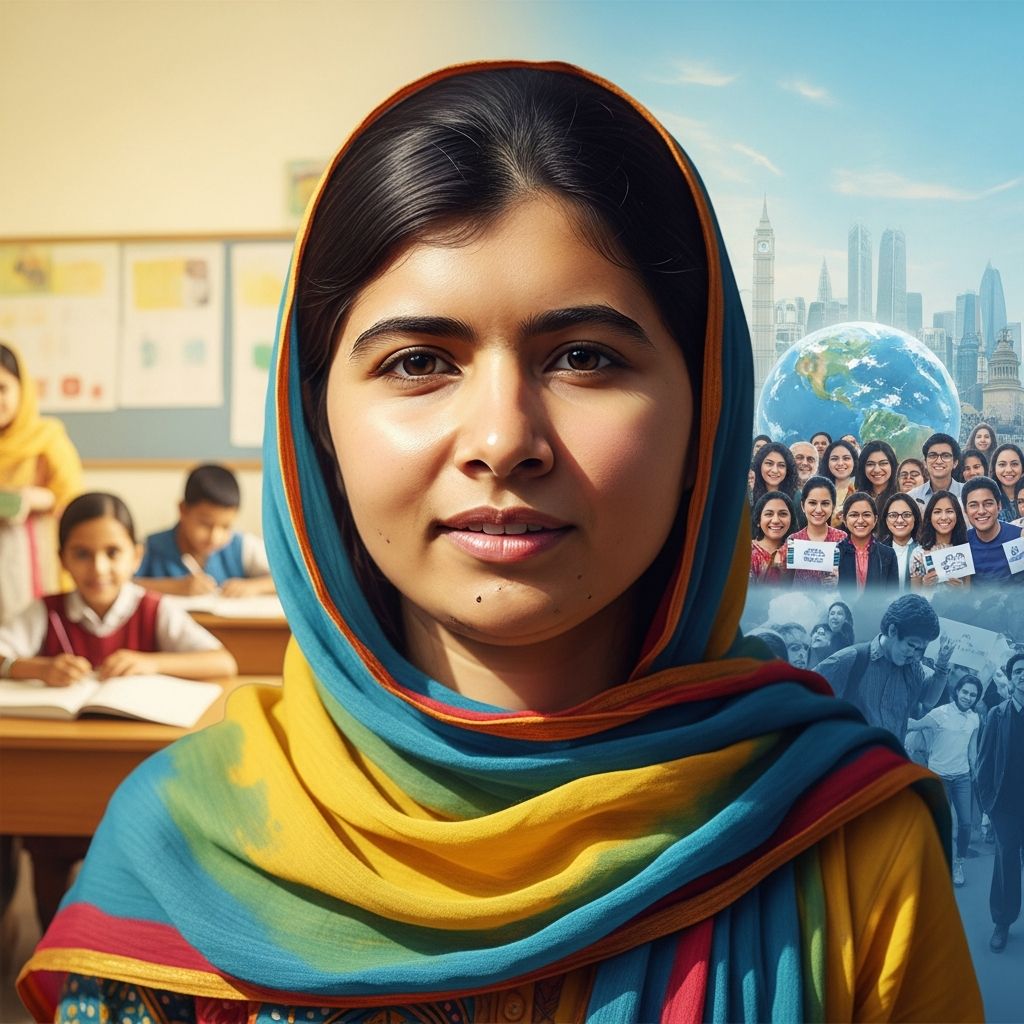
The Unlikely Rise of a Global Advocate
Malala Yousafzai’s story is not just one of survival, but of transformation. Born in 1997 in Mingora, Swat Valley, Pakistan, she grew up in a region where education was both a privilege and a battleground. Her father, Ziauddin Yousafzai, ran a school and instilled in her a deep respect for learning and justice. From an early age, Malala absorbed the idea that education was not just a personal right, but a collective necessity for peace and progress.
When the Taliban tightened its grip on Swat in the late 2000s, banning girls from attending school and destroying hundreds of educational institutions, Malala’s world changed. Instead of retreating, she stepped forward. At just 11 years old, she began writing a blog for BBC Urdu under a pseudonym, describing life under Taliban rule and the growing fear among girls who simply wanted to learn. That voice, small at first, would eventually echo across continents.
From Local Voice to Global Symbol
Malala’s early writings offered a rare, intimate look at the human cost of extremism. Her diary entries were not abstract political commentary, but the lived experience of a child watching her school close, her friends disappear, and fear settle over her community. When international media picked up her story, she became more than a schoolgirl — she became a symbol of resistance against oppression.
The Taliban’s violent response in 2012, when Malala was shot on her way home from school, was meant to silence her. Instead, it amplified her message. Her survival and recovery in the United Kingdom turned a regional struggle into a global movement. The world saw not just a victim, but a determined advocate who refused to be erased. Her courage resonated with millions, especially young people who saw in her a model of how one person’s voice can challenge even the most powerful forces of repression.
The Mindset Behind the Movement
What sets Malala apart is not just her bravery, but the clarity and consistency of her purpose. From the beginning, her activism has been rooted in a simple, powerful idea: every child, regardless of gender or background, deserves access to quality education. This is not a vague ideal, but a concrete demand backed by data, policy advocacy, and on-the-ground action.
Her ability to articulate this vision in a way that is both principled and practical has been key to her influence. Whether speaking at the United Nations, meeting world leaders, or engaging with grassroots educators, she frames education not as a luxury, but as the foundation of peace, economic development, and human dignity. This clarity of mission has allowed her to build coalitions across cultures, religions, and political systems.
Building a Legacy Through the Malala Fund
In 2013, Malala co-founded the Malala Fund with Shiza Shahid, a non-profit organization dedicated to ensuring 12 years of free, safe, and quality education for every girl. The Fund operates on a model that combines global advocacy with local empowerment, supporting education projects in countries like Pakistan, Nigeria, Lebanon, and Brazil.
Key aspects of the Malala Fund’s work include:
- Funding local education initiatives led by women and girls in underserved communities
- Advocating for policy changes that remove barriers to girls’ education (such as child marriage, poverty, and conflict)
- Amplifying the voices of young activists through programs like the Gulmakai Network
- Investing in innovative solutions, such as digital learning platforms and community-based schools
One of the Fund’s most visible projects was the opening of a school for Syrian refugee girls in Lebanon in 2015, on Malala’s 18th birthday. This act was symbolic and practical: a declaration that education must continue even in the most difficult circumstances, and that investing in girls is investing in the future.
Recognition and Influence on the World Stage
Malala’s impact has been recognized through numerous international honors. In 2011, at age 14, she became the first recipient of Pakistan’s National Youth Peace Prize. The following year, she was nominated for the International Children’s Peace Prize by Archbishop Desmond Tutu, and in 2013, she received the Sakharov Prize for Freedom of Thought from the European Parliament.
Her most prominent recognition came in 2014, when, at 17, she became the youngest-ever Nobel Peace Prize laureate, sharing the award with Indian children’s rights activist Kailash Satyarthi. The Nobel Committee cited her “struggle against the suppression of children and young people and for the right of all children to education.”
Other major milestones include:
| Year | Award / Recognition | Significance |
|---|---|---|
| 2011 | Pakistan National Youth Peace Prize | First recipient; recognized early activism for girls’ education |
| 2013 | Sakharov Prize for Freedom of Thought | European Parliament’s top human rights award |
| 2014 | Nobel Peace Prize | Youngest laureate; global recognition for education advocacy |
| 2017 | UN Messenger of Peace | UN’s highest honor for peace advocates; focused on girls’ education |
| 2024 | Champion of the International Rule of Law Award | Recognized for combating gender apartheid and advancing girls’ rights |
Education as a Tool for Peace and Equality
Malala’s advocacy is grounded in the belief that education is not just a social good, but a strategic necessity for peace and stability. Research from organizations like UNESCO and the World Bank consistently shows that educating girls leads to lower child mortality, reduced poverty, and greater political participation. Malala has used this evidence to argue that denying girls education is not only a human rights violation, but a threat to national and global security.
She has repeatedly emphasized that:
- Girls’ education reduces child marriage and early pregnancy
- Each additional year of schooling increases a girl’s future earnings and strengthens her community
- Education is a powerful counter to extremism, offering alternatives to violence and radicalization
Her speeches at the UN and other global forums often return to this theme: that peace cannot be built on ignorance, and that true development must include every child, especially the most marginalized.
Challenges and Criticisms
No public figure, especially one who rises so young and so quickly, is immune to criticism. Malala has faced scrutiny from various quarters:
- Some in Pakistan have questioned whether her international platform overshadows local activists or distorts the complexity of the country’s political and religious landscape.
- Others have debated the effectiveness of top-down advocacy versus grassroots organizing, particularly in conflict-affected regions.
- There are also ongoing discussions about how to balance security concerns with the need to operate in high-risk areas.
Malala and the Malala Fund have responded by emphasizing collaboration with local partners, transparency in funding, and a commitment to listening to the communities they serve. They acknowledge that change is slow and complex, but argue that visibility and pressure from the global stage can accelerate progress where local efforts are already underway.
Personal Growth and Ongoing Commitment
Malala’s journey has also been one of personal growth. After moving to the UK, she completed her secondary education and went on to study Philosophy, Politics, and Economics (PPE) at the University of Oxford. This academic path reflects her desire to understand the structural forces that shape inequality and conflict, and to equip herself with the tools to influence policy and institutions.
Even as she has become a global icon, she has remained committed to the core of her mission: ensuring that every girl can go to school. Her work continues to focus on:
- Advocating for increased government and donor funding for education
- Supporting girls in conflict zones and refugee settings
- Challenging cultural and legal norms that limit girls’ access to education
- Using storytelling and media to keep the issue in the public eye
Why Malala’s Story Matters Today
In a world where millions of girls still lack access to education, Malala’s story is more relevant than ever. According to UNESCO, over 120 million girls worldwide are out of school, with the numbers highest in sub-Saharan Africa, South Asia, and conflict-affected regions. The reasons are complex: poverty, child marriage, gender-based violence, and weak education systems.
Malala’s example shows that:
- Young people can be powerful agents of change, not just future leaders but present-day advocates.
- Education is not a secondary issue, but a central pillar of human rights, development, and peace.
- Global solidarity, when combined with local action, can create real impact.
Her life challenges the idea that change must come from the top. It demonstrates that a single voice, sustained over time and supported by others, can shift public opinion, influence policy, and inspire a generation.
Frequently Asked Questions (FAQs)
What is Malala Yousafzai best known for?
Malala is best known for her courageous advocacy for girls’ education, especially in Pakistan, and for surviving a Taliban assassination attempt at age 15. She became the youngest Nobel Peace Prize laureate in 2014 for her work on children’s rights and education.
What is the Malala Fund?
The Malala Fund is a non-profit organization co-founded by Malala Yousafzai in 2013. It works to ensure 12 years of free, safe, and quality education for every girl by funding local education projects, advocating for policy change, and supporting young activists around the world.
Has Malala Yousafzai continued her education?
Yes. After recovering from her injuries and moving to the UK, Malala completed her secondary education and went on to study Philosophy, Politics, and Economics (PPE) at the University of Oxford, one of the world’s leading universities.
What awards has Malala received?
Malala has received numerous awards, including the Nobel Peace Prize (2014), the Sakharov Prize (2013), Pakistan’s National Youth Peace Prize (2011), and the UN Messenger of Peace title (2017). In 2024, she and the Malala Fund were honored with the Champion of the International Rule of Law Award.
How can people support Malala’s cause?
People can support Malala’s cause by:
- Donating to or volunteering with the Malala Fund
- Advocating for increased government funding for girls’ education
- Supporting local organizations that work on education and gender equality
- Amplifying the voices of girls and young women in their communities
References
- Malala Yousafzai – Facts — NobelPrize.org. 2024. https://www.nobelprize.org/prizes/peace/2014/yousafzai/facts/
- Malala Yousafzai — Britannica. 2024. https://www.britannica.com/biography/Malala-Yousafzai
- Malala Fund: Our Work — Malala.org. 2024. https://malala.org/our-work
- Education: Out-of-school children — UNESCO. 2023. https://uis.unesco.org/en/topic/out-of-school-children
- Champion of the International Rule of Law Award 2024 — American Society of International Law. 2024. https://www.asil.org/events/champion-international-rule-law-award-2024

- Integrated M.A. in Applied Linguistics, University of Hyderabad
- 5+ years in editorial, instructional, SEO, and research-based writing
Sneha is a relationships and lifestyle writer with a strong foundation in applied linguistics and certified training in relationship coaching. She brings over five years of writing experience to theskillvault, crafting thoughtful, research-driven content that empowers readers to build healthier relationships, boost emotional well-being, and embrace holistic living. Her writing and insights reflect the belief that beauty, happiness, and wellness…