
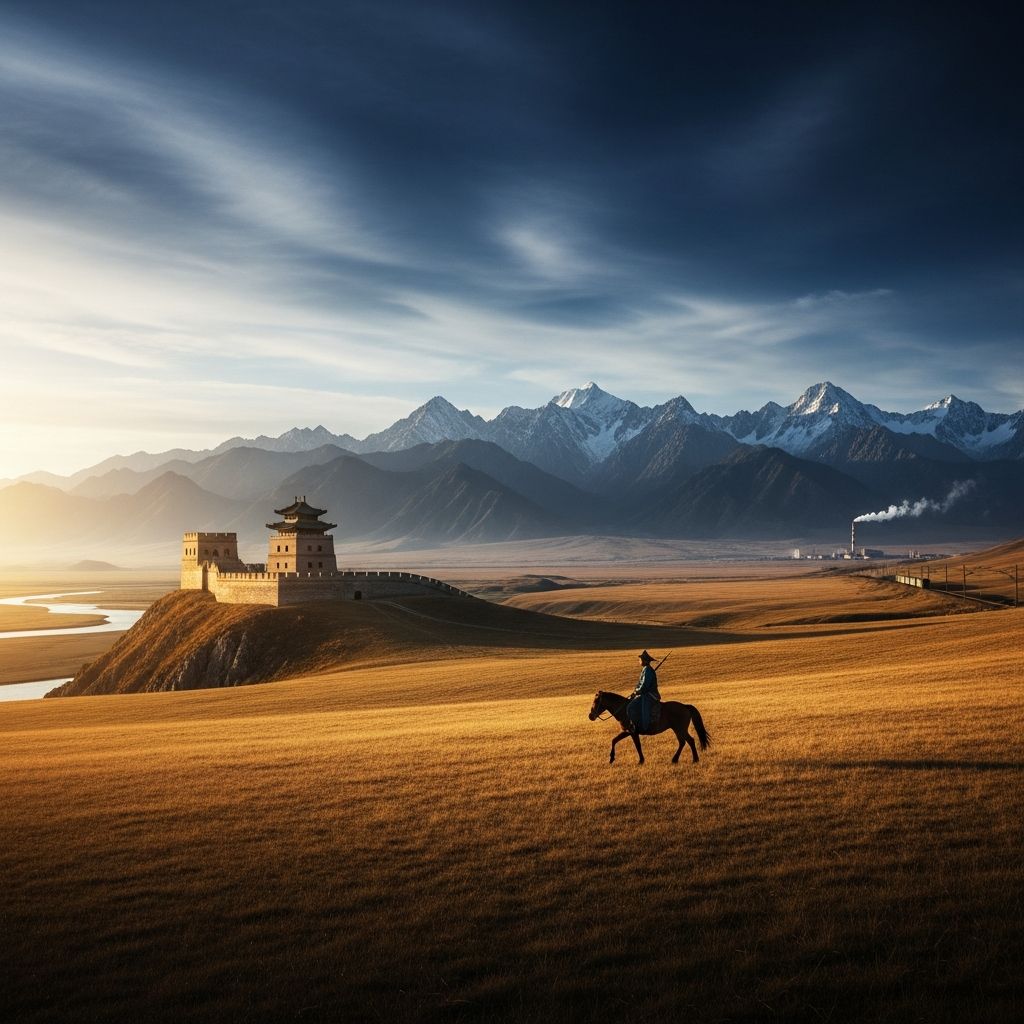
Manchuria represents a vast and strategically vital region in northeastern China, historically defined by its fertile plains, rugged mountains, and role as a crossroads of empires. Today known as China’s Northeast or Dongbei, it encompasses the provinces of Liaoning, Jilin, and Heilongjiang, covering about 1.5 million square kilometers of diverse terrain.
Defining the Land: Boundaries and Natural Features
The region’s geography is marked by the fertile Songliao Plain in the center, flanked by the Changbai Mountains to the east and the Greater Khingan Range to the west. These features create a landscape ideal for agriculture, with black soil supporting soybean, corn, and rice cultivation, making it one of China’s key grain baskets. Rivers like the Amur (Heilong Jiang) and Yalu form natural borders with Russia and North Korea, respectively.
Climatically, Manchuria experiences extreme continental weather: frigid winters dropping below -30°C and humid summers fostering rapid plant growth. This harsh environment shaped resilient nomadic and agrarian societies over millennia. Prehistorically, it served as an eastern corridor for migrations across the Eurasian steppe, linking Siberia to the Korean Peninsula.
- Major rivers: Amur, Songhua, Liao—vital for irrigation, transport, and hydropower.
- Mountain ranges: Changbai (home to Baekdu Mountain, sacred in Korean lore) and Lesser Khingan.
- Coastal access: Via the Liaodong Peninsula on the Yellow Sea, historically contested for ports like Dalian.
Ethnic Mosaic: Peoples of the Northeast
Manchuria’s population blends Han Chinese majorities with indigenous groups like the Manchus, Mongols, Evenks, Oroqen, and Koreans. The Manchus, originally Jurchens, rose from these lands in the 17th century, forging the Qing Dynasty that unified China.
Nomadic Tungusic peoples dominated early history, practicing hunting, herding, and rudimentary farming amid dense forests and steppes. Mongol incursions integrated the area into larger empires, while Han migration surged post-Qing, diluting native influences. Today, ethnic minorities comprise under 10% but preserve traditions like shamanism and reindeer herding.
| Ethnic Group | Historical Role | Modern Population Share |
|---|---|---|
| Manchus | Qing founders, warriors | ~2-3% in Northeast |
| Mongols | Steppe nomads, Yuan ties | ~1% |
| Koreans | Border settlers, farmers | ~1-2% (concentrated in Yanbian) |
| Evenks/Tungus | Hunters, reindeer herders | <0.5% |
Ancient Foundations: From Nomads to Dynastic Cradle
Manchuria’s story begins with prehistoric migrations around 3000 BCE, when proto-Mongolic and Tungusic tribes traversed its plains. By the 3rd century BCE, the Great Wall’s construction symbolized China’s defensive posture against these “barbarian” northerners.
Genghis Khan’s Mongol Empire invaded in 1211, incorporating the region into the Yuan Dynasty (1271-1368). Post-Yuan rebellions paved the way for Ming rule, but true transformation came with the rise of the Later Jin under Nurhaci in 1616, evolving into the Qing by 1644. The Manchus, from their Aisin Gioro clan base in what is now Liaoning, conquered Beijing, establishing nearly three centuries of rule.
Under Qing emperors like Kangxi, Manchuria was a forbidden homeland reserved for bannermen (Manchu soldiers), limiting Han settlement to prevent cultural erosion. The 1689 Treaty of Nerchinsk with Russia delimited early borders, ceding northern territories for fur trade stability.
Imperial Rivalries: Opening to Foreign Powers
The 19th century shattered isolation. The Opium Wars indirectly opened ports like Yingkou (Newchang), while the Taiping Rebellion strained Qing control. Russia’s eastward push culminated in the 1858 Treaty of Aigun and 1860 Treaty of Beijing, annexing vast Amur basin lands—over 1 million square kilometers—to create modern Primorsky Krai and its neighbors.
The Sino-Japanese War (1894-1895) shifted dynamics: Japan’s victory granted it Taiwan and influence in Liaodong, though triple intervention by Russia, France, and Germany forced retraction. Undeterred, Russia built the Chinese Eastern Railway (CER) across Manchuria to Vladivostok, shortening the Trans-Siberian by 600 miles.
The Russo-Japanese War (1904-1905) saw Japan seize Port Arthur, the South Manchurian Railway, and southern Liaodong, establishing the South Manchuria Railway Company as an economic foothold.
The Manchukuo Era: Japanese Ambitions Realized
The Mukden Incident of September 18, 1931, provided pretext for Japan to occupy Manchuria, installing Puyi—the last Qing emperor—as puppet ruler of Manchukuo in 1932. This “State of Harmony and Prosperity” masked exploitation: railways expanded, heavy industry boomed with Showa Steel Works in Anshan, and soybean exports fueled Japan’s war machine.
Manchukuo attracted 2 million Japanese settlers and Han migrants, but resistance from communist guerrillas and warlords persisted. Propaganda portrayed it as a utopian multi-ethnic state, yet famines and forced labor revealed its colonial nature.
- Key infrastructure: Expanded CER, Fushun coal mines, vast soya plantations.
- Population influx: From 30 million in 1931 to 45 million by 1945.
- End of era: Soviet invasion in August 1945 dismantled Manchukuo, aiding Chinese Communist victory.
Postwar Rebirth: Soviet Shadow and Communist Consolidation
World War II’s end brought Soviet occupation until 1946, during which they dismantled factories for reparations. Chinese communists, led by Mao Zedong, seized control amid civil war, using Manchuria as a strategic base.
In 1954, the region formalized as three provinces: Liaoning (industrial south), Jilin (central agriculture), Heilongjiang (northern resources). The First Five-Year Plan (1953-1957) poured investment into steel (Anshan), machinery (Shenyang), and oil (Daqing), propelling it to China’s “Ruhr.”
Modern Manchuria: Industrial Giant Facing Challenges
Today, Dongbei is China’s rustbelt-turned-innovation hub. GDP exceeds $1 trillion, driven by petrochemicals, autos (FAW in Changchun), and high-speed rail linking Harbin to Beijing. Yet, state-owned enterprise reforms, population decline (from 120 million in 2000 to ~98 million), and U.S.-China trade tensions pose hurdles.
Revitalization efforts include “Made in China 2025” tech parks and Belt and Road extensions to Russia. Culturally, it’s a fusion of Russian influences (vodka distilleries), Korean enclaves, and Manchu heritage sites like the Mukden Palace in Shenyang.
| Sector | Key Centers | Output Contribution |
|---|---|---|
| Heavy Industry | Anshan, Benxi | 20% of China’s steel |
| Automotive | Changchun, Shenyang | 10 million vehicles/year |
| Agriculture | Songnen Plain | 25% national soybeans |
Frequently Asked Questions (FAQs)
Is Manchuria a current political entity?
No, the term is historical; it’s officially the Northeast provinces of Liaoning, Jilin, and Heilongjiang since 1954.
What was Manchukuo?
A Japanese puppet state (1932-1945) in Manchuria, nominally led by Puyi but controlled from Tokyo for resource extraction.
Why is Manchuria economically important?
Rich in coal, iron, oil, and farmland, it powers China’s manufacturing with cities like Shenyang and Harbin as hubs.
Are there ongoing border disputes involving Manchuria?
Minor Sino-Russian issues persist over Heixiazi Island in the Amur, largely resolved by 2008 agreements.
How did the Qing Dynasty originate here?
Manchu tribes under Nurhaci unified in 1616, conquering China by 1644 from their Liaodong base.
Strategic Crossroads: Manchuria’s Global Relevance
Manchuria’s position astride Eurasia ensures its future role in Sino-Russian energy pipelines, Arctic routes, and U.S. containment strategies. Climate change may thaw permafrost, unlocking minerals, while ethnic ties bolster soft power with Korea and Mongolia.
Scholars debate its identity: a conquered periphery or imperial heartland? Regardless, its legacy—from Manchu banners to Manchukuo factories—defines modern China.
References
- Manchuria summary — Britannica. 2023. https://www.britannica.com/summary/Manchuria
- The Development Of Manchuria — U.S. Naval Institute. 1933-05-01. https://www.usni.org/magazines/proceedings/1933/may/development-manchuria
- Manchuria | Historical Region — Britannica. 2023. https://www.britannica.com/place/Manchuria
- Manchoukuo: Come for the Prosperity — Library of Congress Blogs. 2021-06. https://blogs.loc.gov/maps/2021/06/manchoukuo-come-for-the-prosperity-stay-for-the-harmony/
- Where Is Manchuria? – China Cultural Expedition — YouTube (Library of Congress affiliate content). 2023. https://www.youtube.com/watch?v=R_FXO3zFDoc

- Integrated M.A. in Applied Linguistics, University of Hyderabad
- 5+ years in editorial, instructional, SEO, and research-based writing
Sneha is a relationships and lifestyle writer with a strong foundation in applied linguistics and certified training in relationship coaching. She brings over five years of writing experience to theskillvault, crafting thoughtful, research-driven content that empowers readers to build healthier relationships, boost emotional well-being, and embrace holistic living. Her writing and insights reflect the belief that beauty, happiness, and wellness…