
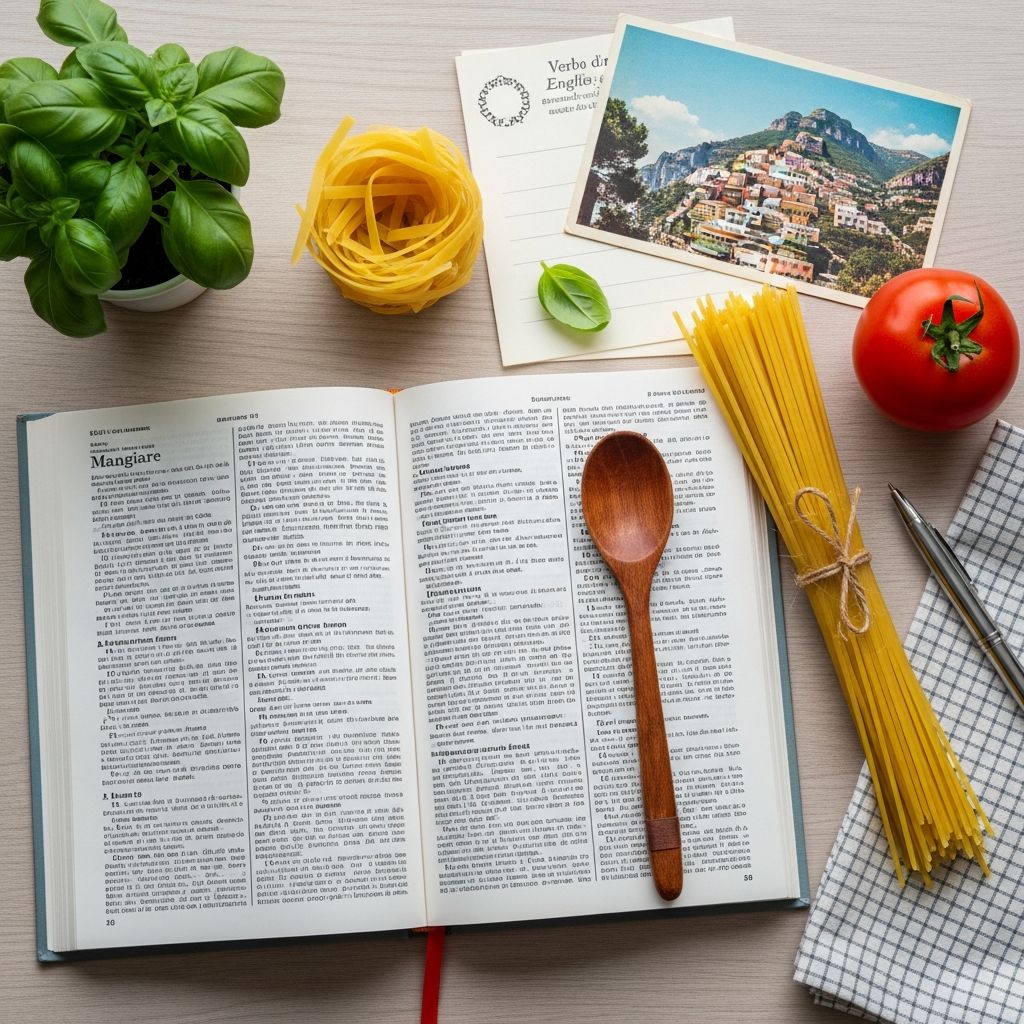
The verb mangiare holds a central place in Italian, translating directly to ‘to eat.’ As one of the most frequently used regular -are verbs, mastering its forms unlocks everyday conversations about meals, dining, and food culture. This guide provides an original, in-depth exploration of its conjugations across all major tenses and moods, complete with tables, real-world examples, and learning strategies.
Understanding the Basics of Mangiare
Mangiare belongs to the first conjugation group in Italian, ending in -are, which follows predictable patterns. Unlike irregular verbs, its stem remains consistent with minor adjustments for vowels and endings. The infinitive form is ‘mangiare,’ and its past participle is ‘mangiato.’ It pairs with the auxiliary verb ‘avere’ in compound tenses.
Why focus on mangiare? Italians express daily life through food—’I eat pasta,’ ‘We are eating out,’ or ‘Have you eaten?’—making this verb indispensable. Regularity simplifies learning: drop the -are ending and add tense-specific suffixes.
Present Tense: Everyday Actions
The present tense (presente) describes current habits, facts, or ongoing actions. For mangiare, it emphasizes routine meals or immediate plans.
| Pronoun | Conjugation |
|---|---|
| Io | mangio |
| Tu | mangi |
| Lui/Lei | mangia |
| Noi | mangiamo |
| Voi | mangiate |
| Loro | mangiano |
Examples:
- Io mangio la pizza ogni venerdì. (I eat pizza every Friday.)
- Tu mangi troppo dolce! (You eat too much sugar!)
- Noi mangiamo insieme stasera. (We eat together tonight.)
Notice the ‘io’ form adds -gio for smooth pronunciation, a hallmark of -giare verbs.
Imperfect Tense: Habits of the Past
Imperfetto conveys ongoing or repeated past actions, like childhood eating habits. Form it by dropping -are and adding -avo, -avi, etc.
| Pronoun | Conjugation |
|---|---|
| Io | mangiavo |
| Tu | mangiavi |
| Lui/Lei | mangiava |
| Noi | mangiavamo |
| Voi | mangiavate |
| Loro | mangiavano |
Examples:
- Da bambino, io mangiavo solo pasta. (As a child, I used to eat only pasta.)
- Voi mangiavate sempre fuori. (You all used to always eat out.)
This tense paints vivid pictures of past routines, essential for storytelling.
Passato Prossimo: Recent Past Events
For completed actions in the recent past, use passato prossimo: auxiliary ‘avere’ + ‘mangiato.’
| Pronoun | Conjugation |
|---|---|
| Io | ho mangiato |
| Tu | hai mangiato |
| Lui/Lei | ha mangiato |
| Noi | abbiamo mangiato |
| Voi | avete mangiato |
| Loro | hanno mangiato |
Examples:
- Io ho mangiato una pizza enorme. (I ate a huge pizza.)
- Hanno mangiato tutto il gelato? (Have they eaten all the ice cream?)
Future and Conditional: Plans and Hypotheticals
The future semplice (futuro semplice) drops -are and adds -erò, with ‘mang-‘ becoming ‘manger-.’ Conditional presente follows suit for polite requests or wishes.
Future Semplice
| Pronoun | Conjugation |
|---|---|
| Io | mangerò |
| Tu | mangerai |
| Lui/Lei | mangerà |
| Noi | mangeremo |
| Voi | mangerete |
| Loro | mangeranno |
Example: Domani mangeremo pesce fresco. (Tomorrow we will eat fresh fish.)
Conditional Presente
| Pronoun | Conjugation |
|---|---|
| Io | mangerei |
| Tu | mangeresti |
| Lui/Lei | mangerebbe |
| Noi | mangeremmo |
| Voi | mangereste |
| Loro | mangerebbero |
Example: Mangerei volentieri un tiramisù. (I would gladly eat a tiramisu.)
Subjunctive Mood: Expressing Doubt and Desire
Congiuntivo expresses subjectivity, wishes, or uncertainty, often after ‘che’ (that). Present subjunctive for mangiare:
| Pronoun | Conjugation |
|---|---|
| Io | mangi |
| Tu | mangi |
| Lui/Lei | mangi |
| Noi | mangiamo |
| Voi | mangiate |
| Loro | mangino |
Examples:
- Spero che tu mangi bene. (I hope that you eat well.)
- Voglio che loro mangino insieme. (I want them to eat together.)
Imperfetto subjunctive: mangiassi, mangiassi, mangiasse, mangiassimo, mangiaste, mangiassero.
Imperative: Giving Commands at the Table
Use imperative for instructions, like in recipes or dining. Positive forms:
- (Tu) mangia! (Eat!)
- (Noi) mangiamo! (Let’s eat!)
- (Voi) mangiate! (Eat! plural)
- (Loro) mangino! (Let them eat!)
Negative: Non mangiare troppo.
Non-Finite Forms: Gerund, Participles, and Infinitive
- Infinito presente: mangiare (to eat)
- Infinito passato: avere mangiato (to have eaten)
- Gerundio presente: mangiando (eating)
- Gerundio passato: avendo mangiato (having eaten)
- Participio presente: mangiando/mangiante (eating)
- Participio passato: mangiato (eaten)
Example: Mangiando la pasta, parlo con amici. (While eating pasta, I talk with friends.)
Compound Tenses Overview
Key compound tenses use ‘avere’ + mangiato:
- Trapassato prossimo: avevo mangiato (I had eaten)
- Passato remoto: mangiai (I ate, distant past)
- Futuro anteriore: avrò mangiato (I will have eaten)
- Congjungtivo passato: abbia mangiato (that I have eaten)
Passato remoto table for reference:
| Pronoun | Conjugation |
|---|---|
| Io | mangiai |
| Tu | mangiasti |
| Lui/Lei | mangiò |
| Noi | mangiammo |
| Voi | mangiaste |
| Loro | mangiarono |
Practical Tips for Learners
To internalize mangiare:
- Practice with food vocab: pizza, pasta, gelato.
- Use apps for drills, focusing on audio pronunciation.
- Compare with irregulars like ‘bere’ (to drink).
- Speak daily: ‘Cosa mangi oggi?’ (What are you eating today?)
Common pitfalls: Forgetting ‘ho’ in passato prossimo or subjunctive triggers like ‘spero che.’
Frequently Asked Questions (FAQs)
Is mangiare a regular verb?
Yes, it’s a regular -are verb with standard patterns, though -giare verbs adjust for sound in future/conditional.
How do I form the past participle?
‘Mangiato’—used in all perfect tenses with ‘avere’.
When to use subjunctive with mangiare?
For wishes, doubts: ‘Penso che mangi troppo’ (I think he eats too much, but subjunctive for opinion).
Difference between imperfect and passato prossimo?
Imperfect for ongoing past (mangiavo regolarmente); passato prossimo for specific events (ho mangiato ieri).
Can mangiare be reflexive?
Yes, ‘mangiarsi’ means ‘to eat up’ reflexively, e.g., ‘Mi sono mangiato la torta’ (I ate up the cake).
Advanced Usage in Italian Culture
In Italy, mangiare ties to social life. Phrases like ‘Buon appetito!’ precede meals. Regionally, Southerners might say ‘Mangia!’ affectionately to children. Literature and songs often feature it, reinforcing cultural ties to cuisine.
Expand by conjugating in context: Future for restaurant reservations, conditional for hypotheticals like ‘Se avessi fame, mangerei…’
(Word count: 1782)
References
- Conjugate Mangiare in Italian — LanguagePosters.com. 2023. https://languageposters.com/pages/italian-verbs-mangiare-conjugation
- Mangiare: conjugations of Italian verbs in all tenses — Online Italian Club. 2024. https://onlineitalianclub.com/free-italian-exercises-and-resources/italian-verb-conjugator/verbo-mangiare/
- Master the classic Italian verb Mangiare — Strommen INC. 2023. https://strommeninc.com/master-the-classic-italian-verb-mangiare/
- Mangiare (to eat) Italian verb conjugations — YouTube (Learnself lingua). 2025. https://www.youtube.com/watch?v=UZThklLW6SI
- Conjugation verb mangiare in Italian — Reverso Conjugator. 2024. https://conjugator.reverso.net/conjugation-italian-verb-mangiare.html

Medha Deb is an editor with a master's degree in Applied Linguistics from the University of Hyderabad. She believes that her qualification has helped her develop a deep understanding of language and its application in various contexts. Medha specializes in the areas of beauty, health, sports, and wellness and is committed to ensuring that the content on the website is…