
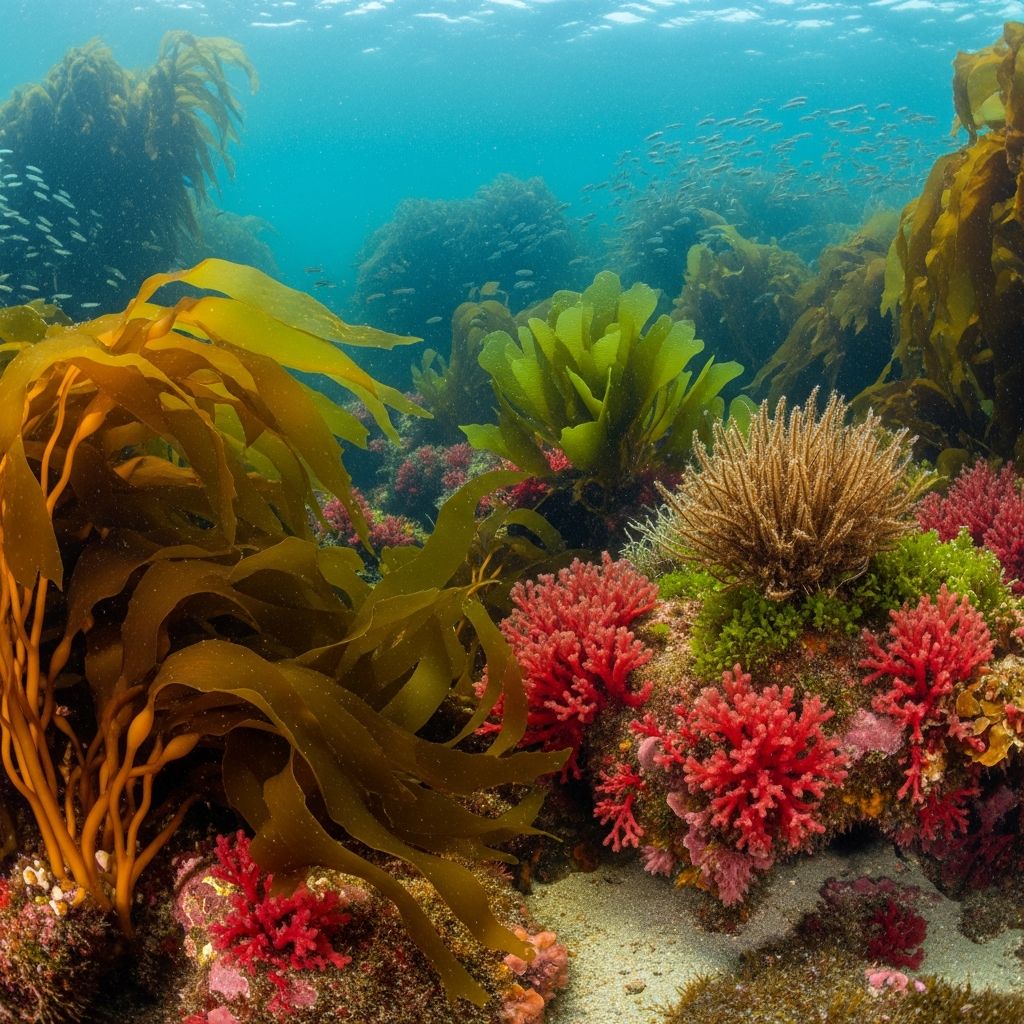
Marine algae form the foundation of aquatic life, thriving in sunlit waters from shallow coasts to deep reefs. These photosynthetic organisms, often called seaweeds, belong to three primary groups: green, red, and brown algae. Each group plays distinct roles in food webs, habitat creation, and even commercial industries like food and medicine.
Foundational Role in Marine Ecosystems
Ocean algae produce much of the world’s oxygen and serve as primary producers, converting sunlight into energy that supports countless species. They stabilize sediments, provide shelter for juvenile fish, and contribute to carbon sequestration. In coral reefs, algae compete with corals for space while forming symbiotic relationships. Their diversity spans thousands of species, adapted to varying light, temperature, and salinity conditions.
Understanding these algae helps explain ocean health. Shifts in algal populations signal environmental changes, such as warming waters or pollution. Conservation efforts, like those at national marine sanctuaries, monitor species lists to track biodiversity.
Green Algae: Chlorophyll-Rich Pioneers
Green algae, or Chlorophyta, resemble land plants due to their dominant chlorophyll pigments, giving them vibrant hues. They inhabit intertidal zones to subtidal depths, often in warm, shallow waters. These algae range from simple filaments to complex, leaf-like forms.
Common examples include Caulerpa species, known for grape-like clusters or flat blades. Caulerpa racemosa var. macrophysa, or green grape alga, forms spherical branches ideal for herbivore grazing. Valonia species, like elongated sea pearls, create bubble-like structures filled with sap, reaching several centimeters in diameter.
- Caulerpa peltata: Shield-shaped fronds attach to rocks, thriving in coral caps up to 40 meters deep.
- Stypopodium zonale: Leafy flat-blade alga with zoning patterns, common in tropical reefs.
- Neomeris annulata: Spindleweed with fuzzy tips, adding texture to benthic communities.
- Enteromorpha intestinalis: Green string lettuce, hollow tubes that float via oxygen bubbles from photosynthesis.
Green algae like Halimeda stand out for calcifying segments, incorporating calcium carbonate for rigidity. This adaptation protects against herbivores and aids in reef building. Halimeda’s intense green contrasts reef palettes, widespread from the Indian Ocean to the Caribbean.
In aquariums, Chaetomorpha and Ulva serve as refugium plants, absorbing nitrates. However, some green turf algae, with wiry blades and mat-like roots, become nuisance species in imbalanced systems.
Red Algae: Pigmented Powerhouses of the Deep
Red algae, Rhodophyta, boast over 7,000 species, distinguished by phycoerythrins and phycocyanins that mask chlorophyll. Colors span pink to deep purple, enabling photosynthesis in low-light depths up to 200 meters.
They dominate intertidal to subtidal zones, forming bushy fronds or crustose layers. Crustose coralline algae encrust rocks with calcium carbonate shells, resembling pink paint spills. These perennials resist grazing and range from Alaska to Mexico, living years with smooth or knobby surfaces.
Articulated corallines branch with jointed segments, common in shallower waters. Nori (Pyropia species) grows annually on North America’s west coast, while Mastocarpus papillatus, or grapestone, textures mid-intertidal rocks.
| Red Alga Type | Habitat | Key Features |
|---|---|---|
| Crustose Coralline | Intertidal to 100 ft | Hard, calcified; pink-purple; grazing resistant |
| Articulated Coralline | Shallow subtidal | Branching, segmented; erect growth |
| Pyropia (Nori) | West Coast, intertidal | Annual; edible; Bering to California |
| Mastocarpus papillatus | Mid-high intertidal | Perennial; rock-attached; Turkish washcloth texture |
Red algae support fisheries; carrageenan from species like Kappaphycus extracts for thickeners. Invasive reds, such as Gracilaria salicornia in Hawaii, disrupt natives by rapid overgrowth.
Brown Algae: Giants of Coastal Forests
Brown algae, Phaeophyceae, feature fucoxanthin pigment yielding olive-to-brown tones. They form massive kelp forests in cool, nutrient-rich waters, absent in tropics.
Kombu (Laminaria setchellii) anchors low intertidal to subtidal rocks, its broad blades waving in currents. Leathesia difformis, sea cauliflower, forms lobed, sack-like clumps of filaments that dissolve under pressure.
- Annual vs. Perennial: Nori renews yearly; kelps like Laminaria persist through seasons.
- Habitat Adaptations: Holdfasts grip substrates; gas bladders buoy fronds for light access.
- Ecological Impact: Forests shelter fish, urchins, and abalone; waves dissipate energy, protecting shores.
Brown algae dominate temperate coasts. UK’s wracks—bladderwrack, serrated wrack—fringe shores, sensitive to temperature rises. In California, kelp beds sustain commercial harvests.
Algae in Coral Reef Dynamics
Reefs host all three groups. Green Halimeda and Caulerpa carpet sands; red corallines cement skeletons; browns rare but filamentous types appear.
Balance is key: algae overgrow bleached corals, phase shifts turning reefs coral-free. Corallines induce larval settlement, vital for recovery. Flower Garden Banks lists dozens, from Sphacelaria to Microdictyon, in 0-40m depths. Caribbean species like mermaid’s fan (red) and bristle ball brush (green) add diversity.
Human Uses and Challenges
Algae fuel economies: nori in sushi, kombu in soups, alginates in ice cream. Pharmaceuticals derive anticoagulants from reds. Aquarists cultivate Chaetomorpha for nutrient export.
Threats include invasives like Hypnea musciformis smothering Hawaiian reefs. Nuisance greens like Bryopsis form hair-like mats, combated by urchins or crabs. Climate change favors turf algae over kelp.
Frequently Asked Questions
What distinguishes red algae from green and brown types?
Red algae use accessory pigments for deep-water photosynthesis, often calcify, and number over 7,000 species, unlike chlorophyll-dominant greens or fucoxanthin-rich browns.
Can marine algae be harmful?
Yes, invasives like Kappaphycus outcompete natives; nuisance turf algae plague aquariums, but most benefit ecosystems.
How do algae contribute to oxygen production?
They photosynthesize massively, generating 50-80% of oceanic oxygen, foundational to global cycles.
Are all brown algae kelps?
No, kelps are large browns like Laminaria; smaller ones like sea cauliflower differ in form and habitat.
What roles do coralline algae play in reefs?
They encrust and branch, binding structures, resisting herbivores, and signaling larval corals to settle.
References
- Flower Garden Banks National Marine Sanctuary Algae Species List — NOAA. Accessed 2026. https://flowergarden.noaa.gov/about/algaelist.html
- Kelp and Other Marine Algae — California Department of Fish and Wildlife. Accessed 2026. https://wildlife.ca.gov/Conservation/Marine/Kelp
- Marine Plants and Algae List — Puget Sound Estuarium. Accessed 2026. https://pugetsoundestuarium.org/marine-plants-list/
- Exploring Marine Algae on Coral Reefs and Beyond — TFH Magazine. Accessed 2026. https://www.tfhmagazine.com/articles/saltwater/exploring-marine-algae-on-coral-reefs-and-beyond
- Nuisance Algae ID Guide — Reef Cleaners. Accessed 2026. https://www.reefcleaners.org/nuisance-algae-id-guide

Medha Deb is an editor with a master's degree in Applied Linguistics from the University of Hyderabad. She believes that her qualification has helped her develop a deep understanding of language and its application in various contexts. Medha specializes in the areas of beauty, health, sports, and wellness and is committed to ensuring that the content on the website is…