
Samuel Langhorne Clemens, better known by his pen name Mark Twain, is celebrated worldwide for his timeless novels like Adventures of Huckleberry Finn and The Adventures of Tom Sawyer. Yet, beneath the surface of this literary icon lay a sharp inventive mind that produced three distinct patents addressing common frustrations of daily life. These creations reveal Twain’s practical problem-solving skills, born from personal annoyances and a fascination with technology. Far from mere hobbies, his inventions intersected with commercial success and enduring influence on modern products.
The Spark of Invention: Twain’s Early Fascination with Gadgets
Twain’s interest in innovation stemmed from his era’s rapid technological advancements. An early adopter of the typewriter—he reportedly wrote the first book produced on one—he befriended inventor Nikola Tesla and frequented his laboratory. This environment fueled Twain’s curiosity, leading him to file his first patent application in 1871. His inventions were not abstract theories but responses to tangible irritations, blending humor, utility, and simplicity.
Unlike his failed investments in complex machines like the Paige Compositor, which bankrupted him, Twain’s personal patents succeeded by targeting niche needs. They demonstrate how observation of everyday flaws could yield practical solutions, a mindset reflective of his satirical eye for human folly.
First Patent: Revolutionizing Garment Fastening
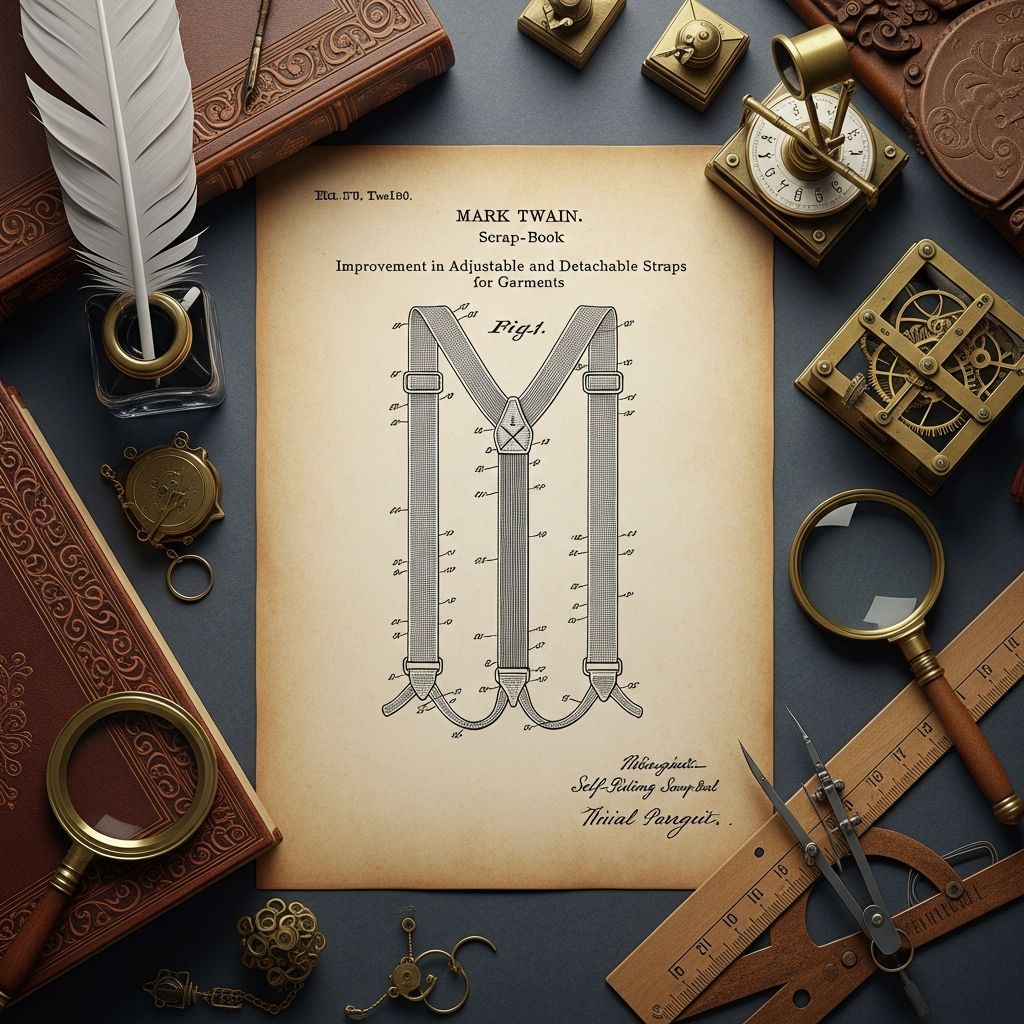
Twain’s debut invention addressed a personal pet peeve: suspenders. He despised their bulkiness and unreliability, inspired by a 1870 encounter with newspaper magnate Horace Greeley, whose trousers sagged awkwardly. Over breakfast with his brother Orion on August 13, 1870, Twain sketched three diagrams: one for vest cinching, another replacing suspenders for pants, and a third for women’s stays or corsets.
Filed under his real name Samuel L. Clemens, U.S. Patent No. 121,992 (granted December 19, 1871) described an “improvement in adjustable and detachable straps for garments.” This elastic strap featured buttonholes at both ends, allowing users to attach, adjust, or remove it easily. Twain emphasized its elasticity for comfort, noting non-elastic versions were possible but inferior.
The patent overcame legal challenges from competitors Alexander & Mason, who claimed prior invention. Despite this, Twain prevailed, and his design found applications beyond pants. The U.S. Patent and Trademark Office notes its use in shirts, underpants, and corsets. Most enduringly, it evolved into the elastic hook clasp ubiquitous in modern bras—a testament to its versatility.
Key Features of Twain’s Garment Strap Patent
| Feature | Description | Applications |
|---|---|---|
| Elastic Material | Preferred for flexibility and comfort | Pants, shirts, corsets |
| Buttonhole Ends | Detachable and adjustable length | Vests, underpants |
| Simple Design | No complex mechanisms; easy to produce | Everyday garments |
Though not a massive commercial hit, this patent showcased Twain’s knack for elegant fixes. Newspapers quipped at the time: “Is it one of Mark’s jokes?”—highlighting public surprise at the humorist’s seriousness.
Second Patent: The Self-Pasting Scrapbook Phenomenon
Twain’s second invention tackled a hobbyist’s headache: scrapbooking. An avid collector of clippings, he grew frustrated with glue pots, brushes, and slipping paper. His solution? A scrapbook with pages pre-coated in dried adhesive, activated by moistening. Granted U.S. Patent No. 140,245 on June 24, 1873, this “improvement in scrap-books” revolutionized the pastime.
The design offered two adhesive systems: full-page coating or targeted strips. Users simply dampened the surface, pressed clippings, and watched them adhere permanently—no mess, no fuss. Twain marketed it aggressively, selling over 25,000 copies through retailers like Macy’s. Astonishingly, this blank-paged “book” out-earned his novels, becoming his most profitable literary product.
- Commercial Success: Generated steady royalties; Twain boasted it as his best-seller.
- Innovation Edge: Prefigured modern self-seal envelopes and sticky notes.
- Personal Touch: Born from Twain’s own note-taking habits during travels and writing.
Critics note Twain’s quip: “It is a troublesome thing for a lazy man to take notes.” This invention embodied his lazy genius—streamlining effort while amplifying output. Its legacy persists in adhesive-backed planners and journals today.
Third Patent: Gamifying History Education
Twain’s final patent, U.S. No. 324,535 (granted August 18, 1885), was the “Memory-Builder,” a board game for memorizing historical dates. Frustrated by his children’s struggles with British monarch timelines—”all dates looked alike and wouldn’t stick”—Twain devised a visual aid. A 50-foot “roadway” represented 800+ years of history, with stakes marking kings’ names and dates at one-foot intervals (each foot equaling a year).
Players advanced along the path, answering trivia to “conquer” eras. Prototypes sent to toy stores in 1891 garnered little interest, preventing mass production. Yet, its educational intent highlighted Twain’s belief in playful learning, predating modern gamified apps.
This invention reflected Twain’s family life and pedagogical insights. Summer vacations turned into interactive lessons, blending fun with facts—a far cry from rote memorization.
Legacy and Commercial Impact of Twain’s Inventions
Twain’s patents collectively earned modest fortunes, with the scrapbook shining brightest. They contrasted his typesetting debacle, where over $8 million (in today’s dollars) vanished on a flawed machine outpaced by Linotype. Success lay in simplicity: his devices solved real problems without over-engineering.
Culturally, the garment strap’s bra clasp endures in billions of garments annually. The scrapbook influenced office supplies, while the game foreshadowed edutainment. Twain’s inventive pursuits humanize him—not just a storyteller, but a tinkerer whose whims shaped daily conveniences.
Twain’s Inventive Process: From Idea to Patent
Twain’s method was iterative and anecdote-driven. Ideas struck during routines—like dressing or family time—followed by sketches and rapid prototyping. He navigated USPTO hurdles with persistence, as seen in the strap patent battle. His letters, preserved in patent files, reveal excitement: “An elastic strap suggested itself & I got up satisfied”.
This hands-on approach mirrored his writing: observe, exaggerate flaws, innovate humorously. Though only three patents, they underscore his polymath nature amid 19th-century innovation booms.
Frequently Asked Questions (FAQs)
What inspired Mark Twain’s first invention?
His hatred of suspenders, amplified by seeing Horace Greeley’s ill-fitting trousers in 1870.
Which of Twain’s inventions was most profitable?
The self-pasting scrapbook, selling over 25,000 units and outpacing his novels.
Did Twain’s garment strap influence modern clothing?
Yes, it evolved into the elastic clasp in bras and similar garments.
Why didn’t the Memory-Builder game succeed commercially?
Limited interest from toy stores despite prototypes in 1891.
How many patents did Mark Twain receive?
Three: garment straps (1871), scrapbook (1873), and history game (1885).
Conclusion: Twain as Inventor and Visionary
Mark Twain’s patents illuminate a multifaceted genius, extending his legacy beyond literature. They remind us that great minds solve problems wherever they arise—be it sagging pants, sticky clippings, or forgettable dates. In an age of invention, Twain’s contributions, though humble, prove enduringly practical.
References
- How Mark Twain’s Hatred of Suspenders Drove Him to Invent — Smithsonian Magazine. 2017-03-09. https://www.smithsonianmag.com/smart-news/how-mark-twains-hatred-suspenders-drove-him-invent-180967577/
- Unswerving irregularity – USPTO — U.S. Patent and Trademark Office. n.d. https://www.uspto.gov/learning-and-resources/journeys-innovation/mark-twain
- Mark Twain’s Patented Inventions for Bra Straps and Other Everyday Items — Open Culture. 2015-11-17. https://www.openculture.com/2015/11/mark-twains-patented-inventions-for-bra-straps-and-other-everyday-items.html
- Patent files hold Mark Twain letter — TwainQuotes.com. 1939-03-12. http://www.twainquotes.com/19390312.html
- Mark Twain — Wikipedia (informational). n.d. https://en.wikipedia.org/wiki/Mark_Twain
- Mark Twain’s Patented Scrapbook — Jillian Hess Substack. n.d. https://jillianhess.substack.com/p/mark-twains-patented-scrapbook

Medha Deb is an editor with a master's degree in Applied Linguistics from the University of Hyderabad. She believes that her qualification has helped her develop a deep understanding of language and its application in various contexts. Medha specializes in the areas of beauty, health, sports, and wellness and is committed to ensuring that the content on the website is…