
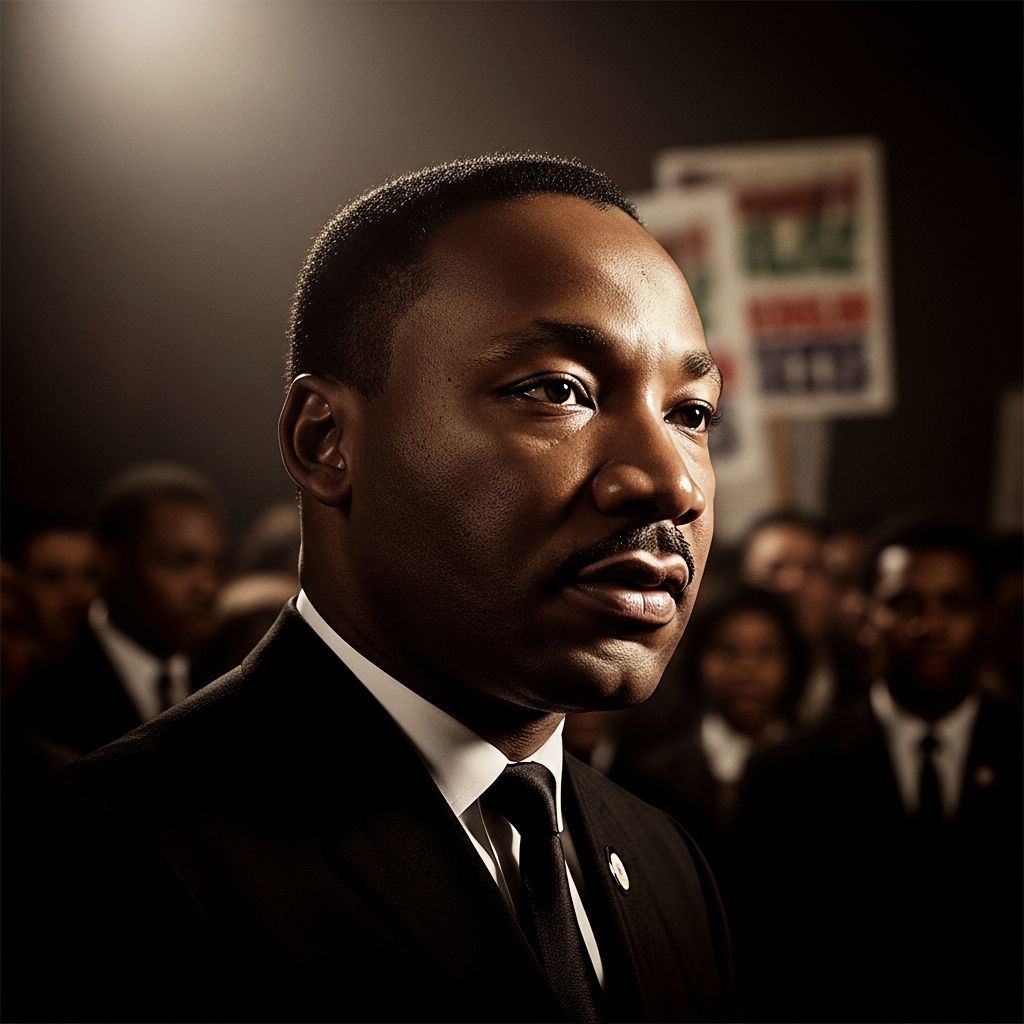
Martin Luther King Jr. is often remembered as a soaring orator and a historic civil rights leader, but beneath the speeches and marches stood a profoundly principled human being guided by conscience, empathy, and moral imagination. Any attempt to understand his legacy must look not only at what he did, but at who he was and how his inner life shaped his public leadership.
This article explores King’s values, his approach to nonviolent change, and the enduring lessons his life offers to anyone who feels called to challenge injustice today.
The Moral Compass Behind the Movement
King’s influence did not come solely from his titles or positions. It flowed from a deeply rooted moral vision that framed racism, poverty, and war as interconnected violations of human dignity. His leadership rested on three closely linked convictions:
- The equal worth of every person – King believed that all people share a common destiny and deserve equal legal and moral consideration.
- The power of nonviolent love – Drawing from Christian ethics and the example of Mahatma Gandhi, he saw nonviolence as both a moral duty and a practical strategy for social transformation.
- The necessity of active resistance – For King, love was not passive; it demanded organized action against unjust systems, including laws that denied basic rights.
These principles shaped every major campaign he helped lead, from the bus boycotts of the 1950s to his later efforts to confront economic inequality and militarism.
From Pulpit to Public Square: How His Convictions Became Action
King’s journey from local pastor to national and global figure shows how personal conviction can scale into collective action. His trajectory illustrates how one person, when rooted in a clear sense of purpose, can help reorient a nation’s conscience.
| Dimension | How King Embodied It | Impact on the Civil Rights Movement |
|---|---|---|
| Spiritual and moral grounding | Preached equality, love of enemy, and justice from the pulpit. | Gave the movement a moral language that resonated across racial and political lines. |
| Strategic organizing | Helped found and lead the Southern Christian Leadership Conference (SCLC). | Created a network that coordinated local activism into national campaigns. |
| Public persuasion | Used speeches, letters, and media to explain the aims of nonviolent protest. | Shifted public opinion toward civil rights reforms, influencing landmark legislation. |
| Willingness to sacrifice | Faced arrests, threats, and violence without abandoning nonviolence. | Demonstrated the credibility of the movement’s commitment to nonviolent discipline. |
Nonviolence as Courage, Not Compliance
King often emphasized that nonviolence was not the path of the timid. It required extraordinary courage to confront brutality without retaliating in kind.
- Montgomery Bus Boycott: Beginning in 1955, Black residents of Montgomery, Alabama, refused to ride segregated buses for more than a year, despite intimidation and economic hardship. Their perseverance, with King as a key leader, helped bring about a Supreme Court decision declaring bus segregation unconstitutional.
- Birmingham Campaign: In 1963, King and local leaders focused on Birmingham, then known for entrenched segregation and violent resistance to change. Television images of protesters—many of them youth—attacked by police dogs and fire hoses shocked the nation and galvanized support for civil rights legislation.
- Selma and Voting Rights: King and fellow activists helped organize marches in Alabama to protest voting discrimination, drawing attention to the violent suppression of Black voters. The resulting national outcry contributed directly to the passage of the Voting Rights Act of 1965.
In each case, nonviolence was used not to avoid conflict but to surface injustice so vividly that it could no longer be ignored.
Empathy, Imagination, and the Dream of a Different Future
King’s famous ability to articulate a “dream” of a just society rested on something deeper than rhetoric: an expansive moral imagination. He asked people to envision relationships, institutions, and policies built on fairness rather than fear.
Key elements of that vision included:
- Legal equality: Ending segregation and dismantling laws that sorted people by race in schools, public spaces, jobs, and housing.
- Political participation: Guaranteeing the right to vote, free from intimidation or discriminatory barriers.
- Economic justice: Linking civil rights to fair wages, decent housing, and the dignity of work, especially for the poor of all races.
- Global peace: Critiquing war and calling for a world in which resources were invested in human development rather than destruction.
By asking people to see beyond immediate fear and resentment, King helped move the conversation from narrow self-interest to shared humanity.
Achievements That Reshaped Law and Culture
King did not act alone, and he consistently pointed to the thousands of ordinary people whose courage made change possible. Yet his leadership was central to several milestones that transformed U.S. law and public life.
- Montgomery Bus Boycott (1955–1956)
King emerged as a prominent leader during the boycott, which ended when the U.S. Supreme Court ruled racial segregation on public buses unconstitutional. - Southern Christian Leadership Conference (SCLC) (founded 1957)
King helped establish this organization to support nonviolent campaigns across the South, strengthening the infrastructure of the civil rights movement. - Letter from Birmingham Jail (1963)
While imprisoned, King wrote a powerful defense of nonviolent protest and a critique of complacency in the face of injustice. The letter has since become a foundational text in ethics and social justice studies. - March on Washington (1963)
As one of the principal organizers and speakers, King helped lead an interracial gathering of hundreds of thousands in the nation’s capital, pressing for civil and economic rights. The event contributed to the momentum for major federal legislation. - Civil Rights Act of 1964
King’s advocacy, along with that of countless activists, helped pave the way for this landmark law, which outlawed segregation in public accommodations and banned many forms of discrimination. - Voting Rights Act of 1965
Mobilization in places like Selma, supported and publicized by King and others, led to legislation protecting the right to vote for Black citizens and other historically disenfranchised groups. - Nobel Peace Prize (1964)
King was awarded the Nobel Peace Prize for his leadership of a nonviolent struggle for civil rights, becoming, at the time, the youngest recipient of the award.[10]
These accomplishments did not eliminate racism or inequality, but they fundamentally altered the legal and moral landscape of the United States.
Inner Strength in the Face of Pressure
King’s public achievements came with intense personal costs: frequent death threats, surveillance, arrests, and physical danger to him and his family. Maintaining a commitment to nonviolence under such pressure required emotional resilience as well as moral clarity.
Several inner qualities helped sustain him:
- Courage tempered by humility – King did not claim to be flawless. He presented himself as a fellow traveler, asking people to join a cause greater than any one person.
- Ability to absorb criticism – He faced critiques from those who wanted slower change and those who favored more militant tactics. He continued to advocate nonviolence while listening seriously to the frustrations of younger activists.
- Deep sense of calling – King often spoke of feeling compelled by conscience and faith to continue, even when the risks became overwhelming.
These traits made his leadership not merely strategic, but profoundly human. His struggles and doubts did not undermine his message; they made it more relatable.
What King’s Example Offers Today’s Advocates
The injustices King confronted—racial discrimination, economic inequality, political exclusion—have not disappeared. His life offers practical and ethical insights for anyone working to address contemporary challenges.
Practical Lessons for Modern Changemakers
- Link values to strategy
King did not separate moral principles from organizational planning. Campaigns were designed to dramatize injustice in ways that aligned with nonviolent ethics and invited broad public sympathy. - Center those most affected
Movements King supported were rooted in the experiences of local communities, not imposed from outside. This grounding gave campaigns legitimacy and resilience. - Use communication as a tool of justice
King wrote, preached, and spoke with the aim of clarifying issues and inviting empathy, not merely winning arguments. - Accept that tension is often necessary
He argued that nonviolent protest deliberately creates constructive tension, forcing societies to confront issues they would otherwise avoid.
Personal Practices Inspired by King’s Life
- Reflect regularly on how your daily choices align with your stated values.
- Develop the habit of listening deeply, especially to those whose experiences differ from your own.
- Study examples of effective nonviolent campaigns to understand how moral clarity and strategic planning can reinforce each other.
- Find supportive communities that can share both the burdens and hopes of long-term advocacy.
Frequently Asked Questions (FAQs)
Q: Why is Martin Luther King Jr. considered such a pivotal figure in U.S. history?
A: King helped lead a nonviolent movement that significantly advanced civil rights, contributed to major laws like the Civil Rights Act of 1964 and the Voting Rights Act of 1965, and reshaped public understanding of justice and equality.
Q: What made King’s approach to social change distinctive?
A: He combined a deep moral and spiritual commitment to nonviolence with disciplined strategic organizing, using marches, boycotts, and public speeches to expose injustice while affirming the dignity of opponents.
Q: Did King’s work end with racial segregation laws?
A: No. In his later years, King increasingly addressed poverty and opposition to war, arguing that racism, economic exploitation, and militarism were interconnected problems that all needed to be confronted.
Q: How did King’s religious beliefs influence his leadership?
A: As a Baptist minister, King drew on Christian teachings about love, justice, and forgiveness. He believed that all people are part of a single human family, which underpinned his insistence on nonviolence and reconciliation.
Q: What can individuals do today to honor King’s legacy in practical ways?
A: People can honor his legacy by learning about the history of civil rights, supporting efforts to protect voting rights, participating in peaceful advocacy for fair policies, and practicing everyday acts of empathy and inclusion in their own communities.
References
- Martin Luther King, Jr. — NAACP. 2024-01-05. https://naacp.org/find-resources/history-explained/civil-rights-leaders/martin-luther-king-jr
- Martin Luther King, Jr. — The King Center. 2024-01-10. https://thekingcenter.org/about-tkc/martin-luther-king-jr/
- Martin Luther King, Jr.’s Achievements — Encyclopædia Britannica. 2023-08-15. https://www.britannica.com/summary/Martin-Luther-King-Jr-s-Achievements
- Honoring Martin Luther King Jr.’s Legacy of Global Justice and Peace — Northeastern University. 2022-01-18. https://cssh.northeastern.edu/honoring-martin-luther-king-jr-s-legacy-of-global-justice-and-peace/
- Dr. King’s Legacy — National Civil Rights Museum. 2021-01-15. https://civilrightsmuseum.org/learn/dr-kings-legacy/
- Martin Luther King, Jr. Day: Remembering the civil rights leader — Joint Base Andrews (U.S. Air Force). 2022-01-13. https://www.jba.af.mil/News/Article-Display/Article/2900940/martin-luther-king-jr-day-remembering-the-civil-rights-leader/
- MLK Milestones — Seattle Colleges. 2020-01-20. https://www.seattlecolleges.edu/mlk/mlk-milestones

Medha Deb is an editor with a master's degree in Applied Linguistics from the University of Hyderabad. She believes that her qualification has helped her develop a deep understanding of language and its application in various contexts. Medha specializes in the areas of beauty, health, sports, and wellness and is committed to ensuring that the content on the website is…