
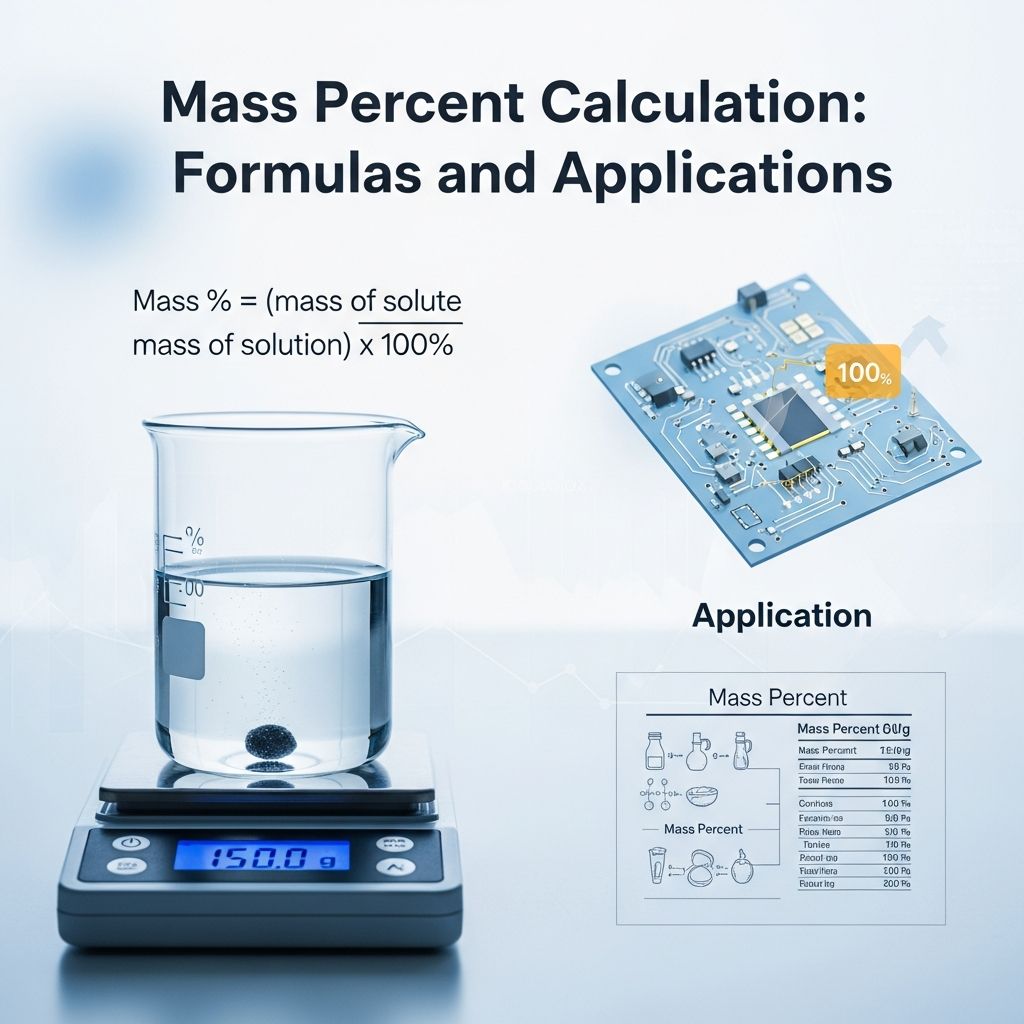
Understanding Mass Percent in Chemistry
Mass percent is a fundamental concept in chemistry that represents the proportion of a specific component within a mixture or compound, expressed as a percentage of the total mass. This measurement is essential for understanding solution composition, determining chemical purity, and conducting laboratory work with precision. Whether you are working with solutions in a chemistry lab or analyzing the elemental composition of compounds, understanding how to calculate mass percent is critical for accurate results and proper chemical analysis.
The concept of mass percent, also known as weight percent, provides a standardized way to express how much of a particular substance is present in a larger system. Unlike volume-based measurements, which can vary with temperature and pressure, mass-based calculations offer consistency and reliability across different conditions. This makes mass percent an invaluable tool for chemists, researchers, and students alike.
The Fundamental Formula for Mass Percent
The basic equation for calculating mass percent is straightforward and forms the foundation for all mass percent calculations in chemistry. The formula expresses the relationship between the component of interest and the total system:
Mass Percent = (Mass of Component / Total Mass of System) × 100%
This formula applies to various scenarios in chemistry. When working with solutions, the component typically refers to the solute (the dissolved substance), while the total mass represents the combined mass of the solute and solvent. When analyzing chemical compounds, the formula helps determine what percentage of the compound’s total mass comes from each individual element.
The multiplication by 100% converts the decimal ratio into a percentage format, making the results easier to interpret and communicate. Without this conversion factor, the result would be expressed as a decimal between 0 and 1, which is less intuitive for most applications.
Calculating Mass Percent for Solutions
Solutions represent one of the most common applications for mass percent calculations in laboratory settings and industrial processes. A solution consists of a solute (the substance being dissolved) and a solvent (typically the liquid medium in which dissolution occurs). Understanding the composition of a solution through mass percent helps chemists prepare solutions of specific concentrations and verify the purity of chemical mixtures.
Step-by-Step Process for Solutions:
- Determine the mass of the solute in grams
- Measure or calculate the total mass of the solution (solute + solvent)
- Divide the solute mass by the total solution mass
- Multiply the result by 100 to convert to percentage form
For example, if you dissolve 25 grams of salt in 175 grams of water, the total solution mass is 200 grams. The mass percent of salt would be calculated as (25 / 200) × 100 = 12.5%. This means the solution contains 12.5% salt by mass, with the remaining 87.5% being water.
One important consideration when working with solutions is understanding what constitutes the “total mass.” The total mass must include both the solute and the solvent, not just the solvent alone. This distinction is critical for accurate calculations and is a common source of error for those beginning to study chemistry.
Determining Percent Composition of Chemical Compounds
Beyond solutions, mass percent calculations also apply to pure chemical compounds, where the goal is to determine what percentage of the compound’s mass comes from each individual element. This calculation requires knowledge of atomic masses and the ability to interpret chemical formulas.
Method Overview:
- Identify the atomic mass of each element in the compound
- Multiply each atomic mass by the subscript number from the chemical formula
- Add all these products to obtain the molar mass of the compound
- For each element, divide its total mass by the molar mass and multiply by 100%
Consider dichlorine heptoxide (Cl₂O₇) as an example. Chlorine has an atomic mass of approximately 35.45 g/mol, and oxygen has an atomic mass of approximately 16.00 g/mol. The mass of chlorine in one mole is 2 × 35.45 = 70.90 grams, and the mass of oxygen is 7 × 16.00 = 112.00 grams. The total molar mass is 182.90 g/mol. Therefore, the chlorine mass percent is (70.90 / 182.90) × 100% = 38.76%, and the oxygen mass percent is (112.00 / 182.90) × 100% = 61.24%.
Working with Atomic and Molar Masses
Accurate calculations depend heavily on using correct atomic masses for each element. The periodic table provides these values, typically expressed in atomic mass units (amu) or grams per mole (g/mol). When calculating percent composition of compounds, molar masses are used because they represent the mass of one mole of the compound.
The periodic table is the reference resource for atomic masses. For common elements, these values are standardized and readily available. When solving problems, it is important to use consistent units and to maintain appropriate significant figures throughout the calculation process. The final answer should reflect the precision of the data provided in the problem.
When elements appear multiple times in a chemical formula (indicated by subscripts), you must multiply the atomic mass by the subscript before adding it to the total. Overlooking this step is a frequent source of calculation errors among chemistry students.
Practical Applications in Laboratory Settings
Mass percent calculations are not merely theoretical exercises but practical tools used regularly in chemistry laboratories and industrial settings. Pharmaceutical companies use mass percent to ensure that active ingredients in medications are present in the correct proportions. Food scientists apply these calculations to verify nutritional content and ingredient composition. Environmental chemists use mass percent to analyze contaminant levels in water and soil samples.
In quality control applications, mass percent helps verify that manufactured products meet specified standards. When preparing a solution of a specific concentration, chemists calculate the required mass of solute needed based on the desired mass percent and the total mass of solution to be prepared. This ensures consistency across batches and maintains product quality.
Research laboratories frequently rely on mass percent calculations when working with analytical techniques such as gravimetric analysis, where substances are quantified by measuring mass. Understanding these calculations allows scientists to interpret experimental results accurately and to make reliable conclusions about sample composition.
Common Scenarios and Variations
Different laboratory situations may require variations on the basic mass percent formula. When information is rearranged algebraically, the formula can solve for different unknowns:
- Finding solute mass: Mass of Solute = (Mass Percent / 100%) × Total Mass of Solution
- Finding solvent mass: Mass of Solvent = Total Mass – Mass of Solute
- Finding total solution mass: Total Mass = (Mass of Solute / Mass Percent) × 100%
These rearrangements allow chemists to solve for any unknown variable provided that sufficient information is available. For instance, if a chemist needs to prepare a 4.5% solution and knows the desired total mass of solution is 175 grams, they can calculate the required mass of solute as (4.5 / 100) × 175 = 7.875 grams. This type of calculation is performed routinely when preparing solutions in laboratory environments.
Multi-Component Systems and Complex Mixtures
When dealing with systems containing more than two components, mass percent calculations extend naturally. Each component’s mass percent is calculated individually using the same formula, dividing each component’s mass by the total system mass. An important property of mass percent is that all components in a pure system must sum to exactly 100%.
This property serves as a useful check on calculations. If your calculated mass percentages do not sum to 100% (within rounding error), this indicates an error in your calculations that should be investigated. For binary systems (two components), if one component is 35%, the other must be 65%. For multicomponent systems, each percentage represents a portion of the whole.
Complex mixtures in industrial processes often contain numerous components. Calculating the mass percent of each allows for precise control and optimization of chemical processes. Environmental monitoring requires mass percent calculations to track pollutant concentrations in air, water, and soil samples.
Distinguishing Between Mass Percent and Other Concentration Units
Chemistry employs various methods for expressing concentration, and understanding the differences is important for accurate work. Mass percent (also called weight/weight or w/w percentage) differs from molarity, molality, parts per million, and volume-based percentages. Mass percent specifically compares mass to total mass, making it dimensionless and temperature-independent.
Volume-based measurements, such as volume percent (v/v) or mass/volume percent (w/v), can change with temperature because liquids expand and contract with thermal changes. Mass percent avoids this complication entirely, making it more reliable for precise scientific work. When preparing solutions in a laboratory, mass percent provides greater accuracy than volumetric methods, particularly when high precision is required.
Each concentration unit serves specific purposes in chemistry. Molarity is preferred for solution stoichiometry in chemical reactions because it directly relates to moles. Mass percent is preferred for solution preparation and for understanding actual composition. Choosing the appropriate concentration unit for a given application is an important skill in chemistry.
Troubleshooting Common Calculation Errors
Students and professionals alike often encounter predictable mistakes when calculating mass percent. A frequent error involves forgetting to include all components in the total mass when working with solutions. Remember that the total mass must encompass the solute plus the solvent, not just the solvent alone.
Another common mistake occurs when working with chemical formulas. Failing to multiply atomic masses by subscripts produces incorrect molar masses and subsequently incorrect percent compositions. When an element appears multiple times in a formula, its atomic mass must be multiplied by the number of atoms present.
Rounding errors can accumulate through multiple calculation steps. To minimize this effect, carry additional significant figures through intermediate calculations and round only the final answer. Additionally, ensure that percentage results for all components in a system sum to approximately 100%, accounting for rounding differences.
Tools and Resources for Mass Percent Calculations
While hand calculations develop important conceptual understanding, digital tools can verify results and expedite calculations for complex problems. Online calculators designed for mass percent computations can handle multiple components simultaneously and often provide verification features. Many chemistry software packages include built-in mass percent calculators that use stored atomic mass values.
A reliable periodic table remains an essential resource, whether in printed or digital form. Online periodic tables often provide additional information such as electron configurations and isotopic abundances. Educational websites and textbooks provide practice problems with solutions, allowing students to develop proficiency with these calculations.
Frequently Asked Questions
Q: Why is mass percent preferred over volume percent in many chemistry applications?
A: Mass percent is independent of temperature, whereas volume changes with temperature. This makes mass percent more reliable and accurate for precise laboratory work and ensures consistent results across different conditions.
Q: Can mass percent values exceed 100%?
A: No. In a pure system, the sum of all component mass percentages must equal 100%. Individual components cannot exceed this value when properly calculated.
Q: How do I verify my mass percent calculations are correct?
A: For multicomponent systems, add all calculated mass percentages together. They should sum to 100% (or very close, accounting for rounding). If they do not, recalculate to find the error.
Q: What should I do if my calculated mass percent doesn’t match expected values?
A: Check that you have used the correct atomic masses, multiplied by all subscripts in the formula, and included all components in the total mass. Verify your arithmetic and ensure proper significant figures.
Q: Are there differences in calculating mass percent for ionic compounds versus molecular compounds?
A: The calculation method is identical regardless of compound type. Gather atomic masses, multiply by subscripts, sum to find molar mass, then calculate each element’s percentage using the standard formula.
References
- Mass Percent Composition from a Chemical Formula — LibreTexts Chemistry. 2024. https://chem.libretexts.org/Bookshelves/Introductory_Chemistry/Introductory_Chemistry_(LibreTexts)/06:_Chemical_Composition/6.07:_Mass_Percent_Composition_from_a_Chemical_Formula
- Mass Percent Formula — BYJU’S. 2024. https://byjus.com/mass-percent-formula/
- How to Find Mass Percent from Chemical Formulae — Study.com. 2024. https://study.com/skill/learn/how-to-find-mass-percent-from-chemical-formulae-explanation.html
- Worked example: Calculating mass percent — Khan Academy. 2024. https://www.khanacademy.org/science/hs-chemistry/x2613d8165d88df5e:stoichiometry-and-the-mole/x2613d8165d88df5e:mole-calculations/v/worked-example-calculating-mass-percent
- Mass Percent Calculator — AAT Bioquest. 2024. https://www.aatbio.com/tools/solve-equation-calculator/mass-percent

- Integrated M.A. in Applied Linguistics, University of Hyderabad
- 5+ years in editorial, instructional, SEO, and research-based writing
Sneha is a relationships and lifestyle writer with a strong foundation in applied linguistics and certified training in relationship coaching. She brings over five years of writing experience to theskillvault, crafting thoughtful, research-driven content that empowers readers to build healthier relationships, boost emotional well-being, and embrace holistic living. Her writing and insights reflect the belief that beauty, happiness, and wellness…