
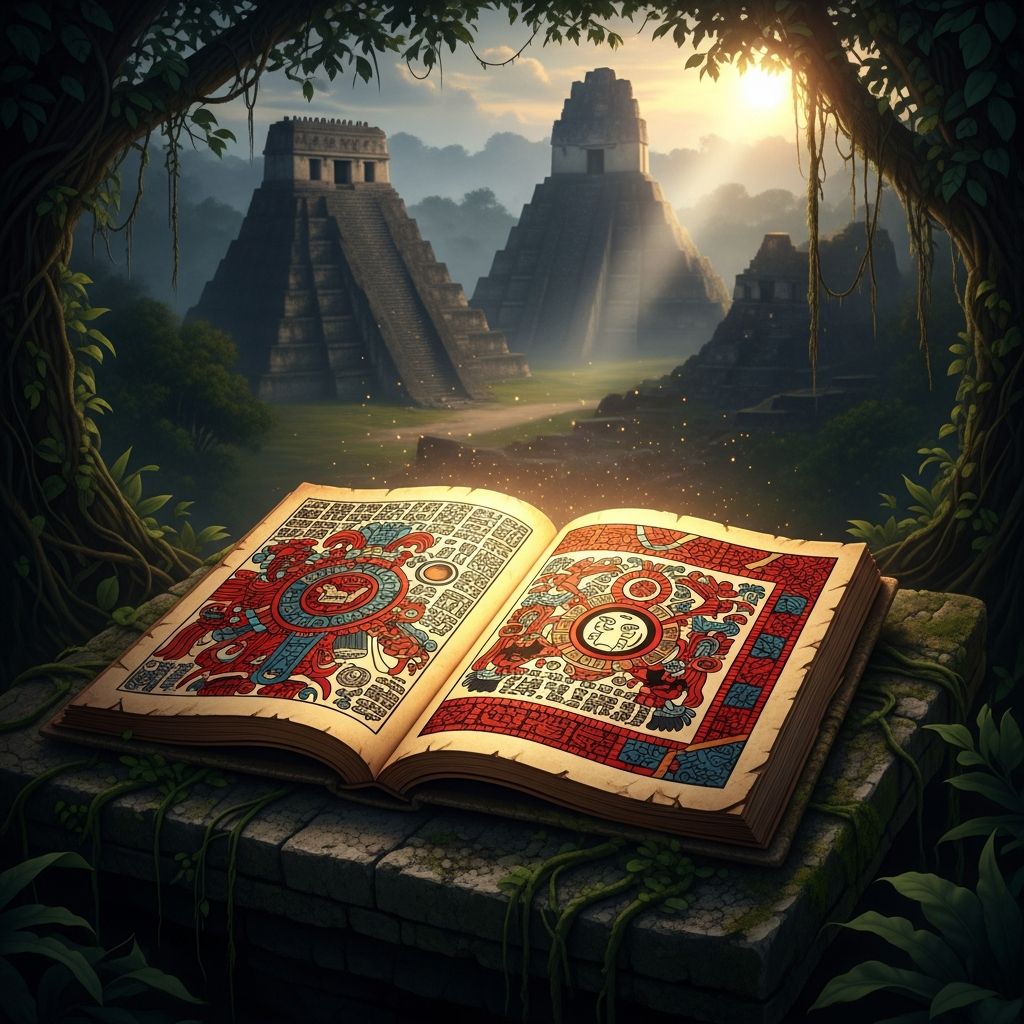
The Maya codices stand as remarkable testaments to the intellectual and spiritual achievements of the ancient Maya people. These folded-screen books, crafted from tree bark, encapsulate centuries of knowledge in hieroglyphs, intricate illustrations, and precise calculations. Despite the near-total destruction of Maya written records by Spanish colonizers, four codices endured: the Dresden, Madrid, Paris, and Grolier. They offer invaluable windows into Maya cosmology, agriculture, divination, and daily rituals.
The Essence of Maya Writing and Bookmaking
Maya codices represent a sophisticated form of pre-Columbian literature, distinct from the stone inscriptions that adorn temples and stelae. Made from the inner bark of fig trees, the pages were coated with lime to create a smooth surface for painting with mineral-based pigments. Scribes folded these screens into accordion-like books, often 10 to 20 pages long, protected by wooden covers in elite contexts.
Hieroglyphic writing in codices combined logograms and syllabic signs, enabling complex narratives far beyond simple pictograms. Unlike narrative histories, these texts focused on practical, esoteric knowledge: almanacs for rituals, astronomical tables, and divinatory guides. A single codex might involve multiple scribes, each contributing distinctive styles, as seen in the Dresden Codex with its eight identified hands.
- Bark paper production: Stripped, soaked, and beaten into thin sheets, then whitened with lime plaster.
- Pigments: Derived from plants, minerals, and shells for vibrant reds, blues, and yellows.
- Folding mechanism: Allowed compact storage and sequential reading from left to right.
This craftsmanship ensured durability in humid tropical environments, though few survived the fervent book-burnings ordered by figures like Bishop Diego de Landa in the 16th century.
Survival Amid Destruction: A Precarious Legacy
By the time Europeans arrived, the Maya had produced countless codices, but colonial zeal for conversion led to their mass destruction. Franciscan missionaries viewed them as idolatrous, torching libraries in acts of cultural erasure. Only a handful escaped, smuggled to Europe or hidden in caves.
Three codices surfaced in European libraries: Dresden (Germany, 1744 acquisition), Paris (France), and Madrid (Spain). The fourth, the Grolier Codex, emerged controversially in Mexico City in the 1960s, sparking debates over authenticity until rigorous 2016 analysis by experts including Stephen Houston confirmed its genuineness and antiquity. Today, these artifacts reside in museums, studied with modern tools like multispectral imaging to reveal faded inscriptions.
Dresden Codex: Masterpiece of Celestial Precision
Housed in Dresden’s Saxon State Library, this 11-meter-long codex is the most intact and astronomically rich. Composed around the 11th-12th centuries, it features eclipse tables, planetary positions, and ritual almanacs. Its lunar series accurately predicts eclipses worldwide, a feat achieved through meticulous observations spanning generations.
Key sections include:
- Eclipse tables: 69-year cycles for solar and lunar events, usable globally despite local observations.
- Venus and Mars tables: Tracking synodic periods for ritual timing.
- Ritual handbooks: Deities linked to days, guiding ceremonies for rain and harvest.
Agricultural imperatives drove this precision; Maya farmers relied on celestial cues for planting maize amid seasonal rains. The codex’s predictive power underscores the Maya’s empirical astronomy, intertwined with spirituality.
Madrid Codex: Rituals of Daily Life and Cosmos
Split between Madrid’s Museum of America and a private collection, this codex (ca. 1250-1450 AD) emphasizes practical rituals. It details New Year ceremonies, directional gods, and weather divination, reflecting community life.
| Section | Content Focus | Ritual Purpose |
|---|---|---|
| Apiculture | Bee gods and honey rituals | Ensuring bountiful harvests |
| Directional Deities | Gods of four cardinal points | Balancing cosmic forces |
| Calendar Rituals | Daily almanacs | Guiding daily sacrifices |
Its fragmented state reveals repairs with later paper, yet core content dates to the Late Postclassic period, highlighting ongoing scribal traditions.
Paris Codex: History, Stars, and Prophecy
The shortest at about 11 pages, the Paris Codex (ca. 1185-1450 AD) uniquely blends history with astronomy. It describes constellations, zodiac-like symbols, and catastrophic prophecies tied to calendrical endings.
- Includes rare historical notations absent in other codices.
- Depicts weather gods and seasonal rites.
- Suggests partial copying from earlier manuscripts, preserving lost knowledge.
Scholars value it for insights into Maya eschatology, where time’s cycles foretold world renewals or ends.
Grolier Codex: Venus, Authenticity, and Fundamentals
This 10-page fragment, now in Mexico’s National Museum of Anthropology, tracks Venus over 104 years. Dated to the 13th century, it’s the oldest confirmed Maya manuscript. Long doubted due to its dramatic provenance—found in a Chiapas cave and briefly owned by a collector—it was vindicated by Yale-Brown researchers analyzing pigments, paper, and style.
Venus, as a war and fertility deity, dominated its content: predetermined tables linked to gods like K’awiil (lightning) and solar figures. Stripped to essentials, it served calendar priests across generations, evading Spanish inquisitors as a sacred relic.
Astronomical Brilliance: Beyond Mere Observation
Maya codices reveal a civilization obsessed with time’s cyclical nature. They computed Venus’s 584-day cycle, lunar phases, and eclipses with error margins under a day—rivals to European astronomy.
These weren’t telescopes but naked-eye records refined over centuries, aiding agriculture in a rain-dependent society. Philosophically, time embodied deities; rituals synchronized human actions with cosmic rhythms.
Ritual and Divination: Codices as Sacred Tools
Codices functioned as priestly manuals, not public reads. Deities on each page prescribed offerings for prosperity or averting disasters. Divination linked days to outcomes, influencing war, trade, and planting.
Their non-narrative style prioritized utility: numbers and glyphs formed almanacs for the 260-day ritual calendar (Tzolk’in) intertwined with the 365-day solar year (Haab’).
Modern Decipherment and Cultural Revival
19th-century breakthroughs decoded the bar-and-dot numerals, unlocking codices. Today, digital scans and AI aid hieroglyph reading, while Maya descendants reclaim these texts in revitalized ceremonies.
Challenges persist: disputed dates, fragmented pages, and colonial biases. Yet, codices affirm Maya ingenuity, countering outdated collapse narratives.
Frequently Asked Questions (FAQs)
What materials were used to make Maya codices?
They were crafted from amate bark paper, coated in lime plaster, and painted with natural pigments for durability in tropical climates.
Why were most Maya codices destroyed?
Spanish colonizers, led by missionaries like Diego de Landa, burned them to eradicate ‘pagan’ beliefs during conversion efforts in the 16th century.
How accurate were Maya astronomical predictions?
Extremely precise; Dresden Codex eclipse tables predicted events worldwide with minimal error, based on long-term observations.
Is the Grolier Codex authentic?
Yes, confirmed by 2016 peer-reviewed studies analyzing its antiquity, style, and materials as the oldest surviving Maya book.
What do codices reveal about Maya society?
Advanced math, astronomy tied to agriculture and rituals, elite scribal traditions, and a cyclical view of time governed by deities.
References
- An ancient Maya ‘codex’ keeps predicting future events with eerie accuracy — BBC Science Focus Magazine. 2023-05-15. https://www.sciencefocus.com/planet-earth/ancient-codex-helping-unravel-biggest-mysteries-maya
- 13th century Maya codex, long shrouded in controversy, proves genuine — Brown University News. 2016-09-07. https://www.brown.edu/news/2016-09-07/mayacodex
- Mayan: Codices — Gilbert Redman, Medieval Manuscripts. Accessed 2026. https://gilbertredman.com/medievalmanuscripts/codicology/mayan-codices/
- The Maya Sense of Time — Archaeology Magazine. 2012-11-01. https://archaeology.org/issues/november-december-2012/collection/groiler-dresden-codex/the-maya-sense-of-time/
- Maya glyphs, a basic introduction — Smarthistory (Khan Academy). Accessed 2026. https://smarthistory.org/maya-glyphs-introduction/

Medha Deb is an editor with a master's degree in Applied Linguistics from the University of Hyderabad. She believes that her qualification has helped her develop a deep understanding of language and its application in various contexts. Medha specializes in the areas of beauty, health, sports, and wellness and is committed to ensuring that the content on the website is…