
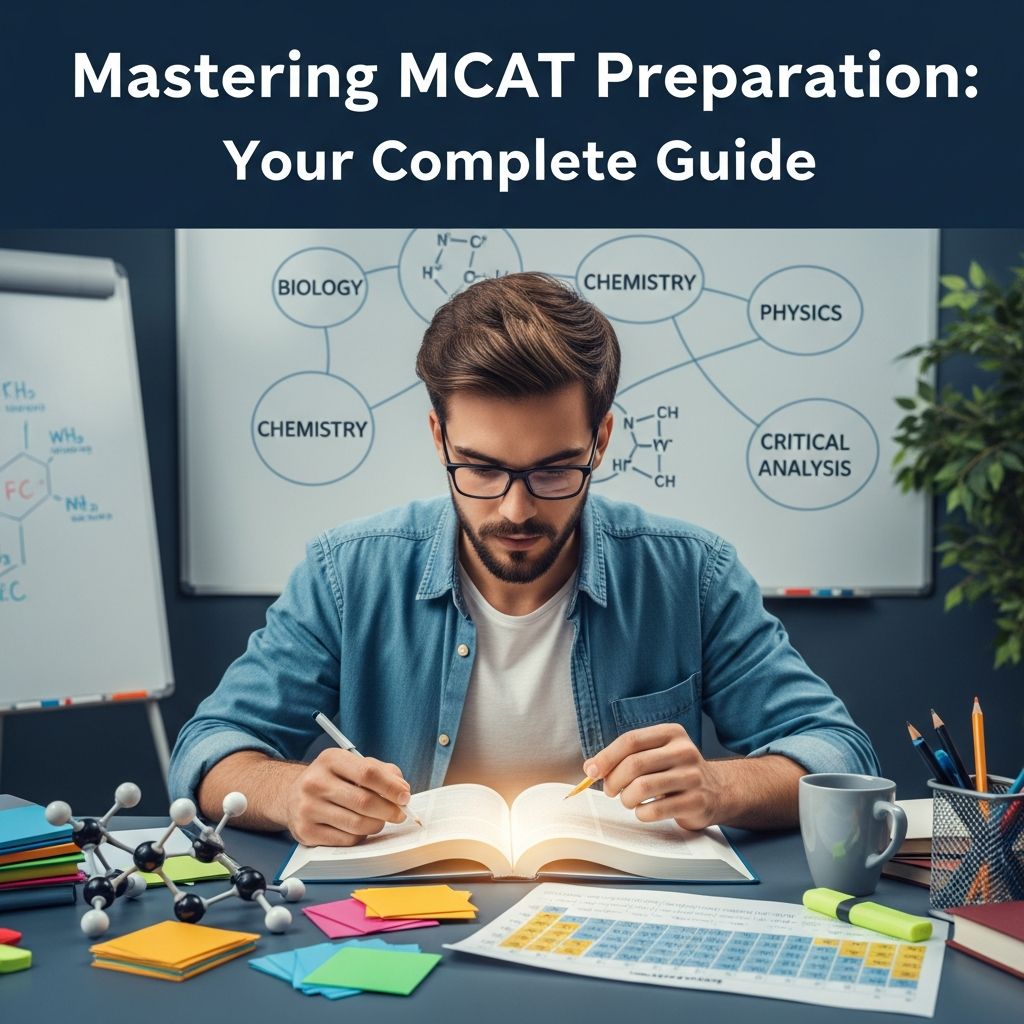
The Medical College Admission Test (MCAT) stands as a pivotal hurdle for aspiring medical students, evaluating a broad spectrum of knowledge and skills essential for medical school success. This exhaustive guide draws from authoritative sources to equip you with everything needed for effective preparation in 2026, from understanding the exam’s framework to deploying high-yield study tactics.
Understanding the MCAT Exam Structure
The MCAT is a rigorous 7.5-hour examination comprising four distinct sections, each designed to probe different competencies required in medical education. It tests not only foundational scientific principles but also critical reasoning and behavioral insights.
Delivered digitally at authorized testing centers, the exam allocates 90-95 minutes per section, interspersed with optional breaks. Total seated time exceeds nine hours, including check-in procedures, underscoring the need for stamina-building in your prep routine.
Chemical and Physical Foundations of Biological Systems (Chem/Phys)
This section integrates chemistry, physics, and biochemistry within biological contexts, featuring 59 questions: 15 standalone and 44 passage-based. Topics span atomic structure, thermodynamics, kinematics, and circuits, emphasizing quantitative analysis.
Biological and Biochemical Foundations of Biological Systems (Bio/Biochem)
Centered on cellular and molecular biology, this section mirrors Chem/Phys in format with 59 questions. Key areas include genetics, metabolism, microbiology, and anatomy, requiring integration of first-principles reasoning.
Psychological, Social, and Biological Foundations of Behavior (Psych/Soc)
Addressing behavioral sciences, this part covers psychology, sociology, and biology’s influence on behavior. With 59 questions, it demands comprehension of theories like social identity and memory systems.
Critical Analysis and Reasoning Skills (CARS)
Unique among sections, CARS assesses reading comprehension through nine humanities and social sciences passages (500-600 words each), yielding 53 questions. Success hinges on inference, evaluation, and application skills rather than memorized content.
Decoding MCAT Scoring and Percentiles
Each section receives a scaled score from 118 to 132, culminating in a total ranging 472-528. Raw performance converts to scaled scores accounting for difficulty, with national averages hovering around 500-501.
A competitive total exceeds 510, correlating with higher med school acceptance odds. Percentiles guide interpretation: a 510 equates to roughly 80th percentile, vital for top programs. Subscores reveal strengths, like balancing a lower CARS with superior sciences.
| Score Range | Percentile | Med School Competitiveness |
|---|---|---|
| 510-513 | 75-85 | Strong for mid-tier schools |
| 514-517 | 86-94 | Competitive for top programs |
| 518+ | 95+ | Elite candidacy |
This table illustrates score benchmarks based on recent data.
Building Your Personalized MCAT Study Timeline
Optimal preparation spans 3-6 months, calibrated to your baseline via a diagnostic exam. Full-time students might condense to 300 hours over 12 weeks; working professionals extend to 500 hours across 20 weeks.
- Months 1-2: Content Mastery – Solidify foundations using review texts and lectures.
- Months 3-4: Intensive Practice – Tackle thousands of questions, analyzing errors deeply.
- Final 4-6 Weeks: Simulated Exams – Complete 6-10 full-length tests under timed conditions.
Weekly structure: 20-30 hours, incorporating active recall, spaced repetition, and rest days to avert burnout.
Top-Tier Resources for Each Prep Phase
Content Review Phase
Establish bedrock knowledge with comprehensive texts. Kaplan’s MCAT Complete 7-Book Subject Review (2026-2027) offers in-depth chapter reviews, diagrams, and practice sets aligned to AAMC outlines. Princeton Review’s Subject Review Complete Box Set provides concise summaries and cheat sheets for quick reference.
Practice Phase Essentials
Transition to application with question banks. UWorld QBank delivers 3,000+ questions with textbook-level explanations, ideal for mixed-mode timed practice. AAMC Question Packs (720 questions) and Section Banks (300 high-difficulty items) mirror real exam logic precisely—indispensable for authenticity.
Full-Length Simulations
Blueprint’s 6-10 exams replicate test-day rigor for endurance training. Mometrix MCAT Secrets Study Guide includes 650+ questions, three interactive tests, and video tutorials across all sections.
Proven Strategies to Elevate Your Score
Active learning trumps passive reading. Employ Anki for flashcards on high-yield facts, focusing on weak areas identified via practice analytics.
- Dissect passages: Map main ideas, tones, and inferences before questions.
- Error journaling: Categorize mistakes (content gap, misread, logic error) and revisit weekly.
- Time management: Allocate 1.3-1.5 minutes per question; flag and return to tough ones.
For CARS, daily reading of scientific journals hones analytical speed. Simulate test day weekly in the final month, including breaks and nutrition.
Nutrition, Exercise, and Mental Resilience
Sustained performance demands holistic care. Prioritize 7-9 hours sleep, balanced macros (proteins, complex carbs, healthy fats), and hydration. Incorporate 30-minute daily cardio to boost cognition and reduce anxiety.
Mindfulness practices like meditation mitigate stress; track progress to maintain motivation. Avoid cramming—spaced repetition yields superior retention.
Test Day Protocols and What to Expect
Per AAMC Essentials for 2026, arrive 30 minutes early with ID and confirmation. No personal items allowed; lockers provided. Breaks: 10-minute optional after first two sections, 30-minute lunch, 10-minute post-CARS.
Post-exam, scores release 30-35 days later via AAMC portal. Void option exists pre-submission, but scores are final otherwise.
Frequently Asked Questions (FAQs)
How long should I study for the MCAT?
Most dedicate 3-6 months, totaling 300-500 hours based on starting score and goals.
Is the MCAT offered year-round?
Yes, from January to September, with multiple dates; register 60 days early for prime slots.
Can I retake the MCAT?
Up to three times per year, seven lifetime, but schools see all scores.
What is a good MCAT score for med school?
510+ for most; 515+ for top-tier.
Do I need to memorize every detail?
No—focus on principles and patterns; exam tests reasoning over rote facts.
Common Pitfalls and How to Sidestep Them
Avoid over-relying on one resource; diversify for comprehensive coverage. Neglecting CARS practice tanks totals—dedicate equal time. Procrastination on full-lengths leads to pacing issues; start simulations early.
Underestimating Psych/Soc is frequent; treat it as rigorously as sciences. Balance prep with self-care to prevent fatigue.
References
- MCAT Prep Books 2025-2026 – 650+ Practice Test Questions — Mometrix Test Preparation. 2025. https://store.mometrix.com/products/mcat-27162ebook
- Best MCAT Resources Ranked by Score (2026) — The Match Guy. 2026. https://thematchguy.com/mcat-resources-ranked-by-score/
- MCAT Books | Kaplan Test Prep — Kaplan. 2026. https://www.kaptest.com/mcat/mcat-books
- 2026 MCAT Study Guide — Everything You Need to Prepare — Med School Insiders. 2026. https://medschoolinsiders.com/pre-med/mcat-study-guide/
- MCAT Test Prep Book from The Princeton Review — Princeton Review. 2026. https://www.princetonreview.com/mcat-book
- The MCAT® Essentials for Testing Year 2026 — AAMC. 2025-10-01. https://students-residents.aamc.org/media/11711/download

Medha Deb is an editor with a master's degree in Applied Linguistics from the University of Hyderabad. She believes that her qualification has helped her develop a deep understanding of language and its application in various contexts. Medha specializes in the areas of beauty, health, sports, and wellness and is committed to ensuring that the content on the website is…