
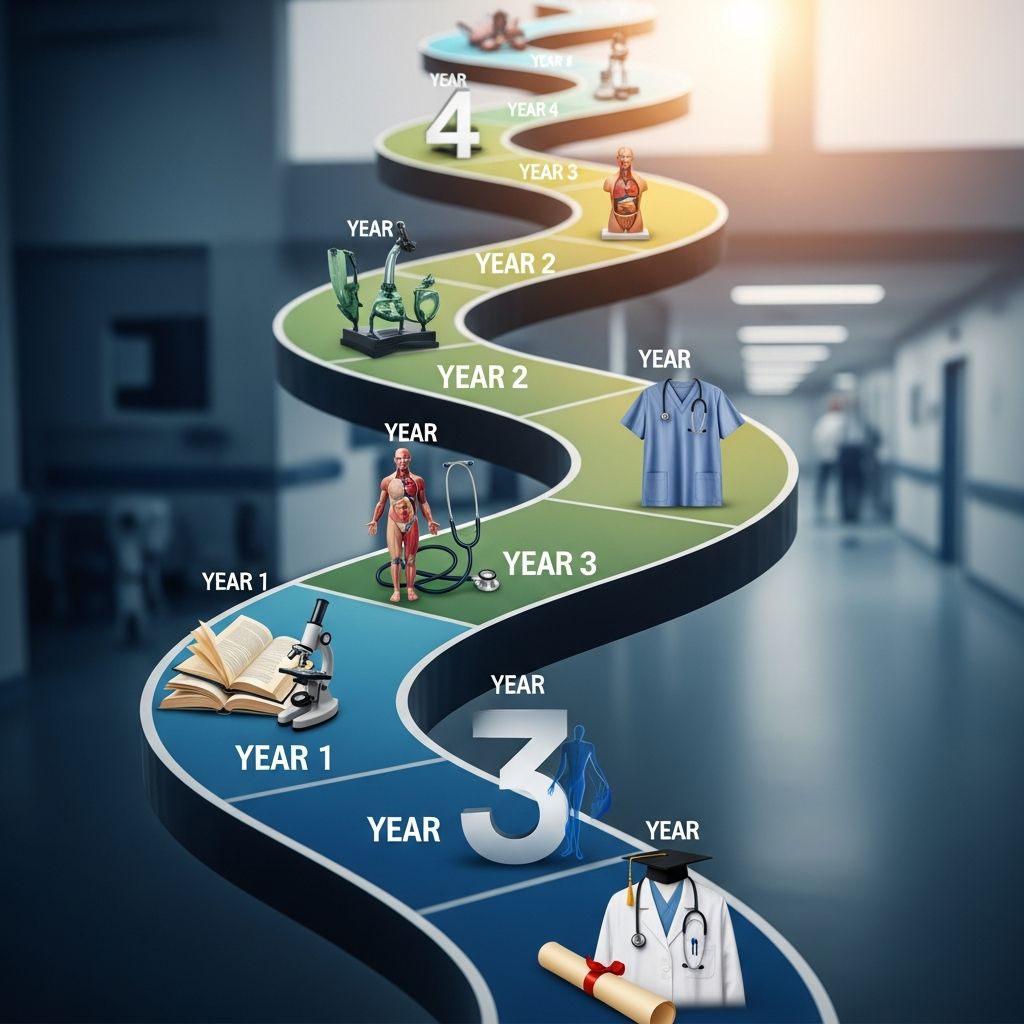
Medical school represents a transformative path filled with intense learning, hands-on patient care, and personal growth. Spanning four years, it divides into preclinical and clinical phases, demanding resilience, discipline, and passion for medicine. This guide outlines the curriculum, challenges, and milestones year by year, drawing from established educational frameworks to help aspiring and current students prepare effectively.
Foundational Preclinical Training: Years 1 and 2
The initial two years focus on building a robust scientific foundation through classroom lectures, labs, and self-directed study. Students immerse in basic sciences like anatomy, biochemistry, physiology, microbiology, pathology, and pharmacology. These courses employ systems-based or interdisciplinary models, examining how body systems interconnect.
First-year students often describe the pace as overwhelming, akin to ‘drinking from a fire hose,’ with four to five simultaneous classes plus labs in histology, embryology, and molecular biology. The goal is mastering normal human structure and function to understand disease processes later.
Second year shifts toward pathology and pathophysiology, integrating prior knowledge to diagnose complex scenarios. Clinical reasoning sharpens as students apply concepts to patient cases. Key exams include the USMLE Step 1 or COMLEX Level 1 at year’s end, testing comprehensive basic science knowledge.
- Daily Routine: Lectures from 8 AM to 5 PM, followed by 4-6 hours of review using tools like Anki flashcards or Picmonic visuals.
- Challenges: Volume of material; time management; balancing study with wellness.
- Tips: Form study groups, prioritize high-yield topics, and practice active recall.
Transition to Clinical Practice: Year 3
Third year marks the shift to clinical rotations or clerkships in hospitals and clinics. Students spend most time applying preclinical knowledge under supervision, rotating through core specialties: internal medicine, surgery, pediatrics, obstetrics-gynecology, family medicine, and psychiatry. Some programs add emergency medicine, neurology, or radiology.
Each rotation, lasting 4-12 weeks, involves pre-rounding, presenting cases, performing procedures, and interacting with diverse patients. Evaluations from residents and attendings weigh heavily, influencing residency applications. Shelf exams test specialty-specific knowledge post-rotation.
Urban hospitals expose students to trauma and infectious diseases, while community sites emphasize primary care. This year hones procedural skills, patient communication, and teamwork.
| Core Rotation | Duration (Typical) | Key Skills Developed |
|---|---|---|
| Internal Medicine | 8 weeks | History-taking, diagnostics, chronic disease management |
| Surgery | 6-8 weeks | Pre-op assessment, assisting in OR, wound care |
| Pediatrics | 6 weeks | Child exams, growth monitoring, family counseling |
| OB-GYN | 6 weeks | Deliveries, prenatal care, gynecologic procedures |
| Psychiatry | 4-6 weeks | Mental health assessments, therapy basics |
| Family Medicine | 4-6 weeks | Holistic care, preventive medicine |
By year’s end, students take USMLE Step 2 CK (clinical knowledge) and often a clinical skills exam.
Advanced Rotations and Specialization: Year 4
Fourth year emphasizes electives, sub-internships, and residency preparation. Students select rotations aligning with career interests, such as cardiology, dermatology, or research blocks. Sub-internships act as auditions for competitive residencies, demanding near-resident-level performance.
Time splits between away rotations at other institutions, interview trails, and dedicated USMLE Step 2 prep. Fewer core requirements allow flexibility, but the residency match process dominates, with applications via ERAS and interviews from September to January.
- Away Rotations: Build letters of recommendation and network.
- Electives: Explore niches like global health or research.
- Match Day: Culminates in March with residency assignments.
Essential Competencies for Medical Students
Beyond curriculum, schools expect 17 core competencies from day one, per AAMC guidelines. These span preprofessional (e.g., ethical integrity, teamwork), thinking/reasoning (critical thinking, quantitative reasoning, scientific inquiry), and science abilities (living systems, human behavior).
Critical thinking involves analyzing data for evidence-based decisions. Scientific inquiry fosters research skills, vital for innovation. Human behavior competency addresses sociocultural factors influencing health, informed by volunteer experiences.
Research participation enhances clinical reasoning, as noted by AMA experts.
Navigating Exams and Milestones
USMLE Steps 1 and 2 are pivotal. Step 1 (end of MS2) covers basic sciences; Step 2 CK (MS3/4) assesses clinical knowledge. Passing scores are residency gateways.
Shelf exams punctuate rotations; practice resources like AAFP questions aid family medicine prep.
Student Life: Balancing Demands
Expect 60-80 hour weeks, minimal sleep, and high stress. Wellness is crucial: exercise, peer support, and hobbies prevent burnout. Schools offer counseling and wellness programs.
Diversity in settings—urban vs. rural—shapes experiences. Financial aid, loans, and stipends ease burdens.
Frequently Asked Questions (FAQs)
What makes the first year the hardest?
The sheer volume of new, complex material like anatomy and biochemistry, combined with rapid lecture pace, overwhelms many students. Adaptation comes with consistent study habits.
How do rotations differ across schools?
Core clerkships are standard, but lengths, additions (e.g., radiology), and sites vary. Some integrate clinicals earlier.
Can I pursue research in med school?
Yes, electives and summer programs build skills like hypothesis testing, boosting residency apps.
What if I struggle with work-life balance?
Prioritize sleep, join student groups, and seek mentorship. Flexibility improves post-preclinical years.
How competitive is the residency match?
Highly; strong Step scores, rotations, and letters are key. MS4 focuses on tailoring applications.
Strategies for Thriving Throughout
Success hinges on organization: use planners, apps for spaced repetition, and peer accountability. Embrace failures as learning opportunities. Mentorship from upperclassmen and faculty provides guidance.
Diversify experiences through volunteering, shadowing, and leadership to round out your profile. Stay adaptable amid evolving curricula, like integrated models blending sciences with clinicals early.
Ultimately, medical school forges not just knowledge but resilience and empathy, preparing you for lifelong physicianhood.
References
- Expectations in Medical School — American Academy of Family Physicians (AAFP). 2023. https://www.aafp.org/students-residents/medical-students/begin-your-medical-education/expectations-in-med-school.html
- The 17 skills medical schools expect from students on day one — American Medical Association (AMA). 2023-10-17. https://www.ama-assn.org/medical-students/medical-school-life/17-skills-medical-schools-expect-students-day-one
- Typical Medical School Curriculum: What You’ll Learn in Each Year — Ross University School of Medicine. 2024. https://medical.rossu.edu/about/blog/typical-medical-school-curriculum
- What to Expect in Medical School — Association of American Medical Colleges (AAMC). 2024. https://students-residents.aamc.org/choosing-medical-career/what-expect-medical-school
- What to Expect as a First Year Medical Student — Picmonic. 2023. https://www.picmonic.com/pages/5-ways-thrive-your-first-year-med-school/
- What First-Year Medical School Students Should Know — American University of the Caribbean School of Medicine (AUC). 2023. https://www.aucmed.edu/blog/what-first-year-medical-school-students-should-know

- Integrated M.A. in Applied Linguistics, University of Hyderabad
- 5+ years in editorial, instructional, SEO, and research-based writing
Sneha is a relationships and lifestyle writer with a strong foundation in applied linguistics and certified training in relationship coaching. She brings over five years of writing experience to theskillvault, crafting thoughtful, research-driven content that empowers readers to build healthier relationships, boost emotional well-being, and embrace holistic living. Her writing and insights reflect the belief that beauty, happiness, and wellness…