
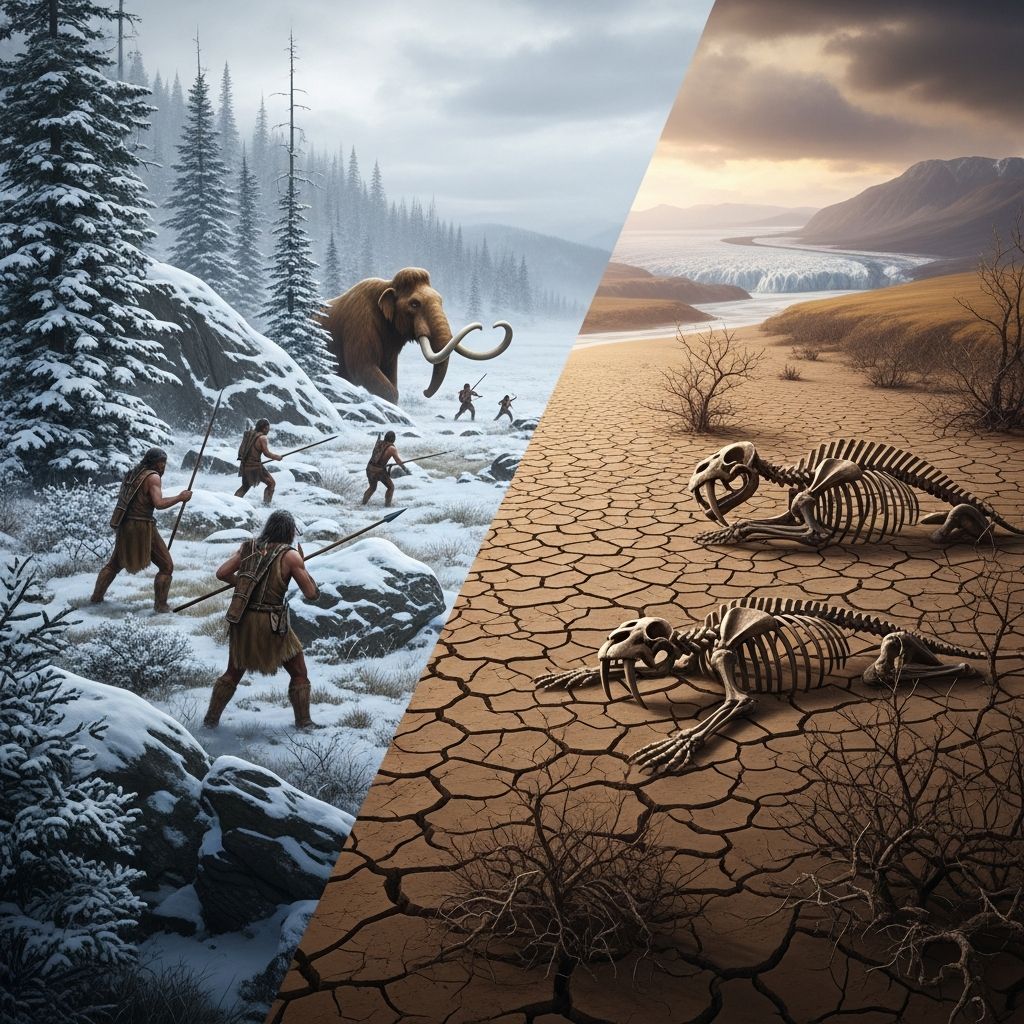
Understanding the Megafauna Extinction Event
The disappearance of Earth’s largest land animals represents one of the most significant ecological transformations in recent geological history. Between 50,000 and 5,000 years ago, the planet experienced a remarkable wave of extinctions that selectively targeted enormous creatures while leaving smaller animals largely unaffected. Scientists define megafauna as animals weighing at least 45 kilograms, and at least 161 mammal species fell victim to this extinction event. This phenomenon fundamentally reshaped terrestrial ecosystems worldwide, yet its underlying causes remain hotly contested among paleontologists and archaeologists.
The scale of this extinction event varied dramatically across continents. North America lost approximately 72 percent of all megafaunal species, while South America experienced even higher losses at 83 percent. Australia saw the most severe impact, with 88 percent of megafaunal species vanishing and all mammals exceeding 1,000 kilograms disappearing entirely. In contrast, Africa, South Asia, and Southeast Asia experienced more moderate extinction rates, reflecting regional differences in how this global process unfolded.
The Size-Selectivity Puzzle
One of the most striking characteristics of the late-Quaternary extinctions is their extreme size bias. Smaller animals remained largely unaffected while the largest species disappeared at dramatically higher rates. This pattern distinguishes these extinctions from all previous extinction events across the past 66 million years. Previous episodes of climate change, including dramatic ice ages and warming periods that dramatically altered environmental conditions, did not produce this selective targeting of megafauna.
Scientists examining historical climate fluctuations have noted a critical discrepancy. The Earth has experienced numerous periods of rapid temperature change, including Dansgaard-Oeschger warming events occurring between 56,000 and 12,000 years ago, yet none of these climatic upheavals produced the distinctive pattern of megafaunal loss observed during the late Pleistocene. This observation has led many researchers to question whether climate alone can explain the extinctions.
The Human Hunting Hypothesis
Archaeological evidence has accumulated over decades suggesting that human populations played a central role in megafaunal extinctions. Paleontologists have discovered traps specifically designed for capturing enormous animals, and isotopic analysis of ancient human remains and protein residues from stone spear points demonstrate that humans actively hunted and consumed the largest mammals available to them.
The temporal correlation between human arrival and megafaunal disappearance provides compelling circumstantial evidence. In North America, the Clovis people arrived approximately 13,000 years ago, just before a rapid extinction pulse eliminated 70 percent of the continent’s large mammals around 12,700 years ago. Similar patterns emerged as human populations expanded into previously uninhabited regions. The extinction of megafauna species appears synchronized with the dispersal of modern humans across different continents, suggesting causation rather than coincidence.
This “overkill” hypothesis proposes that small but intelligent human populations possessed sufficient hunting capabilities to eliminate even the largest animals. Early humans, weighing around 60 kilograms, developed sophisticated hunting techniques and weapons that allowed them to target creatures many times their size. As human populations grew and dispersed, their hunting pressure may have overwhelmed the reproductive capacity of megafauna species, driving populations toward extinction.
The Climate Change Alternative
Proponents of climate-driven extinction theories highlight the dramatic environmental changes occurring during the transition from the last glaciation to the present interglacial period. Rising temperatures, shifting precipitation patterns, and habitat alterations created unprecedented ecological stresses on megafaunal populations. Some researchers argue that a warming climate made these animals more vulnerable to extinction by reducing food availability or eliminating suitable habitats.
However, this explanation faces significant challenges. The most compelling counterargument comes from examining African megafauna. In Africa, where large mammals evolved alongside human populations over millions of years, many megafaunal species survived the late-Quaternary extinction event entirely. If climate change were the primary driver, African species should have experienced similarly high extinction rates as species on other continents, yet they did not. This geographical exception undermines the climate-only hypothesis.
Additionally, research indicates that previous ice ages and interglacial periods produced equally dramatic climatic changes without causing selective megafaunal extinctions. The pattern of climate change alone cannot account for why only the largest animals disappeared during this specific time window.
A Synergistic Model: When Climate and Humans Collided
Recent sophisticated research suggests that neither climate change nor human hunting operated in isolation. Instead, these factors likely worked together in a synergistic relationship, with their combined impact exceeding what either cause could produce independently. This integrated model provides a more nuanced understanding of the extinction process.
Recent investigations from southern California illustrate this interactive mechanism. Researchers compiled extensive evidence from mammal fossils, pollen records, and charcoal deposits preserved in lake sediments to reconstruct the extinction sequence in detail. Their findings reveal that human-caused fires ravaged an ecosystem already destabilized by rising temperatures, habitat fragmentation, and a century-long megadrought. The megafauna vanished not from hunting pressure or climate stress alone, but from the combined effect of environmental vulnerability and human-ignited fire.
This model proposes that climate change created populations weakened and fragmented across smaller ranges. However, before human arrival, these stressed populations might have recovered and rebounded as environmental conditions stabilized. Human hunting pressure and habitat modification prevented this recovery, tipping vulnerable populations toward irreversible extinction.
Regional Variations in Extinction Mechanisms
The extinction process did not unfold uniformly across the globe. Different regions experienced distinct combinations of climatic, ecological, and human factors. Research from northeastern North America demonstrates that climate and environmental stress played substantial roles in some regions, alongside or even instead of human overkill. In areas where megafaunal populations were particularly dense yet archaeological evidence for human involvement remains scarce, researchers argue that climate must have played a major role in the extinctions.
The Great Plains and Southwest regions of North America, in contrast, show stronger archaeological evidence linking human arrival to megafaunal disappearance. This geographic variation suggests that extinction mechanisms were not universal but reflected local environmental and human demographic conditions.
Ecological Consequences and Ecosystem Transformation
The loss of megafauna triggered cascading ecological changes that fundamentally altered terrestrial ecosystems. Large animals exert disproportionate influence on their environments through multiple mechanisms. They shape vegetation structure by grazing and browsing, maintaining the balance between dense forests and open grasslands. They disperse seeds across vast distances, enabling plant species to colonize new areas. They also cycle nutrients through their movements, feeding, and waste deposition, enriching soils across landscapes.
The disappearance of these ecological engineers produced profound transformations. Without megafauna to maintain grasslands through grazing, dense forests expanded into previously open areas. Seed dispersal networks collapsed, altering plant community composition. Nutrient cycling pathways shifted, affecting soil productivity. These ecosystem-level changes persisted for millennia, essentially resetting terrestrial ecology on a global scale.
The Extinction Intensity: A Comparative Overview
| Region | Megafaunal Extinction Rate | Notable Patterns |
|---|---|---|
| Australia | 88% | All mammals over 1,000 kg extinct |
| South America | 83% | Highest diversity losses |
| North America | 72% | Synchronized with Clovis arrival |
| Africa | Moderate | Most megafauna survived |
| South Asia | Moderate | Less severe than other regions |
The Decline in Average Body Size
An additional line of evidence involves tracking the average body mass of mammalian species over time. Approximately 10,500 years ago, the mean mass of remaining mammals represented merely 1.7 percent of the average mammalian mass 1.5 million years earlier. If we examine the decline from around 700,000 years ago, the reduction becomes even more dramatic, with average body mass declining by more than 99 percent. This extraordinary shift reflects the selective elimination of the largest species, leaving behind predominantly small and medium-sized mammals.
Evaluating the Evidence: Strengths and Limitations
The case for human involvement rests on several pillars of evidence. Archaeological discoveries of specialized hunting tools and kill sites demonstrate that humans actively targeted and consumed megafauna. The temporal correspondence between human arrival and extinctions across multiple continents suggests causal relationships. The absence of similar size-selective extinctions during previous climate change episodes undermines climate-only explanations.
Conversely, the climate hypothesis draws support from the dramatic environmental changes occurring during the late Pleistocene transition. Rising temperatures, shifting vegetation zones, and altered precipitation patterns created genuine ecological stress. The survival of African megafauna alongside humans raises questions about human hunting capability. Regional variation in extinction patterns suggests that local climatic conditions influenced outcomes.
However, research acknowledges important limitations. Most studies of human-megafauna interactions focus on specific regions, making continent-wide generalizations problematic. Archaeological evidence, while compelling, remains incomplete, particularly for species that left few kill sites. Climate reconstructions, though increasingly sophisticated, contain uncertainties regarding regional specificity and ecological impacts.
Modern Implications and Future Extinction Risk
Understanding the mechanisms behind megafaunal extinctions carries urgent contemporary relevance. Today’s megafauna—including elephants, rhinos, and large predators—face threats analogous to those operating 12,000 years ago: climate change, habitat modification, and direct human hunting through poaching. Modern humans have become the planet’s dominant megafaunal predator, yet we possess far greater capability to consciously manage extinction risk than our ancestors possessed.
The late-Pleistocene extinction event demonstrates that human populations need not deliberately or completely eradicate a species to cause extinction; modest but sustained hunting pressure combined with environmental stress suffices to drive populations irreversibly toward zero. This warning applies forcefully to contemporary conservation efforts aimed at protecting remaining large animals in an increasingly human-dominated world.
Frequently Asked Questions
Q: How are megafauna defined scientifically?
A: Megafauna are defined as animals weighing at least 45 kilograms (approximately 99 pounds). This threshold encompasses the largest land vertebrates, from bison and giant ground sloths to mammoths and massive carnivores.
Q: Why did small animals survive while megafauna went extinct?
A: Large animals require vastly greater amounts of food, occupy larger territories, and reproduce more slowly than small animals. These biological characteristics made megafauna especially vulnerable to both hunting pressure and food scarcity resulting from environmental change. Small populations of small animals could survive on limited resources where megafauna could not.
Q: Did all megafauna go extinct at the same time?
A: No, extinctions occurred over several thousand years and varied by region. North America experienced rapid extinctions around 12,700 years ago, while other regions experienced more gradual species loss. The overall process spanned from approximately 50,000 to 5,000 years ago globally.
Q: Why did African megafauna survive when other continents’ megafauna went extinct?
A: African megafauna evolved alongside human populations for millions of years, allowing both species and humans to adapt to each other’s presence. In contrast, megafauna on other continents encountered humans for the first time relatively recently, with no evolutionary adaptations to human hunting pressure.
Q: What scientific consensus exists regarding megafaunal extinction causes?
A: While debate continues, most scholars support a contributory role for humans in the extinctions, though many recognize that climate change and environmental factors also played important roles. The relative importance of each factor likely varied by region and species.
Q: How did megafaunal extinctions reshape Earth’s ecosystems?
A: Megafauna extinctions altered vegetation patterns, eliminated seed dispersal networks, and disrupted nutrient cycling. Open grasslands converted to forests, plant communities shifted, and soil productivity changed—transformations that persisted for millennia and fundamentally reorganized terrestrial ecology.
References
- Evidence Mounting That Humans Responsible for Extinction of Large Mammals — Phys.org, citing research from ECONOVO led by Jens-Christian Svenning. 2024-07. https://phys.org/news/2024-07-evidence-mounting-humans-responsible-extinction.html
- The Late-Quaternary Megafauna Extinctions: Patterns, Causes, and Consequences — PubMed Central, National Institute of Health. 2024. https://pmc.ncbi.nlm.nih.gov/articles/PMC11895740/
- The Late Pleistocene Megafauna: Huge Animals That Used to Roam Earth — Frontiers for Young Minds. 2024. https://kids.frontiersin.org/articles/10.3389/frym.2024.1225865
- What Became of the Megafauna — American Scientist. https://www.americanscientist.org/article/what-became-of-the-megafauna
- What Killed the Great Beasts of North America? — Science Magazine, AAAS. https://www.science.org/content/article/what-killed-great-beasts-north-america
- Why Did the Ice Age Titans Go Extinct? — La Brea Tar Pits Museum. 2023-08-17. https://nhm.org/stories/why-did-ice-age-titans-go-extinct
- The Largest Mammals Have Always Been at Greatest Risk of Extinction — Our World in Data. https://ourworldindata.org/large-mammals-extinction
- Extinction of Large Mammals in the Late Quaternary Ice Age — Natural History Museum London. https://www.nhm.ac.uk/our-science/research/projects/extinction-large-mammals-late-quaternary.html
- Late Pleistocene Extinctions — Wikipedia (informational source, citations drawn from academic references). https://en.wikipedia.org/wiki/Late_Pleistocene_extinctions

Medha Deb is an editor with a master's degree in Applied Linguistics from the University of Hyderabad. She believes that her qualification has helped her develop a deep understanding of language and its application in various contexts. Medha specializes in the areas of beauty, health, sports, and wellness and is committed to ensuring that the content on the website is…