
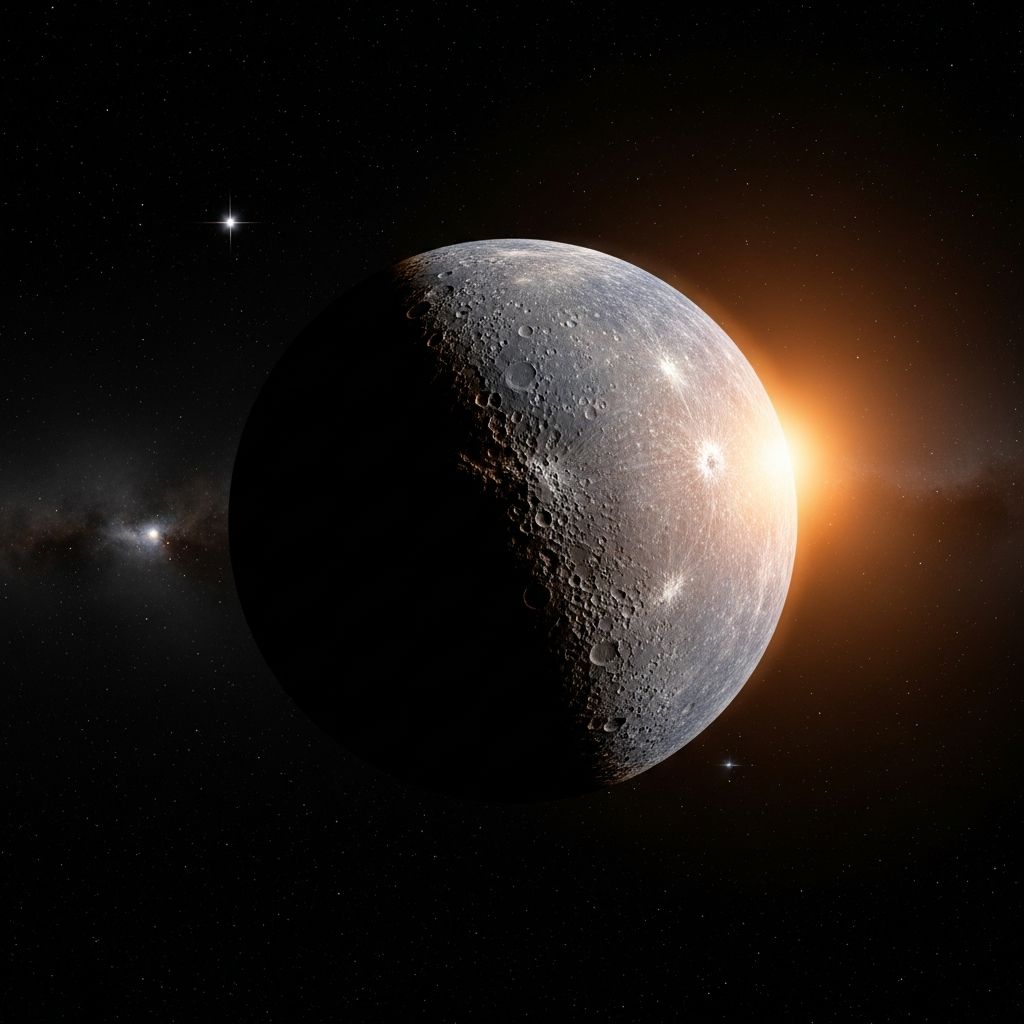
Mercury, the tiniest planet orbiting our Sun, captivates scientists with its paradoxes: blistering daytime heat juxtaposed against frigid polar shadows, a disproportionately huge core, and a surface etched by eons of cosmic battering. As the innermost world, it hurtles through space at unprecedented speeds, offering clues to planetary formation and evolution.
Physical Dimensions and Basic Characteristics
Mercury measures just 4,879 kilometers in diameter, roughly 0.38 times Earth’s size or 1.4 times the Moon’s, making it the smallest planet in the Solar System. Its surface spans 74.8 million square kilometers, a mere 0.147 of Earth’s land area, with a mass of 3.3 × 10²³ kg, or 0.055 Earth masses. Gravity pulls at 3.7 m/s², only 38% of Earth’s, meaning a 100 kg object weighs just 38 kg there.
With an equatorial circumference of 15,329 km and radius of 2,440 km, Mercury’s volume totals 61 billion km³. Its near-zero axial tilt of 0.01° aligns the equator almost perfectly with its orbital plane, minimizing seasons. No moons orbit this rocky terrestrial planet, likely due to the Sun’s overpowering gravity disrupting potential satellites.
Orbiting the Sun: Speed, Eccentricity, and Resonance
Average 58 million km from the Sun—less than 40% of Earth’s distance—Mercury completes an orbit every 88 Earth days, racing at 47 km/s, the fastest of any planet. Its orbit is highly elliptical, swinging from 47 million km at perihelion to 70 million km at aphelion, flexing the planet with intense solar tides 17 times stronger than Earth’s lunar bulges.
Rotation adds intrigue: Mercury spins once every 59 Earth days in a 3:2 spin-orbit resonance, where it rotates three times for every two orbits. This yields a ‘solar day’ of 176 Earth days—twice its year—causing the Sun to appear to loop backward in the sky during ‘sunrises’. Sunlight intensity varies from 4.59 to 10.61 times Earth’s solar constant (1,370 W/m²), fueling temperature extremes.
Extreme Surface Environment: Heat, Cold, and Impacts
Mercury’s dayside scorches to 430–450°C (700–700 K at subsolar points), hot enough to melt lead, while nights plummet to -180°C (110 K). Absent a thick atmosphere, heat dissipates rapidly, creating swings of over 600°C. Polar craters in permanent shadow harbor water ice—estimated at 1014–1015 kg—possibly from cometary impacts or internal outgassing, dwarfed by Earth’s Antarctic sheet (4×10¹⁸ kg) but notable in such heat.
The cratered surface, akin to the Moon’s, bears scars like the vast Caloris Basin (1,550 km wide) and Rachmaninoff (306 km), from ancient asteroid strikes. Cliffs (lobate scarps) stretch hundreds of miles high as the cooling interior contracted. Volcanic plains and tectonic features hint at a dynamic past. Space weathering darkens the regolith, rich in low-iron, high-sulfur silicates from early reducing conditions.
Internal Makeup: The Oversized Iron Core Mystery
Densest after Earth, Mercury’s iron-nickel core spans ~85% of its radius (1,289 miles or 2,074 km across), comprising half its volume versus Earth’s 15%. A thin outer shell—400 km thick mantle and crust—overlays this, with evidence of a solid inner core, liquid outer core layer, and solid mantle. Partial molten core churns a weak magnetic field, unique among inner planets except Earth.
Why so iron-rich? Theories invoke a giant impact stripping lighter mantle, evaporation in the hot early Solar System, or formation from metal-enriched materials. The homogeneous yet sulfur-rich mantle suggests a primordial magma ocean that crystallized unevenly.
| Feature | Mercury | Earth |
|---|---|---|
| Diameter (km) | 4,879 | 12,742 |
| Core Radius (% of planet) | 85% | ~50% |
| Surface Gravity (m/s²) | 3.7 | 9.8 |
| Day Length (Earth days) | 176 | 1 |
| Year Length (Earth days) | 88 | 365.25 |
Whispy Atmosphere: Exosphere Composition and Dynamics
Mercury’s ‘atmosphere’ is a tenuous exosphere (<10-14 bar), a quadrillionth Earth’s pressure, sustained by solar wind, micrometeorites, and planetary outgassing. It comprises oxygen (42%), sodium (29%), hydrogen (22%), helium (6%), plus traces of potassium, calcium, magnesium. Solar radiation and wind strip it away, necessitating constant replenishment.
- Sources: Solar wind implantation, surface vaporization, internal volcanism.
- Sinks: Escape to space, burial in regolith, ion sputtering.
- Effects: Sodium tail extends millions of km, visible from Earth telescopes.
This dynamic envelope influences surface chemistry, with polar ice preserved under regolith blankets against sublimation.
Geological Evolution: From Magma Oceans to Modern Features
Early Mercury likely featured a global magma ocean, yielding a heterogeneous crust via mineral crystallization and convection. Volcanism flooded basins with lava, while contraction formed scarps. Impacts dominated until ~3.5 billion years ago, followed by relative quiescence, though hints of recent activity persist.
Chemical mapping reveals sulfur enrichment and low iron, contrasting other terrestrials, tied to formation in reducing conditions. BepiColombo will probe these further.
Human Exploration: Missions That Unveiled Mercury
Mariner 10 (1974–75) provided the first close-ups, imaging 45% of the surface and discovering the magnetic field. NASA’s MESSENGER (2004–2015) orbited for four years, mapping 100%, confirming ice, core state, and volcanism.
ESA/JAXA’s BepiColombo, launched 2018, arrives 2025 for dual orbiters studying magnetosphere, exosphere, and geology. Future missions may sample surface materials.
Frequently Asked Questions (FAQs)
Why is Mercury’s core so large compared to its size?
Scientists hypothesize giant impacts vaporized lighter materials or that it accreted from metal-rich dust near the Sun, leaving a dense remnant.
Can humans survive on Mercury’s surface?
No—daytime heat exceeds 430°C, nights drop to -180°C, lethal radiation, and microgravity make it uninhabitable without advanced tech.
Does Mercury have water?
Yes, water ice exists in permanently shadowed polar craters, totaling 1014–1015 kg, likely from comets or interior sources.
How long is a day on Mercury?
A solar day—from sunrise to sunrise—lasts 176 Earth days due to 3:2 spin-orbit resonance.
Is Mercury visible from Earth?
Yes, as a bright ‘wandering star’ near the horizon at dawn or dusk, never far from the Sun.
Mercury’s Role in Broader Astronomy
Studying Mercury illuminates ‘hot Jupiters’ and rocky exoplanets orbiting close to stars, testing formation models. Its survival of solar expansion until the Sun’s red giant phase (~7–8 billion years) intrigues long-term Solar System fates. Ongoing data refines our cosmic origins understanding.
References
- Mercury (planet) – Wikipedia — Wikipedia contributors. 2026 (continuously updated). https://en.wikipedia.org/wiki/Mercury_(planet)
- Meet Mercury — European Space Agency (ESA). 2023-10-12. https://www.esa.int/Science_Exploration/Space_Science/BepiColombo/Meet_Mercury
- Mercury, world of extremes — The Planetary Society. 2024-05-20. https://www.planetary.org/worlds/mercury
- Mercury: Facts — NASA Science. 2025-08-15. https://science.nasa.gov/mercury/facts/
- Planet Mercury — Natural History Museum. 2024-02-10. https://www.nhm.ac.uk/discover/planet-mercury.html

Medha Deb is an editor with a master's degree in Applied Linguistics from the University of Hyderabad. She believes that her qualification has helped her develop a deep understanding of language and its application in various contexts. Medha specializes in the areas of beauty, health, sports, and wellness and is committed to ensuring that the content on the website is…