
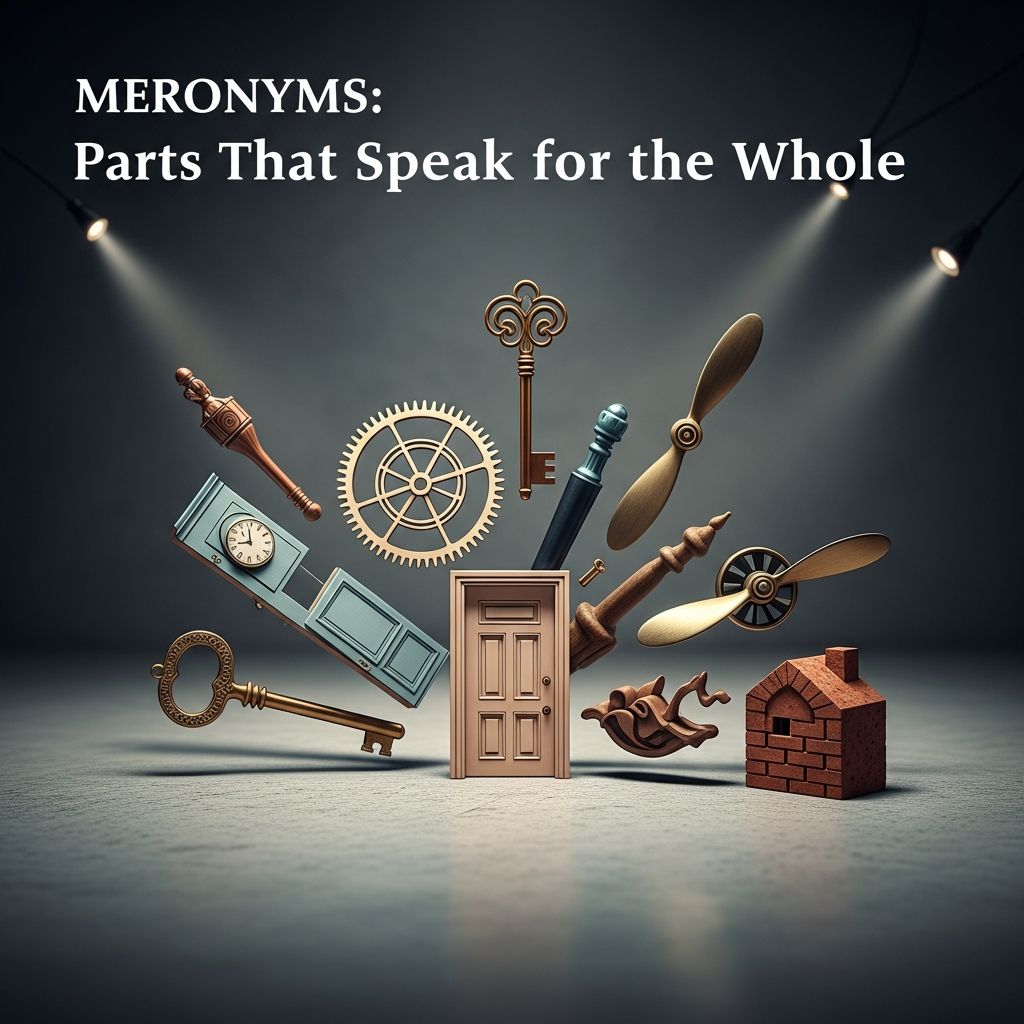
In the rich tapestry of language, words often carry layers of meaning beyond their literal definitions. One fascinating phenomenon is the use of **meronyms**, terms that name a part of something to represent the entire entity. This linguistic device allows speakers to evoke vivid images or imply completeness through partial references, enhancing communication’s efficiency and expressiveness.
Defining Meronyms and Their Core Concept
A **meronym** refers to a word or phrase denoting a component of a larger whole, frequently used to symbolize that whole itself. For instance, saying “nice wheels” typically means praising someone’s car, not just its tires. This part-whole relationship forms the backbone of meronymy, a key semantic relation in linguistics.
Etymologically, ‘meronym’ derives from Greek roots: ‘meros’ meaning ‘part’ and ‘onyma’ meaning ‘name.’ Its counterpart, the **holonym**, names the whole of which the meronym is a part. Thus, ‘finger’ is a meronym of ‘hand,’ the holonym. This distinction clarifies how language structures relationships between elements and aggregates.
Meronyms appear ubiquitously in daily discourse. Consider “all hands on deck,” where ‘hands’ stands for sailors or workers. Such expressions leverage synecdoche, a rhetorical figure where a part substitutes for the whole, making meronyms a practical tool for concise yet evocative speech.
Types of Meronymic Relationships
Meronymy isn’t monolithic; it manifests in varied forms based on the nature of the part-whole bond. Linguists classify these into functional and continuous meronymy.
Functional Meronymy involves detachable parts. Here, components can be removed from the whole without destroying its integrity. Examples include ‘engine’ as a meronym of ‘car’—you can swap engines—or ‘string’ of ‘guitar.’ These relations highlight modular aspects of objects.
Continuous Meronymy describes inseparable parts forming a unified structure. ‘Blade’ of a ‘knife’ exemplifies this; separating it fundamentally alters the whole. Similarly, ‘nose’ and ‘mouth’ are continuous meronyms of ‘face.’ This type underscores inherent, non-detachable integrations.
Another categorization distinguishes **comeronyms**, fellow parts sharing the same holonym. For a ‘tree,’ comeronyms include ‘leaves,’ ‘branches,’ ‘trunk,’ and ‘roots’. Recognizing these subtypes aids in dissecting complex semantic networks.
Everyday Examples of Meronyms in Action
Meronyms permeate colloquial language, often unnoticed. In sports, “the Bulls won” uses the team mascot as a meronym for players and staff. Nautical commands like “man the oars” employ ‘oars’ for rowers.
- “She’s got a new set of wheels” – ‘wheels’ for car.
- “Familiar faces in the crowd” – ‘faces’ for people.
- “Lend me a hand” – ‘hand’ for assistance/person.
- “The White House announced” – building for administration.
- “Boots on the ground” – soldiers’ footwear for troops.
These instances demonstrate meronyms’ role in idiomatic expressions, fostering brevity and imagery. In literature, authors exploit them for stylistic flair, as in Shakespeare’s “Give every man thy ear, but few thy voice,” where ‘ear’ and ‘voice’ evoke listening and speaking holistically.
Meronyms vs. Other Semantic Relations
Distinguishing meronyms from similar concepts prevents confusion. A common mix-up is with **hyponyms** and **hypernyms**.
| Relation | Example | Description |
|---|---|---|
| Meronym-Holonym | Leaf → Tree | Part-of relation. |
| Hyponym-Hypernym | Oak → Tree | Type-of relation (oak is a kind of tree). |
| Synonym | Car → Automobile | Interchangeable terms. |
| Antonym | Whole → Part | Opposites. |
While a leaf is part of a tree (meronymy), an oak is a type of tree (hyponymy). Mereology, a philosophical framework, formalizes part-whole logics, influencing linguistics. Meronymy forms a partial order, allowing hierarchical modeling without full inclusion like hyponymy.
Meronyms in Computational Linguistics and NLP
Beyond human speech, meronyms power natural language processing (NLP). Semantic analysis relies on them to parse meaning, as in WordNet, where nouns link via meronymy. This database, developed by George A. Miller, maps ‘brim’ and ‘crown’ as meronyms of ‘hat’.
In machine translation, recognizing “hands” as people avoids literal errors. Search engines use meronymy for query expansion: searching ‘car engine’ retrieves ‘car’ results. AI models trained on these relations improve entity recognition and sentiment analysis.
Challenges persist; context determines if ‘wheels’ means tires or vehicles. Advanced NLP incorporates mereological hierarchies to resolve ambiguities, enhancing AI’s linguistic grasp.
Advanced Applications Across Disciplines
Meronymy extends to philosophy, cognitive science, and ontology. In mereology, pioneered by Lesniewski, axioms define part-whole without mereological sums, underpinning formal semantics.
Cognitive linguists study how humans conceptualize wholes via parts, linking to embodiment theory—our bodily experiences shape meronymic expressions. In education, teaching meronyms bolsters vocabulary, as exercises like listing a ‘house’s’ meronyms (‘roof,’ ‘door’) build relational thinking.
Legal and technical writing employs precise meronyms for clarity, e.g., ‘CPU’ as a computer’s meronym. In poetry, they create metaphors, amplifying emotional depth.
Building Your Meronym Vocabulary
To master meronyms, practice identification:
- Object: Bicycle → Meronyms: pedals, chain, frame.
- Body: Human → Meronyms: heart, eyes, limbs.
- Group: Orchestra → Meronyms: violin, conductor, score.
Create sentences substituting wholes with parts, e.g., “The ship’s sails caught the wind” for ‘ship.’ Analyze idioms; many embed meronyms, revealing cultural patterns.
Frequently Asked Questions (FAQs)
What is the difference between a meronym and a synecdoche?
A synecdoche is a rhetorical device using meronyms (parts for wholes), but meronymy is the broader semantic relation.
Can meronyms be abstract?
Yes, e.g., ‘chapter’ is a meronym of ‘book,’ or ‘member’ of ‘team’ in organizational contexts.
How does meronymy apply to AI?
In NLP, it structures knowledge graphs, aiding comprehension of compositional meaning.
Are there languages without meronyms?
No universal language lacks part-whole expressions; they are cognitive universals reflected in all tongues.
What’s a comeronym?
Fellow meronyms of the same holonym, like ‘arm’ and ‘leg’ of ‘body’.
Conclusion: The Ubiquity of Part-Whole Logic
Meronyms illuminate language’s ingenuity, enabling parts to embody wholes efficiently. From casual chats to AI algorithms, their influence is profound, inviting deeper appreciation of semantic intricacies. Embrace meronyms to enrich your expression and analysis.
References
- Meronym – Jaxon, Inc. — Jaxon.ai. 2023. https://jaxon.ai/glossary/meronym/
- MERONYM Definition & Meaning — Dictionary.com. 2023-10-15. https://www.dictionary.com/browse/meronym
- Meronymy and holonymy — Wikipedia. 2026-04-01. https://en.wikipedia.org/wiki/Meronymy_and_holonymy
- Meronym – Definition, Meaning & Synonyms — Vocabulary.com. 2023. https://www.vocabulary.com/dictionary/meronym
- meronym — Wiktionary. 2024-05-20. https://en.wiktionary.org/wiki/meronym

Medha Deb is an editor with a master's degree in Applied Linguistics from the University of Hyderabad. She believes that her qualification has helped her develop a deep understanding of language and its application in various contexts. Medha specializes in the areas of beauty, health, sports, and wellness and is committed to ensuring that the content on the website is…