
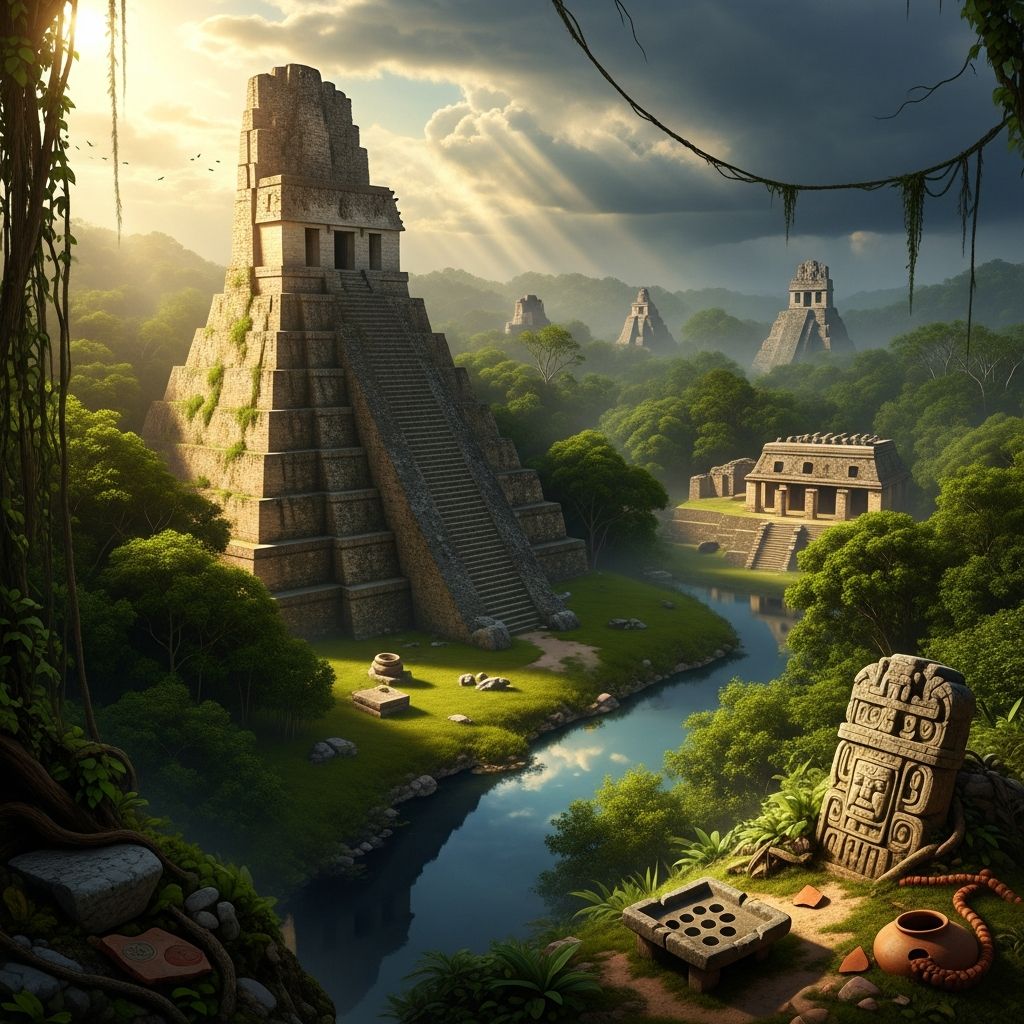
Mesoamerica represents a profound historical and cultural region where indigenous societies independently developed advanced civilizations, rivaling those of ancient Egypt and Mesopotamia. Spanning from central Mexico to parts of Central America, this area fostered innovations in agriculture, architecture, writing, and governance for over 3,000 years before European contact.
Defining the Boundaries of Mesoamerica
The term Mesoamerica describes a cultural zone encompassing modern-day central and southern Mexico, Belize, Guatemala, El Salvador, western Honduras, northern Nicaragua, and northwestern Costa Rica. This region lies on the Middle American isthmus between 10° and 22° northern latitude, featuring diverse ecological systems from tropical lowlands to highland plateaus.
Anthropologist Paul Kirchhoff coined the term in the mid-20th century to delineate areas sharing specific cultural traits, distinguishing it from neighboring Oasisamerica to the north and Aridoamerica. While geographic boundaries shifted over time, the core heartland remained in southern Mexico, with influences radiating outward.
Diverse Landscapes Shaping Societies
Mesoamerica’s geography is a mosaic of environments that profoundly influenced its peoples. Lowlands below 1,000 meters offer humid tropical climates ideal for maize cultivation, while highlands between 1,000 and 2,000 meters provide temperate zones with reliable rainfall. Coastal plains, deserts, and volcanic mountains add further variety, supporting specialized economies like fishing, mining, and agriculture.
- Tropical Lowlands: Hot, wet areas in the Maya regions of northern Guatemala and Belize, perfect for dense rainforests and river-based trade.
- Highland Plateaus: Central Mexico’s valleys, home to Teotihuacan and Tenochtitlan, with fertile volcanic soils.
- Gulf Coast: Swampy, resource-rich zones linked to Olmec culture.
- Pacific Coast: Narrow strips with access to obsidian and cacao trade routes.
These landscapes necessitated adaptive strategies, from terraced farming in highlands to raised fields in wetlands, enabling population growth and urbanization.
Timeline of Mesoamerican Development
Archaeologists divide Mesoamerican history into key periods, tracing evolution from hunter-gatherers to empire-builders. Human presence dates back potentially 30,000 years, but civilization emerged around 2500 BCE.
| Period | Timeframe | Key Developments |
|---|---|---|
| Paleo-Indian | ~30,000–8000 BCE | Early hunter-gatherer migrations; first human footprints. |
| Archaic | ~8000–2000 BCE | Agricultural revolution; domestication of maize, beans, squash. |
| Preclassic (Formative) | 2000 BCE–250 CE | Olmec rise; early cities, writing origins. |
| Classic | 250–900 CE | Maya golden age; Teotihuacan peak; monumental architecture. |
| Postclassic | 900–1521 CE | Aztec and Mixtec dominance; intensified trade and warfare. |
This progression marks Mesoamerica as one of six global cradles of civilization, alongside Peru’s Caral-Supe in the Americas.
Pioneering the Olmec: Mother Culture
The Olmec, flourishing from 1400–400 BCE along Mexico’s Gulf Coast, are considered Mesoamerica’s foundational culture. Sites like San Lorenzo and La Venta feature colossal stone heads, jade artifacts, and early urban planning. They pioneered rubber processing, monumental sculpture, and possibly the Mesoamerican ballgame.
Olmec influence spread motifs like the were-jaguar deity and ceremonial centers, laying groundwork for later societies. Their collapse around 400 BCE remains mysterious, possibly due to environmental shifts or internal strife.
Maya Civilization: Masters of Time and Space
The Maya, spanning lowlands and highlands from 2000 BCE to Spanish conquest, excelled in hieroglyphic writing, astronomy, and mathematics. Classic period cities like Tikal, Palenque, and Copán boast pyramids, palaces, and observatories aligned with celestial events.
Maya society was decentralized, with city-states ruled by kʼuhul ajaw (divine kings). They developed the Long Count calendar and zero concept independently. Postclassic centers like Chichén Itzá integrated Toltec styles, thriving until 900 CE collapse linked to drought and overpopulation.
- Achievements: Precise calendars tracking 365-day solar year and 260-day ritual cycle.
- Art: Stelae recording dynastic histories; vibrant murals.
- Economy: Cacao currency, long-distance jade trade.
Teotihuacan and Central Mexico’s Urban Giants
Teotihuacan, near modern Mexico City (100 BCE–550 CE), was Mesoamerica’s largest Classic city, housing 125,000 at its peak. The Pyramid of the Sun and Avenue of the Dead symbolize cosmic order. Its talud-tablero architecture influenced distant regions.
Mystery shrouds Teotihuacan’s governance—neither palaces nor royal tombs suggest a collective rule. Decline around 550 CE involved fires and abandonment, paving way for Toltecs.
Aztec Empire: Warriors and Builders
The Mexica Aztecs founded Tenochtitlan in 1325 CE on Lake Texcoco, growing it into a metropolis of 200,000 by 1519. Chinampas (floating gardens) sustained vast populations. Their Triple Alliance dominated via military tribute.
Aztec religion featured human sacrifice to gods like Huitzilopochtli. Codices preserved history and cosmology. The 1521 fall to Cortés ended the Postclassic era.
Shared Cultural Foundations
Despite diversity, Mesoamerican peoples united through traits like maize-beans-squash agriculture (the “Three Sisters”), 260-day calendar, ballgame symbolizing life-death cycles, pyramid temples, and polytheistic pantheons with feathered serpents (Quetzalcoatl/Kukulkan).
- Writing Systems: Independently invented, with Maya logosyllabic script most deciphered.
- Trade Networks: Obsidian, feathers, cacao exchanged over 1,000 miles.
- Ballgame: Ritual sport with rubber balls, often fatal for losers.
These elements created a cultural continuum across ethnic groups speaking over 300 languages.
End of an Era: Spanish Conquest
Colonialism from 1519 dismantled Mesoamerican polities. Tenochtitlan’s fall in 1521 symbolized the region’s transformation, blending indigenous, European, African, and Asian elements into modern cultures. Yet, millions of descendants preserve languages and traditions.
Modern Legacy and Preservation
Today, Mesoamerica’s heritage thrives in UNESCO sites like Palenque and ongoing Maya communities. Archaeological work reveals lost knowledge, affirming its status as a primary urban generator and writing inventor.
Frequently Asked Questions (FAQs)
Where exactly is Mesoamerica located?
Mesoamerica covers central/southern Mexico, Belize, Guatemala, El Salvador, western Honduras, and parts of Nicaragua/Costa Rica.
What are the major Mesoamerican civilizations?
Key ones include Olmec, Maya, Zapotec, Teotihuacan, Mixtec, Toltec, and Aztec.
Did Mesoamerica invent writing independently?
Yes, alongside Egypt, India, Sumer, and China; Maya script is the best-known.
Why did many Classic cities collapse?
Factors include drought, deforestation, warfare, and overpopulation.
Is Mesoamerica still culturally relevant?
Yes, with 10+ million indigenous speakers maintaining traditions.
References
- Mesoamerica — Wikipedia Contributors. 2023-10-01. https://en.wikipedia.org/wiki/Mesoamerica
- What is Mesoamerica, anyway? — Mexico News Daily. 2023-05-15. https://mexiconewsdaily.com/culture/what-is-mesoamerica-why-do-people-talk-about-it/
- Mesoamerica | History | Research Starters — EBSCO. 2024-01-20. https://www.ebsco.com/research-starters/history/mesoamerica
- Mesoamerica, an introduction — Smarthistory. 2023-08-10. https://smarthistory.org/mesoamerica-an-introduction/
- Mesoamerican civilization — Britannica Editors. 2024-03-05. https://www.britannica.com/topic/Mesoamerican-civilization
- Mesoamerica Facts for Kids — Kiddle. 2023-11-12. https://kids.kiddle.co/Mesoamerica
- Mesoamerica, an introduction — Khan Academy. 2023-09-18. https://www.khanacademy.org/humanities/art-americas/beginners-guide-art-of-the-americas/mesoamerica-beginner/a/mesoamerica-an-introduction

Medha Deb is an editor with a master's degree in Applied Linguistics from the University of Hyderabad. She believes that her qualification has helped her develop a deep understanding of language and its application in various contexts. Medha specializes in the areas of beauty, health, sports, and wellness and is committed to ensuring that the content on the website is…