
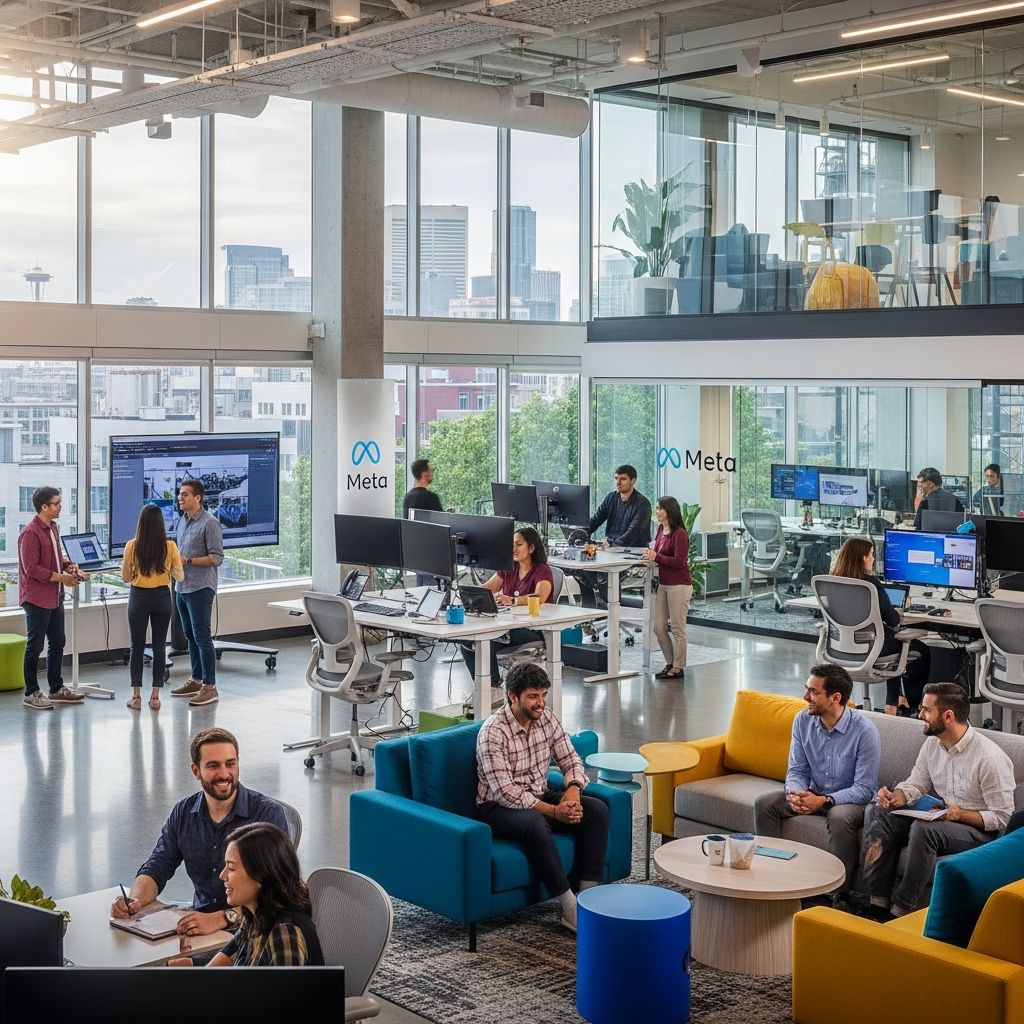
Seattle has evolved into one of the most important technology hubs in the United States, and Meta’s growing footprint in the city reflects that status. The region combines world-class engineering talent, a deep tech ecosystem, and a high quality of life shaped by mountains, water, and a strong urban core. This guide offers an original, holistic look at what it is like to build your career at Meta’s Seattle offices—from the kinds of roles you’ll find to the culture inside the buildings and the realities of life in the Pacific Northwest job market.
Seattle as a Global Tech Powerhouse
Before diving into Meta itself, it helps to understand the broader environment. Seattle’s tech economy expanded rapidly through the 2010s, powered by major employers like Microsoft and Amazon, along with hundreds of startups. In recent years, though, growth has cooled and become more selective. According to the Washington State Employment Security Department, nonfarm employment in Washington experienced three consecutive months of decline in the first quarter of 2025, with employers collectively shedding about 12,400 jobs statewide during that period. Seattle’s unemployment rate has typically tracked close to the national average over the past decade, sometimes slightly higher, reflecting its sensitivity to national tech cycles.
These shifts mean that big, stable players such as Meta have become even more central to Seattle’s white-collar job market. Analyses of tech-heavy cities show that job postings in places like San Francisco and Seattle have dropped more than 30% from prior peaks, underscoring a more competitive environment for candidates. At the same time, the region retains a deep pool of engineers, researchers, data scientists, and product specialists—making it an attractive location for Meta to grow long-term product teams and infrastructure work.
Why Meta Invests in Seattle
Meta’s presence in Seattle is not an outpost; it is a strategic hub. The company can tap into:
- Experienced cloud and distributed-systems talent from other major tech firms and startups.
- AI, AR/VR, and data-science expertise fostered by local universities and industry labs.
- Proximity to Asia-Pacific time zones compared with East Coast offices, useful for global collaboration.
- Quality of life factors that help attract senior engineers and managers looking to relocate.
These factors align with Meta’s long-horizon bets in areas like virtual reality, mixed reality hardware, large-scale infrastructure, and AI research—domains that demand deep technical knowledge and stable multi-year teams.
Core Teams and Typical Roles in Seattle
Meta’s Seattle offices host a wide spectrum of roles, from deeply technical engineering positions to cross-functional business roles. While exact team structures change over time, candidates can expect to see opportunities in the following broad areas.
Product and Software Engineering
Software engineers are the backbone of Meta’s Seattle workforce. Typical work includes:
- Social and messaging experiences for products such as Facebook, Instagram, Threads, and WhatsApp.
- Infrastructure engineering for distributed systems, storage, networking, and developer tools.
- Machine learning platforms that power recommendations, ranking, integrity, and safety systems.
- Privacy and security engineering focused on encryption, access controls, and abuse prevention.
Many Seattle teams own end-to-end product surfaces or infrastructure components, meaning engineers can work on design, implementation, experimentation, and rollout—not just maintenance.
Reality Labs and Emerging Technologies
Meta’s Reality Labs organization drives the company’s work in virtual reality, augmented reality, and related hardware and software. In Seattle, that can mean:
- Graphics and rendering engineers building performant VR/AR experiences.
- Computer vision and perception specialists working on hand tracking or spatial understanding.
- Firmware and systems engineers integrating hardware and software for devices.
- UX designers prototyping interfaces for immersive environments.
Because Seattle has long hosted AR/VR startups and research groups, it provides a strong talent pipeline for these cutting-edge areas.
Data Science, Analytics, and Research
Data roles in the Seattle office typically focus on:
- Product analytics to understand user behavior, engagement, and retention.
- Experiment design and evaluation, including A/B testing frameworks.
- Econometrics and marketplace modeling for ads, commerce, and creator ecosystems.
- Applied machine learning for ranking, recommendations, and personalization.
Seattle’s universities and research institutions supply a steady stream of quantitative talent, and Meta’s scale offers data scientists some of the largest datasets in the industry to explore.
Business, Operations, and Support Functions
Beyond technical roles, Meta’s Seattle hub also includes:
- Product managers driving strategy and execution for Seattle-based initiatives.
- Program managers coordinating complex cross-team projects.
- Recruiters, HR business partners, and people operations specialists supporting growth.
- Legal, public policy, and communications staff working with regional stakeholders.
These functions help integrate Seattle’s work into the company’s global roadmap and ensure that teams operate smoothly across time zones and product groups.
Office Environment and Day-to-Day Experience
Meta’s Seattle buildings are designed to balance heads-down focus with collaboration. While specific layouts differ by campus, employees can generally expect:
- Open-plan workspaces combined with small meeting rooms and focus pods.
- On-site food options or subsidized meals, often reflecting Seattle’s diverse culinary influences.
- Quiet spaces for deep work and phone booths for private calls.
- Wellness-focused amenities such as bike storage, showers, and nearby fitness options.
Major employers increasingly use on-site services and well-designed workspaces as part of an overall value proposition, especially as they encourage more in-office collaboration following the widespread adoption of remote work during the pandemic.
Hybrid, Remote, and In-Office Collaboration
Across the broader labor market, many companies are gradually scaling back fully remote arrangements and emphasizing hybrid or full-time in-office work to restore collaboration and culture. Meta’s Seattle operations fit within this wider movement: employees typically coordinate with managers on their in-office expectations, with an emphasis on being present for:
- Team planning sessions and quarterly roadmap reviews.
- Critical design discussions and cross-team integration meetings.
- Onboarding periods for new hires and interns.
This approach allows teams to benefit from in-person connection while still leveraging the flexibility of modern tools for heads-down work and cross-region collaboration.
Life in Seattle: What Employees Should Know
Seattle offers a distinctive blend of urban living and outdoor access that strongly shapes employee experience.
| Aspect | What to Expect |
|---|---|
| Cost of Living | High housing costs, particularly in central neighborhoods and popular suburbs; competitive tech salaries help offset but do not eliminate the pressure. |
| Commute Options | Light rail expansion, buses, bike infrastructure, and ferry routes; some employees rely on ride-sharing or carpooling from Eastside suburbs. |
| Climate | Mild temperatures, frequent overcast skies and rain in fall–spring, long daylight in summer and strong outdoor culture. |
| Outdoor Access | Nearby mountains, national parks, lakes, and the Puget Sound; popular activities include hiking, skiing, climbing, and boating. |
| Culture | Strong coffee, local music history, arts scene, and a population that values work–life balance and time in nature. |
Employees transferring from other regions often find that Seattle encourages a healthier separation between work and personal time, particularly given the ease of weekend trips to mountains or the coast.
Compensation, Benefits, and Workplace Support
While specific compensation packages vary by role and level, tech employers in Seattle generally aim to remain competitive with other major hubs like the Bay Area and New York. Industry-wide, benefit expectations have evolved significantly since the pandemic. Surveys of job seekers show that candidates increasingly prioritize mental-health support, flexible schedules, and strong total rewards packages—beyond base pay and basic health insurance.
What Employees Commonly Value
- Comprehensive health coverage for employees and dependents.
- Retirement and equity programs that share in the company’s long-term growth.
- Mental health resources, including counseling access and wellness stipends.
- Parental leave and caregiving support that reflect modern family needs.
- Continuous learning budgets or internal training platforms.
Seattle’s more mature workforce and the influx of Gen Z employees both contribute to rising expectations around inclusive policies, transparent career paths, and meaningful development opportunities.
Seattle’s Shifting Job Market and What It Means for Candidates
Seattle is no longer in the phase of unchecked, rapid hiring that defined the late 2010s. Official statistics and independent policy analyses note a cooling trend in recent years, including a rise in unemployment relative to job openings and visible slowdowns in tech hiring. In the Seattle–Bellevue metro area, tech sector job losses and cautious expansion plans have pushed the market toward greater competition for each open role.
For candidates targeting Meta’s Seattle roles, this environment translates into several practical implications:
- Stronger emphasis on proven skills and demonstrable impact on past projects.
- Increased competition from both local talent and relocators from other tech hubs.
- Greater focus on adaptability, especially as AI and automation reshape parts of the software and data stack.
- Premium on communication skills as cross-functional teamwork and hybrid collaboration become standard.
At the same time, Washington’s labor market forecasts suggest that job growth, while slower than in the pre-pandemic decade, remains positive in sectors such as health services and information—including software and digital platforms. For those prepared to navigate a more selective environment, companies like Meta still offer robust long-term career paths.
How to Stand Out for Meta’s Seattle Roles
To succeed in a competitive hiring landscape, candidates can focus on several levers within their control.
1. Build Depth in a Relevant Technical or Business Domain
Instead of only listing broad skills, highlight deep expertise in areas that align with Meta’s work in Seattle, such as:
- Distributed systems and large-scale backend services.
- Machine learning engineering and experimentation.
- AR/VR graphics, computer vision, or real-time rendering.
- Product analytics, experimentation design, or marketplace economics.
Use portfolio pieces, open-source contributions, or publications to show real-world impact.
2. Demonstrate Collaboration Across Time Zones and Teams
Meta operates globally, so hiring teams look for people who can collaborate effectively with colleagues in Menlo Park, New York, London, or Singapore. Concrete examples to emphasize:
- Managing projects that spanned several locations or organizations.
- Documenting decisions clearly to unblock colleagues in other time zones.
- Resolving conflicts or misalignments in cross-functional settings.
3. Show Comfort with Ambiguity and Rapid Change
Large tech organizations iterate quickly and reorient priorities as new data emerges. The ability to adapt—without losing focus on user value—is a differentiator. Highlight stories where you:
- Adjusted your plan after new insights, experiments, or market shifts.
- Helped a team pivot without sacrificing code quality or user trust.
- Took initiative to clarify ambiguous goals and align stakeholders.
4. Align with Meta’s Long-Term Product Vision
Meta invests heavily in AI, social connection, and immersive technologies. Candidates who thoughtfully engage with these themes—whether through personal projects, research, or product thinking—can stand out. Instead of repeating buzzwords, show that you understand how people actually use social, messaging, and immersive experiences, and where you see room for improvement.
FAQs: Meta’s Seattle Office and Careers
Q1: How does Meta’s Seattle office fit into the company’s overall strategy?
Seattle is one of Meta’s key North American hubs outside the Bay Area. The city hosts significant engineering, data, and product teams that own core infrastructure, AI-powered experiences, and parts of the company’s AR/VR roadmap. The location allows Meta to tap into a deep pool of senior technical talent and to diversify its geographic footprint.
Q2: Is the Seattle tech job market still attractive despite recent slowdowns?
Yes, but it is more selective than in earlier boom years. Official data shows that Washington employment growth has slowed and that the first quarter of 2025 brought three months of net job losses statewide. At the same time, the information sector, which includes software and online platforms, still shows net job gains over multi-year periods. For candidates with in-demand skills, Seattle remains a strong long-term option, especially when targeting employers with durable business models.
Q3: What work model should I expect at Meta in Seattle—remote, hybrid, or in-office?
Meta’s approach evolves over time, but industry-wide trends point toward a reduction in fully remote roles and a stronger emphasis on hybrid or largely in-office work, particularly for collaboration-heavy teams. In practical terms, employees can expect to spend regular days in the office for planning, design, and cross-team work, with some flexibility for heads-down or remote days depending on role and manager.
Q4: How competitive are roles in Seattle compared with other Meta locations?
Seattle roles are highly competitive because the region concentrates experienced engineers and product leaders from multiple top-tier companies. Broader labor-market data shows that cities with dense tech employment, including Seattle, have seen sharper drops in job postings than smaller metros, which intensifies competition for each opening. Candidates should expect rigorous interviews and multiple rounds focused on both technical and behavioral skills.
Q5: What should I highlight in my application if I am relocating to Seattle?
Emphasize your readiness for relocation, your interest in the region’s lifestyle, and your ability to build relationships quickly in a new environment. Many teams value candidates who appreciate Seattle’s culture and who are likely to stay and grow with the office over several years—important for product continuity and knowledge retention.
References
- Seattle-Tacoma-Bellevue, WA Economy at a Glance — U.S. Bureau of Labor Statistics. 2025-10-01. https://www.bls.gov/eag/eag.wa_seattle_msa.htm
- First Quarter 2025 Labor Market Briefing — Washington State Employment Security Department. 2025-06-01. https://esd.wa.gov/media/pdf/3549/first-quarter-2025-labor-market-briefing.pdf
- Seattle’s Job Market Decline — Washington Policy Center. 2025-05-20. https://www.washingtonpolicy.org/publications/detail/seattles-job-market-decline
- Cities with the Biggest Job Growth, Charted — Axios. 2025-11-29. https://www.axios.com/2025/11/29/cities-jobs-tech-chart
- 2025 Recruitment Trends that Seattle Headhunters Should Know — NW Recruiting Partners. 2024-11-15. https://nwrecruitingpartners.com/trends-that-seattle-headhunters-should-know/
- Seattle-area Tech Jobs Hit 8-year Low as Industry Moves Toward AI — Puget Sound Business Journal. 2025-10-19. https://www.bizjournals.com/seattle/news/2025/10/19/tech-job-losses-hiring-slowdown.html
- Seattle Job Market Shifts: Competition Rises, Flexible Work Sought — iHeartRadio Podcast (Seattle Job Market Report). 2025-04-03. https://www.iheart.com/podcast/53-seattle-job-market-report-220278707/episode/seattle-job-market-shifts-competition-rises-307523680/

Medha Deb is an editor with a master's degree in Applied Linguistics from the University of Hyderabad. She believes that her qualification has helped her develop a deep understanding of language and its application in various contexts. Medha specializes in the areas of beauty, health, sports, and wellness and is committed to ensuring that the content on the website is…