
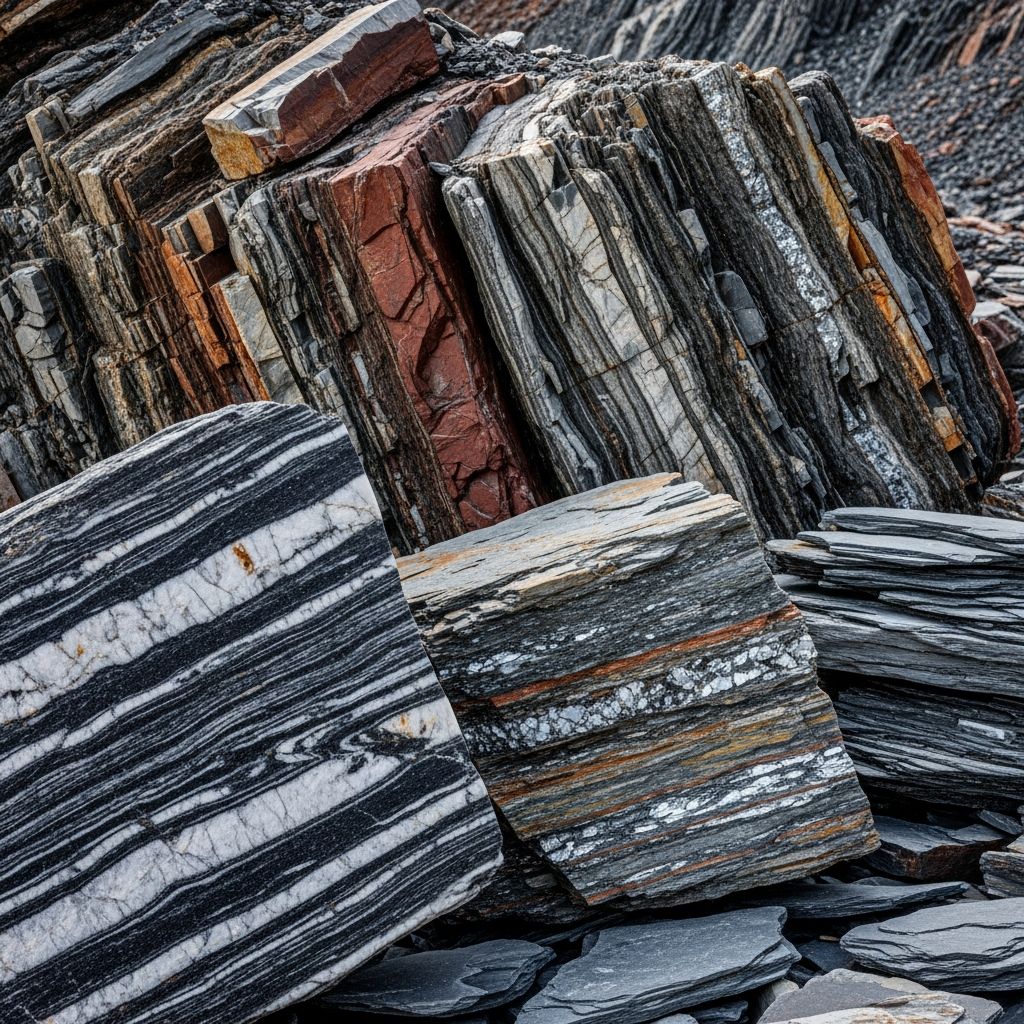
Metamorphic rocks represent a fascinating chapter in Earth’s geological history, formed when existing rocks undergo profound changes due to intense heat, pressure, or chemical activity without melting. These transformations create rocks with unique textures and compositions, essential to understanding mountain building, tectonic processes, and resource extraction. This article examines their origins, classifications, specific varieties, formation environments, and practical applications, drawing from established geological principles.
The Essence of Metamorphism: How Rocks Transform
Metamorphism occurs when protoliths—pre-existing igneous, sedimentary, or even other metamorphic rocks—are subjected to temperatures exceeding 150-200°C and pressures around 100 megapascals, leading to recrystallization while remaining solid. This process realigns minerals, forms new crystals, and often develops foliation, a layered structure from directed stress.
Unlike igneous rocks formed from magma or sedimentary ones from deposition, metamorphic rocks evolve in place, preserving hints of their origins. For instance, shale can become slate under low-grade conditions, while granite might turn into gneiss at higher grades. The grade of metamorphism—low, medium, or high—dictates the extent of change, with higher grades producing coarser grains and more complex minerals.
Classifying Metamorphic Rocks: Foliated vs. Non-Foliated
Metamorphic rocks divide into two primary categories based on texture: foliated, exhibiting visible layers or bands, and non-foliated, which appear massive or granular. Foliation arises from compressive forces aligning platy minerals like mica or elongated ones like amphibole.
- Foliated Rocks: Develop banding from differential pressure, common in regional metamorphism.
- Non-Foliated Rocks: Form under uniform pressure or high temperatures, lacking pronounced layering.
This distinction aids identification in the field, as foliated rocks split along planes, while non-foliated ones fracture irregularly.
Key Foliated Metamorphic Rocks and Their Characteristics
Foliated rocks progress through a sequence with increasing metamorphic intensity, starting from fine-grained varieties to coarse, banded ones.
Slate: The Finest-Grained Foliation
Slate emerges from low-grade metamorphism of shale or mudstone, featuring slaty cleavage that allows splitting into thin sheets. Its glossy surface results from aligned mica flakes, making it ideal for roofing and flooring. Though not perfectly foliated, its perfection lies in durability and water resistance.
Phyllite: A Step Up in Sheen and Strength
Phyllite forms as slate recrystallizes further, developing a silky luster from chlorite and muscovite. Still fine-grained, it resists splitting as easily as slate but shows wavy foliation, often found in low-grade zones of mountain belts.
Schist: Medium-Grade Layered Beauty
Schist, from phyllite under medium-grade conditions, displays pronounced schistosity with visible mica flakes up to several centimeters. Composed of quartz, feldspar, and micas, it varies in color and is prone to weakness along planes, challenging for construction.
Gneiss: High-Grade Banded Powerhouse
Gneiss represents high-grade metamorphism, with alternating light (quartz-feldspar) and dark (biotite-amphibole) bands. Derived from granite or sediments, its coarse texture forms under extreme conditions over 500°C, common in continental cores.
Non-Foliated Metamorphic Rocks: Uniform Transformations
Non-foliated rocks lack layering due to equidimensional minerals or uniform stress, often from contact or high-temperature regional metamorphism.
Marble: Limestone’s Crystalline Cousin
Marble results from limestone or dolomite recrystallizing into interlocking calcite crystals, prized for its workability and polish. Available in whites, greens, and blacks, it’s a staple in sculpture and architecture.
Quartzite: Sandstone’s Impenetrable Form
Quartzite, from sandstone, features fused quartz grains so tight it’s harder than glass. Used in construction for its abrasion resistance, it sometimes retains faint foliation.
Specialized Varieties: Beyond the Basics
Other non-foliated types include hornfels from contact metamorphism—fine-grained and tough—and soapstone, talc-rich and soft for carving. Eclogite and amphibolite form under extreme pressures in subduction zones.
Processes Driving Metamorphic Change
Three main settings produce metamorphic rocks: regional, contact, and dynamic.
| Type | Conditions | Examples | Locations |
|---|---|---|---|
| Regional | High P/T over large areas | Gneiss, schist | Mountain roots |
| Contact | High T, low P near intrusions | Hornfels, skarn | Igneous contacts |
| Dynamic | Shear along faults | Mylonite | Fault zones |
Regional metamorphism dominates, linked to plate tectonics, while contact occurs near magma. Hydrothermal activity adds chemical flair, as in serpentinite from ultramafics.
Metamorphic Rocks in Earth’s grand cycle
These rocks integrate into the rock cycle, potentially melting into igneous or eroding into sedimentary forms. Greenstone belts showcase ancient cycles, with metabasalts enveloped by gneiss. Meteor impacts create shock metamorphism, yielding coesite.
Practical Applications and Economic Value
Metamorphic rocks underpin infrastructure: slate for roofs, marble for monuments, quartzite for roads, gneiss for aggregates. Soapstone serves sinks, while dimension stone like granite gneiss builds enduring structures. Challenges include schist’s instability.
Global Examples and Field Identification
U.S. parks display these rocks: Great Smoky Mountains host gneiss, Shenandoah phyllite. Identify via texture—rub slate for sheen, check gneiss bands—and protolith clues like fossil ghosts in marble.
Frequently Asked Questions
What causes a rock to become metamorphic?
Heat above 150°C, pressure over 100 MPa, or fluids recrystallize minerals without melting.
How do foliated and non-foliated rocks differ?
Foliated have layers from directed stress; non-foliated are massive from uniform conditions.
Can metamorphic rocks form from any parent rock?
Yes, igneous, sedimentary, or prior metamorphic protoliths can transform.
Why is marble used in sculptures?
Its calcite crystals allow fine carving and polishing.
Where are high-grade metamorphic rocks found?
In orogenic cores, subduction zones, and ancient shields.
References
- Metamorphic rock — Wikipedia. 2023-10-01. https://en.wikipedia.org/wiki/Metamorphic_rock
- Metamorphic Rocks — U.S. National Park Service. 2024-01-15. https://www.nps.gov/subjects/geology/metamorphic.htm
- Metamorphic Rocks and the Rock Cycle — South Carolina Department of Natural Resources. 2022-06-10. https://www.dnr.sc.gov/geology/pdfs/education/Metamorphic%20Rocks.pdf
- Metamorphic Rocks: properties, formation, and subtypes! — Wild Earth Lab. 2025-07-09. https://wildearthlab.com/2025/07/09/metamorphic-rocks/
- What are metamorphic rocks? — U.S. Geological Survey. 2023-11-20. https://www.usgs.gov/faqs/what-are-metamorphic-rocks

- Integrated M.A. in Applied Linguistics, University of Hyderabad
- 5+ years in editorial, instructional, SEO, and research-based writing
Sneha is a relationships and lifestyle writer with a strong foundation in applied linguistics and certified training in relationship coaching. She brings over five years of writing experience to theskillvault, crafting thoughtful, research-driven content that empowers readers to build healthier relationships, boost emotional well-being, and embrace holistic living. Her writing and insights reflect the belief that beauty, happiness, and wellness…