
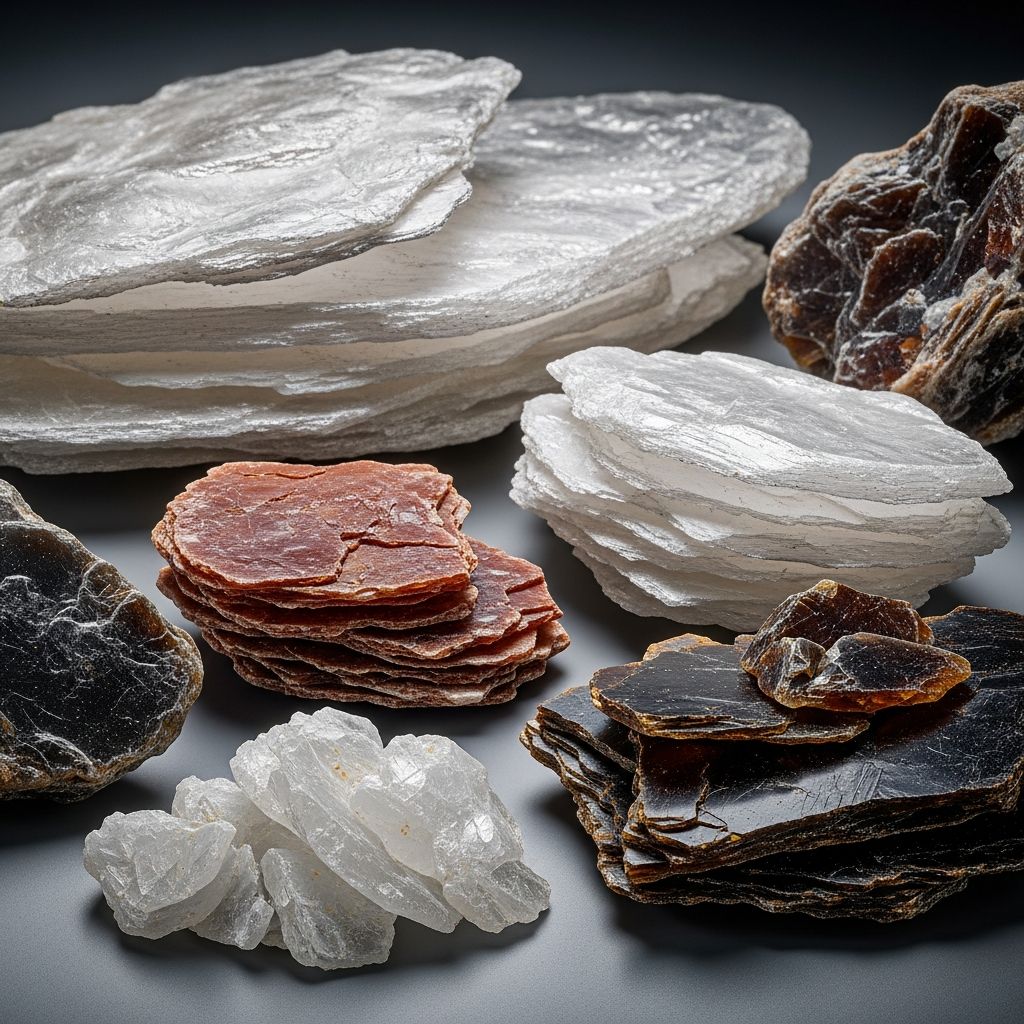
Mica minerals represent a group of silicate minerals renowned for their layered structure and exceptional physical properties, making them indispensable in numerous industrial sectors. These minerals exhibit perfect basal cleavage, allowing them to split into thin, flexible sheets that maintain strength and transparency.
Fundamental Structure of Mica
The atomic arrangement in mica defines its remarkable characteristics. Composed primarily of silicon, oxygen, aluminum, potassium, and other elements, mica forms a sheet-like lattice. Each layer consists of two tetrahedral sheets sandwiching an octahedral sheet, bonded by potassium ions that enable easy separation along cleavage planes. This phyllosilicate structure imparts flexibility, lightness, and durability, distinguishing mica from other minerals.
In practical terms, this structure allows mica sheets to be as thin as 0.025 millimeters while retaining electrical and thermal integrity. The bonds between layers are weak, facilitating cleavage into optically flat sheets ideal for precision applications.
Key Physical and Chemical Properties
Mica’s properties stem directly from its composition and structure. It demonstrates high dielectric strength, low electrical conductivity, and thermal stability up to 500°C, resisting corona discharge and maintaining performance under extreme conditions. Chemically inert, mica withstands acids, alkalis, and moisture without degradation.
- Electrical Insulation: Superior dielectric properties support high-voltage applications without energy loss.
- Thermal Conductivity: Excellent heat dissipation while insulating electrically, unique among insulators.
- Mechanical Strength: High tensile strength and low friction in thin sheets.
- Optical Clarity: Transparency in muscovite varieties for optical uses.
- Flexibility and Elasticity: Bends without breaking, ideal for gaskets and diaphragms.
These attributes position mica as a premium material where reliability under stress is paramount.
Primary Types of Mica Minerals
Several mica varieties exist, each suited to specific uses based on composition.
| Type | Composition | Key Traits | Main Uses |
|---|---|---|---|
| Muscovite | KAl₂(AlSi₃O₁₀)(OH)₂ | Colorless, transparent, high dielectric strength | Electronics, capacitors, insulation |
| Phlogopite | KMg₃(AlSi₃O₁₀)(OH)₂ | Brownish, heat-resistant to 900°C | High-temp furnaces, automotive brakes |
| Biotite | K(Mg,Fe)₃(AlSi₃O₁₀)(OH)₂ | Dark, less pure, ground for fillers | Paints, drilling muds, plastics |
| Lepidolite | K(Li,Al)₃(AlSi₃O₁₀)(OH,F)₂ | Lithium-rich, softer | Ceramics, lithium extraction |
Muscovite dominates electrical applications due to purity, while phlogopite excels in thermal environments.
Global Occurrence and Extraction Methods
Mica occurs in igneous, metamorphic, and sedimentary rocks worldwide. Major deposits are found in India (leading producer), Brazil, China, the United States, and Russia. Pegmatites and schists host large, gem-quality crystals, while metamorphic zones yield industrial grades.
Extraction involves open-pit mining or quarrying, followed by hand-sorting for sheet mica to preserve sheet integrity. Lower grades are crushed and ground for powder uses. Sustainable practices are increasingly emphasized to address child labor concerns in some regions.
Applications in Electronics and Electrical Systems
Mica’s role in electronics is pivotal due to its insulating prowess. Sheet mica forms capacitors, where thin sheets between electrodes store charge efficiently. In commutators, heating elements, and transformers, it prevents breakdowns under high voltage and heat.
Built-up mica, or micanite, combines sheets with binders for rigid insulation in motors and generators. Its use in semiconductors as substrates ensures precise chip mounting and heat management. Specialized sheets serve in radar, lasers, and missile systems for their radiation transparency and gas impermeability.
Role in Construction and Building Materials
In construction, ground mica enhances joint compounds, plasters, and paints. Its platelike particles improve workability, crack resistance, and adhesion in drywall finishes. In wall coatings, it provides smoothness, reduces shrinkage, and prevents sagging.
Mica flakes in roofing and fillers add durability and weather resistance. As an asbestos substitute in fire-resistant materials, it bolsters safety without health risks.
Industrial Uses in Manufacturing and High-Heat Environments
Mica shines in high-temperature settings. Furnace linings, kilns, and crucibles use mica sheets to withstand extreme heat while protecting contents. In metallurgy and glassmaking, it maintains integrity amid molten materials.
Automotive applications include brake linings and clutch plates (phlogopite), reducing noise and vibration. Gaskets, seals, and bearings benefit from low friction and abrasion resistance.
Enhancements in Plastics, Paints, and Composites
Ground mica reinforces plastics, improving stiffness, dimensional stability, and heat resistance in automotive parts and electronics housings. In paints, it acts as a filler for smoother finishes and UV protection.
MicaFort-like products boost polymer performance, reducing warping and enhancing mold release. In tires and rubber, it adds strength and heat dissipation.
Specialized and Emerging Applications
Beyond traditional uses, mica features in cosmetics for shimmer, oil-well drilling muds to seal boreholes (15% of dry-ground use), and medical devices. Optical waveplates leverage birefringence, while radiation detectors use thin sheets as windows.
Emerging trends include sustainable sourcing and nanocomposites for lighter, stronger materials.
Frequently Asked Questions (FAQs)
What makes mica an ideal electrical insulator?
Mica’s high dielectric breakdown voltage, low conductivity, and thermal stability allow it to insulate high voltages without degrading, even at elevated temperatures.
Is mica environmentally friendly?
Yes, as a natural, non-toxic mineral, mica serves as an asbestos alternative. Responsible mining addresses ethical concerns.
How is sheet mica processed for industry?
Crystals are cleaved by hand into thin sheets, trimmed, graded by thickness and quality, then used directly or built into composites.
Which industries consume the most mica?
Electronics, construction, plastics, and automotive sectors lead consumption, with electronics relying heavily on high-quality sheets.
Can mica withstand extreme temperatures?
Phlogopite mica endures up to 900°C, while muscovite handles 500°C, suiting furnaces and aerospace.
References
- Applications and Uses of Mica — Axim Mica. 2023. https://aximmica.com/mica-applications/
- Mica — Wikipedia. 2024-04-01. https://en.wikipedia.org/wiki/Mica
- Uses of Mica — GeeksforGeeks. 2024. https://www.geeksforgeeks.org/chemistry/uses-of-mica/
- What is mica used for? — LKAB Minerals. 2023-10-15. https://www.lkabminerals.com/news/what-is-mica-used-for/
- Mica | Structure, Properties, Occurrence, & Facts — Britannica. 2024. https://www.britannica.com/science/mica

- Integrated M.A. in Applied Linguistics, University of Hyderabad
- 5+ years in editorial, instructional, SEO, and research-based writing
Sneha is a relationships and lifestyle writer with a strong foundation in applied linguistics and certified training in relationship coaching. She brings over five years of writing experience to theskillvault, crafting thoughtful, research-driven content that empowers readers to build healthier relationships, boost emotional well-being, and embrace holistic living. Her writing and insights reflect the belief that beauty, happiness, and wellness…