
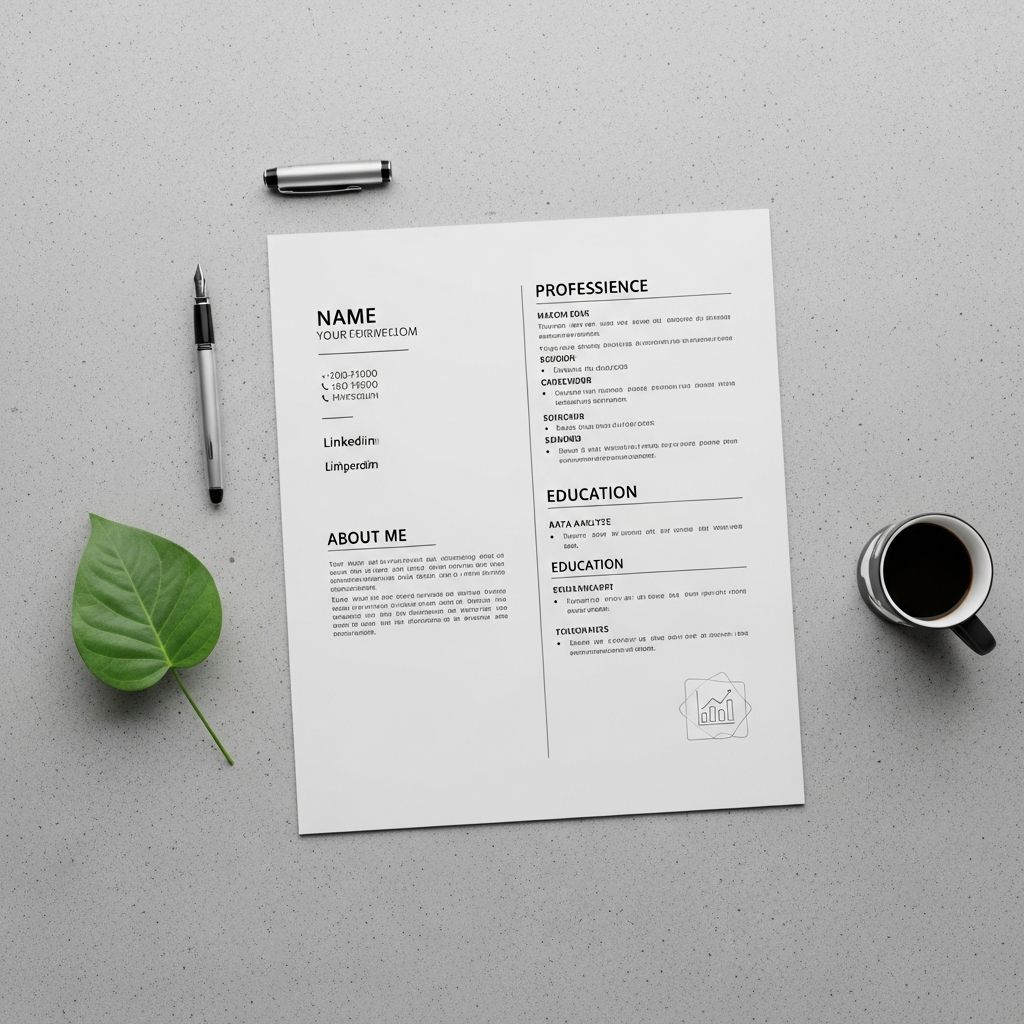
A minimalist resume is not about stripping away personality. It is about removing distractions so your skills, impact, and potential are impossible to miss. In an era where most resumes are first scanned by software, a clean, well-structured layout has become less of a style choice and more of a strategic advantage.
Why Minimalist Resumes Work in Today’s Job Market
Recruiters often skim dozens of resumes per opening, and many organizations rely on Applicant Tracking Systems (ATS) to filter candidates before a human ever looks at the document. A minimalist resume directly addresses these realities.
- Faster readability: Clean layouts help recruiters find job titles, employers, and key achievements in seconds.
- Better ATS parsing: Simple structure and standard headings make it easier for ATS tools to interpret your information correctly.
- Professional impression: A clutter-free design conveys organization, judgment, and attention to detail.
- Focus on substance: With fewer visual extras, your accomplishments, skills, and results take center stage.
Recent resume trends show a shift back to clean, black-and-white, single-column layouts that prioritize clarity and content over elaborate visuals.
Core Principles of a Minimalist Resume
Minimalism in resume design follows a few simple but powerful principles. These apply regardless of industry, level of experience, or country.
1. Simplicity in Layout
A minimalist resume keeps the structure straightforward so both humans and ATS can scan it effortlessly.
- Use a single column for the main content to avoid parsing issues.
- Align text consistently (usually left-aligned) for easy reading.
- Use clear section breaks with generous white space between sections.
- Limit decorative elements such as graphics, shapes, and icons.
2. Consistent, Subtle Formatting
Visual hierarchy should guide the reader’s eye without drawing attention to the design itself.
- Use bold text only for important elements such as section titles, job titles, and company names.
- Rely on font size and spacing instead of colors or lines for emphasis.
- Maintain consistent bullet style, date format, and alignment across the document.
3. Content Over Decoration
A minimalist resume prioritizes meaningful information: responsibilities, accomplishments, and evidence of impact.
- Replace long paragraphs with concise bullet points focused on results.
- Include metrics (percentages, time saved, revenue generated) whenever possible.
- Remove irrelevant or outdated details, such as obsolete software or unrelated hobbies.
4. Accessibility and ATS Compliance
Modern hiring systems often analyze resumes automatically before they reach a human reviewer. Simple, structured formatting makes your resume easier to parse.
- Use standard headings like “Work Experience,” “Education,” and “Skills.”
- Avoid text in images, charts, or complex tables—ATS tools may not read it reliably.
- Export to PDF with selectable text (not scanned images) to maintain clarity and structure.
Ideal Structure for a Minimalist Resume
There is no single perfect layout, but most minimalist resumes follow a variation of the structure below.
| Section | Purpose | Minimalist Tips |
|---|---|---|
| Contact Information | Identify and reach you easily. | Keep to name, phone, professional email, city/region, LinkedIn or portfolio. |
| Professional Summary | Provide a quick snapshot of who you are and what you offer. | 2–3 lines; include role, years of experience, and top achievements or focus areas. |
| Key Skills | Highlight your core technical and soft skills. | Group similar skills; use simple bullet lists and job-related keywords. |
| Work Experience | Demonstrate achievements, responsibilities, and career progression. | Reverse chronological; 3–6 bullets per role; emphasize outcomes with metrics. |
| Education | Show degrees, relevant coursework, and academic distinctions. | List highest level first; include honors, GPA (if strong and recent), and key projects if relevant. |
| Additional Sections | Support your profile with extra credibility. | Certifications, languages, publications, or volunteering—only if relevant. |
Design Choices That Define a Minimalist Resume
Every decision in a minimalist resume—fonts, spacing, or even the use of lines—should serve clarity.
Fonts and Typography
- Choose simple, widely available fonts such as Arial, Calibri, Helvetica, or Times New Roman.
- Use a font size of about 10–12 pt for body text and slightly larger for headings.
- Limit yourself to one font family; use bold or small caps for differentiation instead of adding more fonts.
Colors and Visual Elements
- Black or dark gray text on a white background is easiest to read and safest for ATS.
- Use color, if at all, sparingly—perhaps a single accent color for headings.
- Avoid pictures, icons, and heavy graphics that distract or confuse parsing systems.
White Space and Margins
- Use margins of roughly 1–1.5 cm (0.4–0.6 inches) to prevent the page from feeling cramped.
- Insert clear space between sections to guide the eye naturally down the page.
- Keep bullet lists concise so each block of text feels breathable rather than dense.
Content Strategy for a Minimalist Resume
Minimalism is not only visual; it also involves conscious decisions about what to include and what to remove.
Focus on Achievements, Not Just Tasks
Recruiters and hiring managers are primarily interested in what you achieved, not simply what you were responsible for.
- Transform generic duties into results, for example:
- Instead of “Responsible for managing a team,” write “Led a team of 8 analysts, improving reporting speed by 25%.”
- Include numbers when possible: revenue, cost savings, time savings, growth, or efficiency improvements.
- Show progression: promotions, new responsibilities, or leadership opportunities.
Tailor for Each Role
Minimalist resumes work best when tailored to a specific position. This does not mean rewriting from scratch, but aligning content with each job description.
- Mirror critical keywords and skills from the job ad in your skills and experience sections.
- Prioritize bullet points that match the employer’s most important requirements.
- Remove or de-emphasize experience that does not contribute to the story you want to tell for that role.
Keep Length Under Control
Often, a minimalist resume is short because it is selective, not because it lacks experience.
- Early-career candidates typically aim for one page.
- Professionals with 10+ years of experience may justifiably need two pages, but should still avoid repetition.
- Limit older experience (beyond 10–15 years) to brief entries unless clearly relevant.
Minimalist vs. Complex Resumes: A Quick Comparison
The table below contrasts minimalist resumes with more complex, design-heavy resumes.
| Aspect | Minimalist Resume | Complex / Graphic Resume |
|---|---|---|
| Layout | One column, simple headings | Multiple columns, boxes, shapes |
| ATS Compatibility | High – easy to parse | Variable – may cause parsing errors |
| Readability | Quick to skim; low visual noise | Can be distracting or overwhelming |
| Best For | Most industries, especially corporate and technical roles | Some creative roles where portfolios matter more than ATS |
Adapting Minimalist Resumes to Different Career Situations
Minimalist principles are flexible enough to work for a variety of backgrounds and career stages.
Students and Recent Graduates
- Place Education near the top, followed by internships, projects, and relevant coursework.
- Use bullet points to describe academic projects with measurable outcomes (e.g., survey responses, project scope, or tools used).
- Include a concise “Relevant Coursework” or “Academic Projects” section only if it adds clear value.
Career Changers
- Lead with a strong Professional Summary that connects your past experience to your new target field.
- Highlight transferable skills (communication, leadership, analysis, customer service) in a prominent skills section.
- Use bullet points to emphasize outcomes and responsibilities that resemble those in your goal industry.
Experienced Professionals
- Emphasize strategic impact and leadership: budgets managed, teams led, goals achieved.
- Summarize early roles briefly and focus detail on the most recent 8–10 years.
- Add a short “Selected Achievements” subsection if you have standout highlights.
Common Mistakes to Avoid in Minimalist Resumes
Minimal does not mean incomplete or vague. Avoid these frequent errors:
- Being too generic: One-sentence bullet points with no outcomes or details fail to differentiate you.
- Over-simplifying sections: Removing context such as company size, industry, or tools can make achievements harder to interpret.
- Skipping keywords: Minimalist design still needs job-relevant terminology to pass ATS filters.
- Using tiny fonts: Trying to squeeze everything onto one page by shrinking text harms readability.
- Leaving unexplained gaps: Minimalism is not an excuse to hide employment gaps; use brief explanations if needed.
Practical Checklist for a Minimalist Resume
Use the checklist below before you send your resume:
- Layout is single column with clear section headings.
- Font is standard, professional, and easy to read.
- Key skills match the language of the job posting.
- Each role includes measurable achievements or clear outcomes.
- No unnecessary graphics, icons, or photos.
- File is saved as a PDF with selectable text.
- Resume length is appropriate for your experience level.
Frequently Asked Questions (FAQs)
Q: Is a minimalist resume suitable for creative roles?
A: Often yes, especially when paired with a strong portfolio. For design, marketing, or content roles, use a clean minimalist resume for applications and interviews, and direct hiring managers to an online portfolio or samples that showcase your visual creativity.
Q: Can I use color on a minimalist resume?
A: You can, but sparingly. A single accent color for headings or key lines is usually enough. Avoid multicolored text, gradients, or background images that reduce readability or complicate printing and ATS parsing.
Q: How many skills should I list on a minimalist resume?
A: Focus on quality over quantity. Aim for 8–15 carefully chosen skills, grouped logically (for example, technical, tools, and soft skills). Make sure each one aligns with the requirements of your target role.
Q: Do minimalist resumes work for ATS systems?
A: Yes. In fact, they often perform better because they rely on standard headings, simple formatting, and straightforward text that ATS tools can read reliably. Avoid complex layouts, text inside images, or decorative elements that confuse automated parsers.
Q: Should I always keep my resume to one page?
A: Not necessarily. One page is common for students and early-career professionals, but experienced candidates may reasonably use two pages. The key minimalist principle is relevance: include only what strengthens your case for the role.
References
- 5 Resume Formats That Will Dominate 2025 — The Interview Guys. 2024-03-18. https://blog.theinterviewguys.com/5-resume-formats-that-will-dominate/
- 11 Resume Trends in 2025 That Hiring Managers Can’t Resist — Novorésumé. 2024-01-10. https://novoresume.com/career-blog/resume-trends
- 2025 Resume Trends: What’s Hot, What’s Not — Rezi. 2024-02-05. https://www.rezi.ai/posts/2025-resume-trends
- The Best Resume Format for 2025 (Templates & Examples) — ResumeGenius. 2024-01-01. https://resumegenius.com/blog/resume-help/resume-format

- Integrated M.A. in Applied Linguistics, University of Hyderabad
- 5+ years in editorial, instructional, SEO, and research-based writing
Sneha is a relationships and lifestyle writer with a strong foundation in applied linguistics and certified training in relationship coaching. She brings over five years of writing experience to theskillvault, crafting thoughtful, research-driven content that empowers readers to build healthier relationships, boost emotional well-being, and embrace holistic living. Her writing and insights reflect the belief that beauty, happiness, and wellness…