
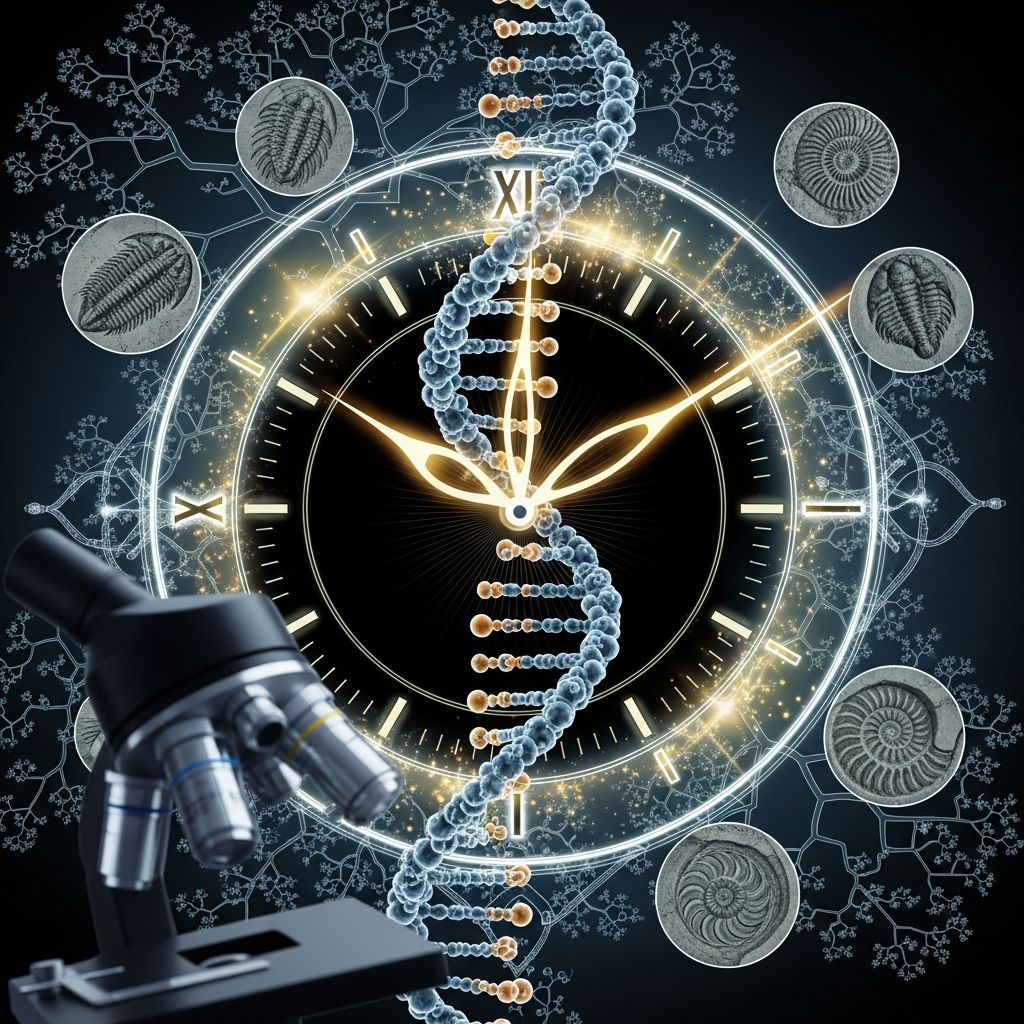
Molecular clocks represent a groundbreaking approach in evolutionary biology, leveraging the steady accumulation of genetic mutations to estimate the timing of species divergences and key evolutionary events. By analyzing DNA or protein sequences, scientists can reconstruct timelines that complement fossil records, offering insights into life’s history over millions of years.
Foundations of Genetic Timekeeping
The concept of a molecular clock emerged in the early 1960s when researchers observed that genetic changes, particularly neutral mutations—those not affecting survival or reproduction—accumulate at predictable rates across generations. Unlike traditional clocks, these biological timers rely on random DNA alterations rather than mechanical ticks, providing a statistical measure of time elapsed since common ancestors diverged.
At its core, the molecular clock hypothesis posits that for certain genes, mutations occur at a relatively constant rate, akin to a stopwatch marking evolutionary epochs. This allows comparisons between species: the more differences in their DNA, the longer ago their lineages split. For instance, in humans, approximately 70 nucleotide changes happen per generation, building up over time to reveal deep history.
- Neutral Mutations: Changes in DNA that do not impact fitness, ideal for clock-like behavior due to lack of selective pressure.
- Calibration: Rates are calibrated using known divergence dates from fossils, ensuring accuracy.
- Gene Variability: Different genes evolve at varying speeds, allowing flexibility for dating recent or ancient events.
How Molecular Clocks Function in Practice
To apply a molecular clock, scientists sequence DNA from two species, count neutral differences, and divide by the known mutation rate per unit time. This yields the time to their most recent common ancestor. For example, the alpha-globin gene mutates at 0.56 changes per base pair per billion years, enabling precise dating.
Two primary types of genetic clocks address different timescales:
| Clock Type | Mechanism | Best For | Example Rate |
|---|---|---|---|
| Mutation Clock | Nucleotide substitutions | Ancient splits (millions of years) | 1×10⁻⁹ per site/year |
| Recombination Clock | Genetic shuffling per generation | Recent events (<100,000 years) | Per generation ticks |
Combining these clocks refines estimates, as seen in Neanderthal-human divergence, dated to 550,000–765,000 years ago using adjusted long-term rates.
Historical Development and Pioneering Insights
Émile Zuckerkandl and Linus Pauling first proposed the molecular clock in 1962, analyzing hemoglobin proteins to estimate primate divergences. Their work on human-horse splits around 100–160 million years ago laid the groundwork, assuming constant rates across lineages.
Over decades, the idea evolved amid challenges like rate variations. Early applications used amino acid sequences and immunological distances, transitioning to genomic data in the modern era. Today, statistical models correct for heterogeneity, making molecular clocks indispensable for the Tree of Life.
Key Applications Across Evolutionary Scales
Dating Human Evolution Milestones
Molecular clocks have revolutionized understanding of Homo sapiens’ origins. They date the human-chimpanzee split to about 6–7 million years ago and Neanderthal admixture events precisely. Ancient DNA from fossils complements this, using recombination clocks for recent gene flow.
Mapping Ancient Explosions and Origins
The Cambrian explosion, primate radiations, and flowering plant divergences have been timed via clocks. By comparing vast gene sets from mammals—over 17,000 sequences—researchers established reliable mutation rates, enhancing precision for mammalian evolution.
- Human-gorilla split: ~8 million years.
- Modern human origins: ~200,000 years, aligned with fossils.
- Whale-elephant common ancestor: Dated via slow-evolving genes.
Resolving Phylogenetic Puzzles
Where fossils are scarce, molecular clocks order events. They reconstruct family trees by inferring shared ancestors, crucial for microbes, plants, and extinct lineages like dinosaurs via bird DNA proxies.
Challenges and Rate Variation Realities
Not all genes tick uniformly; evolutionary rates vary due to generation times, population sizes, and selection. Smaller populations accumulate mutations faster via drift, while long-lived species like mammals show slower rates over deep time.
Historical rates differ: human-chimp divergence uses a slower long-term average (six DNA changes/year), contrasting faster recent pedigrees. Advanced models, like Bayesian relaxed clocks, accommodate this ‘wobble,’ improving accuracy.
Critics note clocks are less precise than atomic timepieces but invaluable when calibrated properly. Ongoing genomic sequencing refines rates, addressing past inconsistencies.
Modern Advancements and Genomic Era Impacts
High-throughput sequencing has supercharged molecular clocks. Whole-genome comparisons across thousands of species yield robust timescales. For mammals, aggregating 5,669 genes from 326 species standardized rates, minimizing errors.
Ancient DNA integration allows direct mutation rate measurements from pedigrees, bridging fossil gaps. Recombination clocks excel for human population history, tracking migrations and adaptations within 100,000 years.
Future Horizons for Evolutionary Timing
Emerging tools like single-cell sequencing and AI-driven rate modeling promise even finer resolutions. Clocks will probe microbial evolution, climate-driven adaptations, and disease origins, intertwining with fields like epidemiology and conservation.
As databases grow, universal rates for life’s domains (bacteria, archaea, eukaryotes) may emerge, fully calibrating the Tree of Life.
Frequently Asked Questions (FAQs)
What is a molecular clock in simple terms?
A molecular clock uses the steady buildup of DNA mutations to estimate how long ago two species shared a common ancestor, like a genetic stopwatch for evolution.
Who invented the molecular clock concept?
Émile Zuckerkandl and Linus Pauling proposed it in 1962 based on protein sequence comparisons.
Why do mutation rates vary between species?
Factors like generation length, population size, and natural selection cause rate differences; neutral mutations provide the most clock-like consistency.
Can molecular clocks replace fossils?
No, they complement fossils; clocks date events while fossils provide morphological context and calibration points.
How accurate are modern molecular clocks?
With genomic data and statistical corrections, they offer divergence estimates within 5–10% error margins for well-calibrated lineages.
References
- How Molecular Clocks Are Refining Human Evolution’s Timeline — SAPIENS. 2023-06-12. https://www.sapiens.org/biology/molecular-clocks/
- The molecular clock and evolutionary timescales — Portland Press, Biochemical Society Transactions. 2018-10-01. https://portlandpress.com/biochemsoctrans/article/46/5/1183/67601/The-molecular-clock-and-evolutionary-timescales
- Probing Question: What is a molecular clock? — Penn State University. 2007-02-26. https://www.psu.edu/news/research/story/probing-question-what-molecular-clock
- Molecular clocks — University of California, Berkeley, Understanding Evolution. N/A. https://evolution.berkeley.edu/molecular-clocks/
- How to Tell Evolutionary Time — Science | AAAS. 2003-11-20. https://www.science.org/content/article/how-tell-evolutionary-time
- Molecular clock hypothesis — EBSCO Research Starters. N/A. https://www.ebsco.com/research-starters/health-and-medicine/molecular-clock-hypothesis
- The Genome as an Evolutionary Timepiece — PMC – NIH. 2017-09-29. https://pmc.ncbi.nlm.nih.gov/articles/PMC5630892/

Medha Deb is an editor with a master's degree in Applied Linguistics from the University of Hyderabad. She believes that her qualification has helped her develop a deep understanding of language and its application in various contexts. Medha specializes in the areas of beauty, health, sports, and wellness and is committed to ensuring that the content on the website is…