
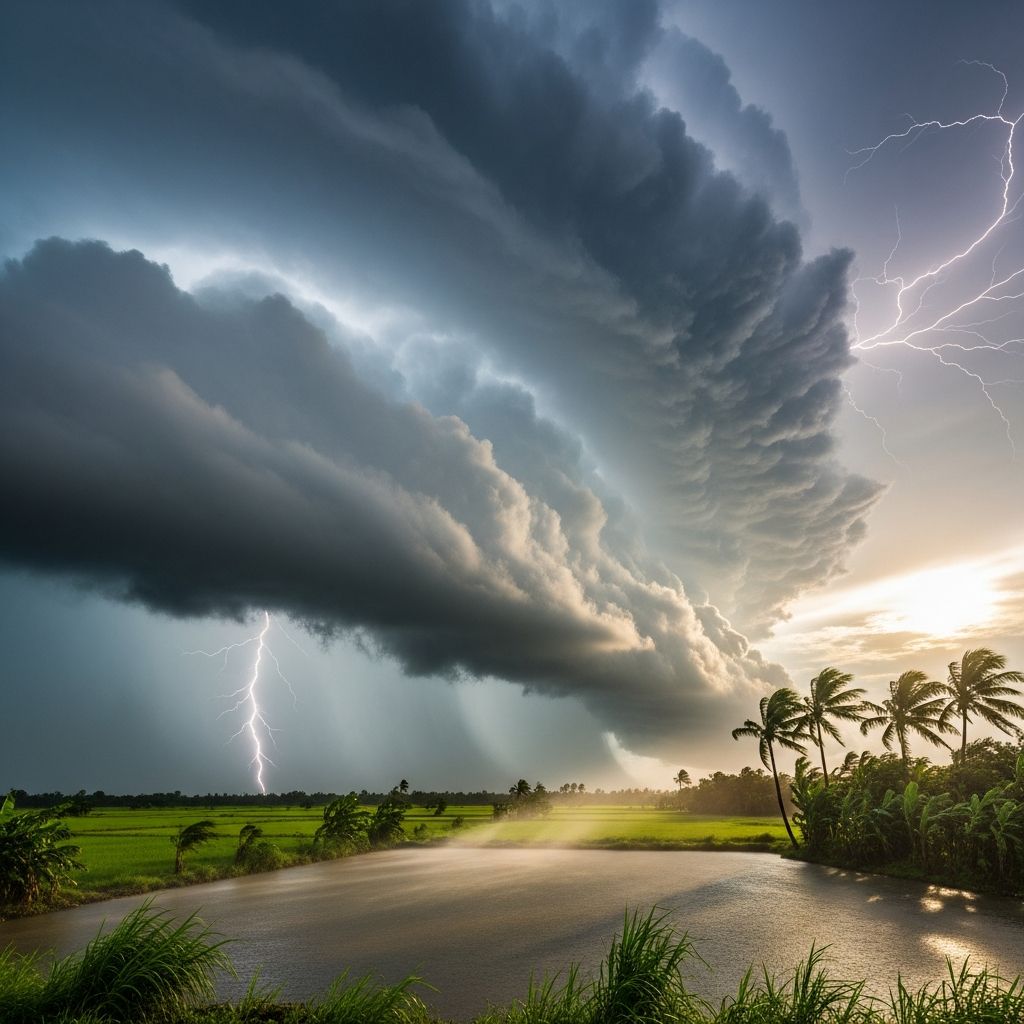
Monsoons define the rhythm of life in many tropical and subtropical areas by creating distinct wet and dry periods through predictable wind reversals. Far from mere rain events, these phenomena involve large-scale atmospheric changes driven by land-ocean temperature differences. This article delves into their mechanics, global reach, influences, and future outlook under changing climates.
The Essence of Monsoon Dynamics
At their core, monsoons arise from seasonal flips in wind direction, tied to the sun’s shifting position and resulting pressure gradients. The term derives from the Arabic ‘mausim,’ meaning season, reflecting their cyclic nature observed by ancient traders.
Land surfaces absorb solar heat faster than oceans, sparking convection. In summer, heated continental air rises, forming low-pressure zones that pull in moist maritime air, yielding heavy precipitation. Winter reverses this: cooling land builds high pressure, driving dry winds outward.
- Key Driver: Differential heating between land and sea creates pressure imbalances.
- Wind Reversal: Summer brings onshore flows; winter, offshore.
- Precipitation Link: Moist air ascent leads to condensation and storms.
Global Monsoon Hotspots
Monsoons span continents, each with unique traits shaped by geography.
Asia’s Dominant Systems
The South Asian monsoon, Earth’s most intense, affects over a billion people. From late May, southwest winds from the Indian Ocean drench the subcontinent, supplying 70-90% of annual rain. Progressing northward, it peaks in July, stalled by the Himalayas, fostering extreme downpours in places like Mawsynram, India, with 11+ meters yearly.
Southeast Asia sees similar patterns, vital for rice paddies, while East Asia’s monsoon blends Pacific influences.
North American Patterns
In southwestern U.S. and Mexico, the North American monsoon starts in June. Gulf of California moisture fuels Arizona and New Mexico thunderstorms from July to September. Elevated terrain amplifies these effects, turning deserts lush temporarily.
African and Australian Influences
West Africa’s monsoon supports Sahel agriculture via southerly Atlantic flows. Northern Australia’s wet season, October-April, mirrors this with low-pressure draws from the ocean.
| Region | Peak Season | Rain Contribution | Notable Feature |
|---|---|---|---|
| South Asia | June-September | 80-90% | Himalayan orographic lift |
| North America | July-September | 50% in deserts | Gulf moisture thunderstorms |
| West Africa | June-October | 70% | Sahel greening |
| Australia | Dec-March | 90% wet season | Cyclone integration |
Mechanisms Powering Monsoon Flows
Monsoons tie to the Intertropical Convergence Zone (ITCZ), a low-pressure belt migrating with the sun. Northern hemisphere summer shifts it north, intensifying Asian rains; southern, boosts Australian ones.
Thermodynamics rule: summer land temps hit 45-50°C, versus cooler seas, birthing sea breezes on continental scales. The Hadley Cell circulates this, with rising equatorial air fueling trade winds.
Upper-level jets and Walker Circulation modulate strength, causing ‘breaks’—sudden dry spells amid wet phases.
Ecological and Human Footprints
Monsoons sustain biodiversity and economies but demand adaptation.
Vital Water Cycles
Rains refill rivers, aquifers, and reservoirs, greening landscapes post-dry spells. In India, they enable two rice crops yearly.
Hazards and Disruptions
Excess brings floods, landslides; deficits, droughts. 2024 India floods displaced millions; failed monsoons spark famines.
- Flooding: River overflows, urban chaos.
- Drought: Crop failures, water scarcity.
- Storms: Enhanced cyclones in bays.
Climate Change’s Evolving Role
Warming intensifies monsoons via higher evaporation and moisture capacity, per IPCC models. Extremes rise: wetter wets, drier dries.
Arctic amplification may weaken patterns; aerosols alter flows. Predictions show 10-20% more Asian rain by 2100, with volatility.
Forecasting and Mitigation Strategies
Agencies like NOAA and IMD use satellites, models for predictions. ENSO links: El Niño weakens Asian monsoons; La Niña strengthens.
Resilience via dams, early warnings, drought-resistant crops.
Frequently Asked Questions
Are monsoons only about heavy rain?
No, they feature wind reversals yielding both wet summers and dry winters.
Which region gets the heaviest monsoon rains?
Cherrapunji/Mawsynram in India, with 11-12m annually.
Do monsoons affect the United States?
Yes, the Southwest monsoon brings summer storms to Arizona and New Mexico.
How does climate change impact monsoons?
It likely increases intensity and variability, heightening flood/drought risks.
What’s the difference between a monsoon and a hurricane?
Monsoons are seasonal wind patterns; hurricanes are intense, rotating storms.
Observing Monsoons Today
Satellites track ITCZ shifts; models refine forecasts. Understanding aids vulnerable populations.
References
- Monsoon – Wikipedia — Wikipedia contributors. 2026. https://en.wikipedia.org/wiki/Monsoon
- Met Office explains: What are monsoons? — Met Office. 2025. https://www.metoffice.gov.uk/blog/2025/met-office-explains-what-are-monsoons
- Ask the Bureau: What is the monsoon? – YouTube — Bureau of Meteorology. 2023. https://www.youtube.com/watch?v=8VWuQ7CJxqo
- What is a monsoon? – YouTube — Met Office. 2023. https://www.youtube.com/watch?v=lpeVqICLTig
- What Is a Monsoon? | NESDIS – NOAA — NOAA NESDIS. 2025. https://www.nesdis.noaa.gov/about/k-12-education/severe-weather/what-monsoon
- What Are Monsoons and Why Do They Happen? — UCAR Center for Science Education. 2025. https://scied.ucar.edu/learning-zone/storms/monsoons

- Integrated M.A. in Applied Linguistics, University of Hyderabad
- 5+ years in editorial, instructional, SEO, and research-based writing
Sneha is a relationships and lifestyle writer with a strong foundation in applied linguistics and certified training in relationship coaching. She brings over five years of writing experience to theskillvault, crafting thoughtful, research-driven content that empowers readers to build healthier relationships, boost emotional well-being, and embrace holistic living. Her writing and insights reflect the belief that beauty, happiness, and wellness…