
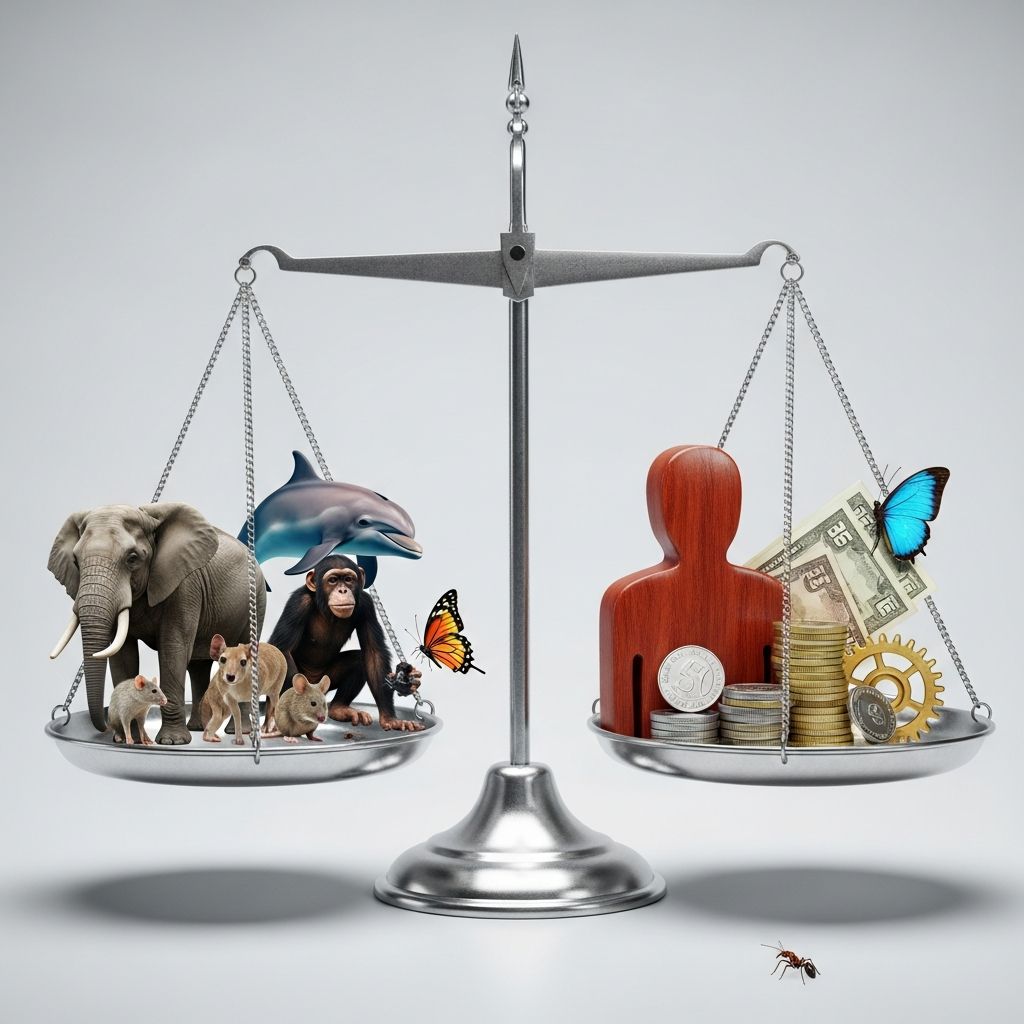
When we decide whether to help a person, a chicken, or a fish, we implicitly answer a difficult question: how much does each being’s welfare matter? The idea of moral weight aims to make that question explicit and, as far as possible, systematic.
This article offers an original overview of how researchers and philosophers think about comparing the welfare of humans and nonhuman animals, why these comparisons are so hard, and how they can still guide real-world action.
1. What Is Moral Weight, In Plain Language?
Moral weight is a way of expressing how much it matters, morally, when a particular kind of being is better or worse off. Roughly, if one unit of suffering for a human counts as “1,” how should we count a similar unit of suffering for a chicken, salmon, or insect?
In much current research, moral weight is closely tied to an animal’s capacity for welfare — the range between the best and worst possible states that a life of that kind can contain.
- Capacity for welfare: how good or bad a life can be for that kind of being, across its whole range of possible experiences.
- Moral status: how much that welfare matters morally, relative to other beings.
- Moral weight (operationally): a combined measure of capacity for welfare and moral status used for comparison across species.
These ideas are especially important in contexts like global health and animal advocacy, where limited resources must be allocated across very different beings and interventions.
2. Why Compare Welfare Across Species At All?
Comparing welfare across species may sound cold or purely theoretical, but it shapes high-stakes decisions:
- Policy and law: How much should legal systems prioritize farmed animals versus human-focused projects, given finite budgets?
- Effective altruism: Organizations trying to do the most good need some way to compare, e.g., reducing human disease with improving conditions for billions of chickens.
- Research funding: Neuroscience and behavioral science can either focus largely on humans or also devote serious attention to nonhuman animal experience.
- Personal ethics: Choices about diet, career, and activism depend on how much weight we give to animal suffering.
Some researchers have tried to formalize these comparisons by treating moral weight as a parameter that can enter cost-effectiveness calculations, for instance in large projects aimed at providing “moral weights” for a range of farmed animals. These efforts do not claim to give final answers, but they show how taking animal welfare seriously can radically change which interventions look most impactful.
3. Two Key Building Blocks: Capacity for Welfare and Moral Status
A central insight in the recent literature is that capacity for welfare and moral status are conceptually distinct, even if they are often related.
| Concept | Core Question | Illustrative Role |
|---|---|---|
| Capacity for welfare | How big is the welfare range for this kind of being? | Humans may have richer emotional and cognitive lives than some animals, so the highs and lows of human life might be more extreme. |
| Moral status | How much does each unit of welfare matter morally for this being? | On some views, all sentient beings have the same moral status; on others, beings with more complex capacities have higher status. |
| Moral weight (operational) | How should we weight welfare changes for this being in calculations? | Used in cost-effectiveness analysis to compare benefits to humans, pigs, chickens, fish, etc. |
Researchers also introduce a helpful idea: status-adjusted welfare, which is the welfare an individual experiences multiplied by that individual’s moral status. This gives a common “currency” for comparisons, no matter which view of moral status one adopts.
4. Unitarian vs Hierarchical Views: Does Status Come in Levels?
There is deep philosophical disagreement about whether moral status comes in degrees.
4.1 Unitarian approaches
Unitarian views claim that all sentient beings who can suffer or enjoy experiences share the same moral status. Well-known defenders of this approach argue that if an experience of pain is equally intense and long-lasting in a human and a mouse, it matters equally, morally, regardless of species.
However, unitarians can still say that humans may often take priority in practice, because human lives may support a wider range of positive and negative experiences. That is, humans might have a greater capacity for welfare, even if they do not have higher status.
4.2 Hierarchical approaches
Hierarchical views claim that some beings have higher moral status than others, typically grounded in capacities like rational agency, self-awareness, or complex social relationships. On these views:
- Beings with richer cognitive and emotional lives can generate more morally significant welfare.
- Equal amounts of suffering in, say, a human and a fish might not be equally important morally.
Some philosophers argue this hierarchy helps explain why we often judge it more urgent to prevent a severe harm to a human than an equivalent harm to a nonhuman animal, and why we rarely see it as an injustice that mice, as a group, are worse off than humans.
4.3 A shared tool: status-adjusted welfare
Despite their differences, both sides can work with the same formal tool: status-adjusted welfare.
- Unitarians set moral status equal across sentient beings, but allow capacity for welfare to vary.
- Hierarchists let moral status vary, often linked to capacities for welfare and rational choice.
From a practical standpoint, this means that researchers can discuss “moral weights” even while admitting deep moral uncertainty about the correct picture of status.
5. How Researchers Try to Estimate Moral Weights
In practice, estimating moral weights blends empirical science with philosophical assumptions. Several strands of work stand out:
- Behavioral and cognitive evidence: Studies of learning, problem-solving, pain behavior, and social interaction across species inform judgments about cognitive and emotional complexity.
- Neuroscience and nociception: Research on nervous systems and pain processing helps determine which animals are likely capable of suffering and to what extent.
- Expert judgment and structured uncertainty: Some projects use expert surveys combined with explicit modeling of moral disagreement to generate wide uncertainty ranges for the relative moral value of different animals.
- Explicit ethical assumptions: Many quantitative projects adopt a simplified framework—for example, utilitarianism, a focus on experiential welfare, and equal consideration of like experiences—to remain tractable.
One comprehensive effort developed a framework for comparing welfare across species by linking cognitive and affective capacities to welfare ranges and then combining these with explicit assumptions about moral status to derive comparable welfare measures across humans and nonhuman animals.
6. Sources of Deep Uncertainty
Even the most careful projects report very large uncertainty in their estimates. Some Monte Carlo simulations that aggregate different ethical viewpoints and empirical interpretations find ranges that stretch from assigning animals essentially no moral value up to assigning them value comparable to humans.
Key drivers of this uncertainty include:
- Limited empirical data on animal consciousness, especially for invertebrates and less-studied vertebrates.
- Philosophical disagreement about which features ground moral status and how to treat differences in cognitive capacity.
- Modeling choices, such as which behavioral traits to count as evidence of valenced states, and how to weight expert priors about sentience.
- Framing assumptions, for example, whether to assume equal moral status across sentient beings or allow a hierarchy.
Some critics argue that specific projects may, intentionally or not, make “animal-friendly” choices at key methodological junctures, pushing estimated moral weights for animals closer to those of humans. Others stress that if we take existing behavioral and neuroscientific evidence at face value, we must at least treat nonhuman suffering as morally serious, even if precise numbers remain elusive.
7. Practical Implications for Cause Prioritization
Even highly uncertain moral weights can dramatically influence which problems look most pressing.
- Scale of impact: Trillions of farmed fish and tens of billions of farmed land animals are raised and killed each year worldwide, many in conditions associated with severe and prolonged suffering. Even small moral weights assigned to each individual can add up to enormous moral stakes.
- Cost-effectiveness: Some interventions that improve farmed animal welfare are relatively inexpensive per animal affected, which means they can appear very cost-effective under a range of plausible moral weights.
- Robustness to disagreement: Because uncertainty ranges are so wide, many analysts advocate focusing on interventions that look good under both more “human-centered” and more “animal-friendly” views—such as reducing the most extreme forms of confinement or supporting research on alternatives to intensive farming.
From the perspective of ethical decision-making under uncertainty, it can be rational to treat moral weights as parameters in a sensitivity analysis rather than fixed truths. If outcomes remain highly favorable for animal-focused interventions even when one uses conservative (low) animal moral weights, that provides a strong practical argument for prioritizing those interventions.
8. Common Misunderstandings About Moral Weight
Discussions of moral weight can easily be misunderstood. Clarifying a few points helps keep debate productive.
- Not about “worth” in a personal sense: Moral weights are not judgments about which individuals are “more valuable as persons” or “deserve to exist.” They are tools for aggregating welfare impacts in policy and philanthropy.
- Compatible with rights-based thinking: Even if one believes animals have strong rights that should not be violated, one might still use moral weight ideas when comparing permissible trade-offs among rights-respecting options.
- Incomplete without indirect effects: Helping humans can have large positive or negative knock-on effects for animals and ecosystems; responsible use of moral weights should consider such indirect impacts, not just direct welfare changes.
- Not a substitute for moral judgment: Quantitative moral weights can inform, but not replace, broader ethical reasoning about fairness, justice, and precaution.
9. How Individuals Can Use These Ideas
Even if you are not building detailed models, you can still let moral weight thinking refine your ethical decisions.
9.1 Clarify your own assumptions
- Do you think all beings who can feel pain have the same moral status, or do you think status comes in degrees?
- How much uncertainty do you feel about the inner lives of different animals?
- Under your best-guess view, which types of suffering look most urgent to reduce?
9.2 Look for robustly good options
Because uncertainty is so large, a practical strategy is to favor actions that look valuable across many reasonable views:
- Reducing the most severe, long-lasting forms of animal suffering, such as extreme confinement.
- Supporting rigorous research on animal sentience and welfare indicators.
- Backing policies that improve both human and animal welfare when possible, such as food system reforms that reduce pollution and suffering simultaneously.
9.3 Treat moral weight as an evolving input
New evidence from behavioral science, neuroscience, and comparative psychology continues to refine our understanding of animal minds. It is reasonable to treat your current view about moral weights as a working model that should be updated as better data and arguments become available.
10. Frequently Asked Questions (FAQs)
Q1: Does comparing moral weights mean valuing humans less?
No. Many frameworks treat human welfare as extremely important while also acknowledging that nonhuman animals can experience serious suffering that deserves moral concern. Adding animals to the moral calculus expands the circle of concern; it does not require reducing the value of human life.
Q2: How can we compare experiences across such different species?
We cannot do this perfectly, but researchers draw on behavioral responses to pain, learning and problem-solving abilities, stress physiology, and neuroanatomy to make cautious inferences about how intense and complex experiences might be in different animals. Large uncertainty remains, which is why some projects explicitly represent wide ranges in their estimates.
Q3: What if we are very unsure whether some animals are sentient?
One approach is to assign a probability of sentience and multiply it by an estimate of welfare range, effectively treating moral weight as a probability-weighted expectation. Under moral risk aversion, even modest probabilities of sentience for vast numbers of animals can justify substantial precaution.
Q4: Are insects or fish likely to have significant moral weight?
Many scientists now consider at least some invertebrates and most vertebrate fish as plausible candidates for sentience, given evidence about their nervous systems, learning, and pain-related behavior. Even if each individual has a lower moral weight than a human, the enormous numbers involved may make their treatment a major moral issue.
Q5: Should we wait for more data before acting on animal moral weights?
Most analysts argue that we should not: delaying action risks allowing vast amounts of preventable suffering to continue. Instead, they recommend prioritizing interventions that are robustly valuable under many plausible moral weight assumptions and continuing to support research that can refine those assumptions over time.
References
- Moral Weights of Animals, Considering Viewpoint Uncertainty — Seeds of Science. 2023-04-19. https://www.theseedsofscience.pub/p/moral-weights-of-animals-considering
- Comparisons of capacity for welfare and moral status across species — Rethink Priorities. 2019-05-23. https://rethinkpriorities.org/research-area/comparisons-of-capacity-for-welfare-and-moral-status-across-species/
- An Introduction to the Moral Weight Project — Rethink Priorities. 2022-01-26. https://rethinkpriorities.org/research-area/an-introduction-to-the-moral-weight-project/
- Is RP’s Moral Weights Project too animal friendly? Four critical junctures — Effective Altruism Forum. 2022-03-28. https://forum.effectivealtruism.org/posts/E9NnR9cJMM7m5G2r4/is-rp-s-moral-weights-project-too-animal-friendly-four
- How Much Do Animals Feel? Understanding Welfare Ranges — Faunalytics. 2023-05-09. https://faunalytics.org/how-much-do-animals-feel-understanding-welfare-ranges/
- Weighing Animal Welfare: Comparing Well-Being Across Species — Eds. Bob Fischer et al., Oxford University Press. 2022-11-10. https://academic.oup.com/book/58809

- Integrated M.A. in Applied Linguistics, University of Hyderabad
- 5+ years in editorial, instructional, SEO, and research-based writing
Sneha is a relationships and lifestyle writer with a strong foundation in applied linguistics and certified training in relationship coaching. She brings over five years of writing experience to theskillvault, crafting thoughtful, research-driven content that empowers readers to build healthier relationships, boost emotional well-being, and embrace holistic living. Her writing and insights reflect the belief that beauty, happiness, and wellness…