
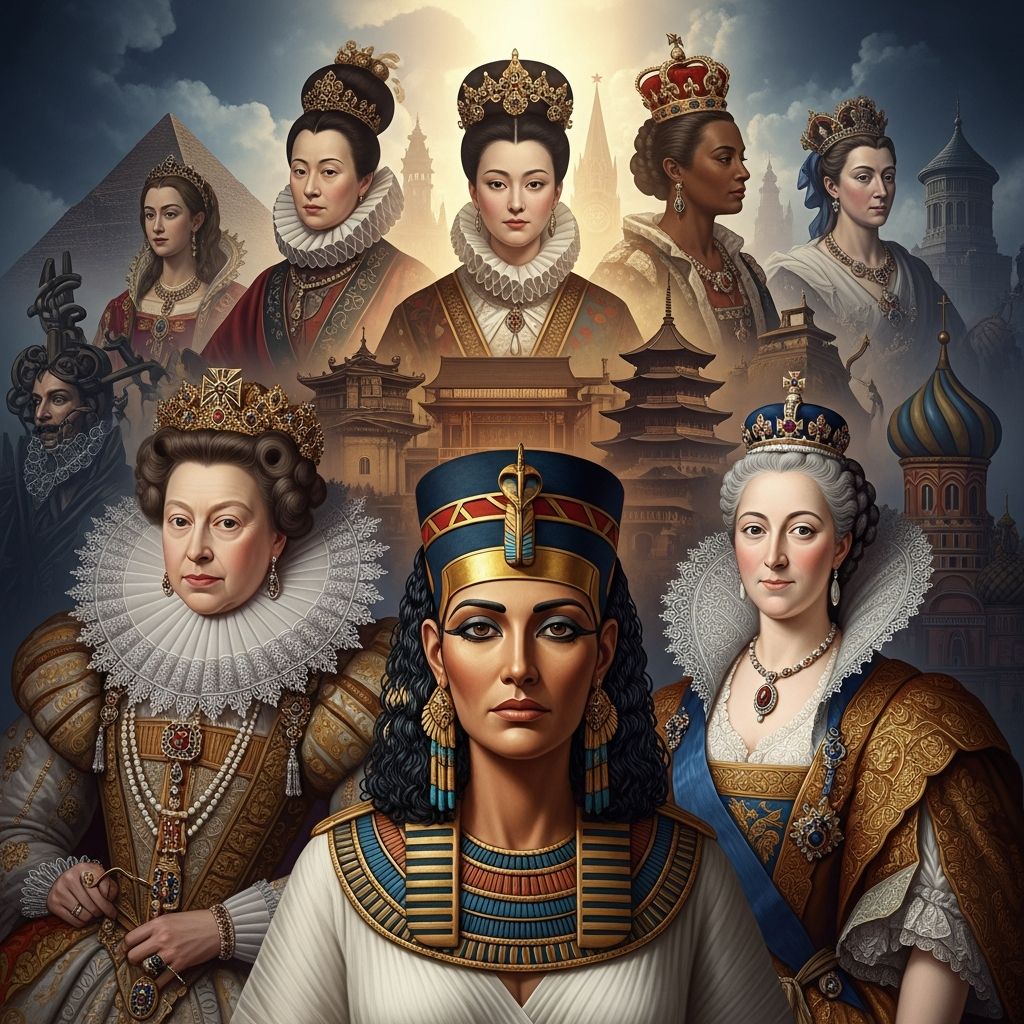
Visionary Women Who Transformed Global Empires
Throughout human history, women have wielded tremendous power and influence despite operating within societies that frequently limited their authority and challenged their legitimacy. The women who ascended to positions of supreme power often did so through remarkable intelligence, strategic brilliance, and unwavering determination. Their reigns fundamentally altered the trajectories of nations, expanded territories, reformed legal systems, and established cultural legacies that persisted for centuries. These female leaders demonstrated that gender posed no obstacle to effective governance, military strategy, or diplomatic acumen. Their stories challenge conventional narratives about historical power dynamics and reveal the sophisticated ways women navigated patriarchal constraints to achieve extraordinary influence.
Ancient Egypt’s Pharaonic Legacy: Hatshepsut and Tawosret
Ancient Egypt produced some of history’s most remarkable female rulers who commanded absolute authority over one of the ancient world’s most sophisticated civilizations. Hatshepsut emerged as a particularly influential figure, establishing herself as pharaoh and presiding over an era of unprecedented prosperity and expansion. She commissioned monumental building projects that showcased Egypt’s wealth and power, including temples and monuments that remained architectural marvels for millennia. Her reign emphasized trade expeditions rather than military conquest, establishing commercial networks that enriched the Egyptian treasury. Hatshepsut demonstrated that effective leadership encompassed diverse strategies beyond warfare, incorporating economic development and cultural patronage.
Tawosret, another prominent Egyptian ruler, inherited the throne during turbulent times and proved her administrative capabilities by stabilizing the kingdom and maintaining internal order. She navigated complex political landscapes, managing relationships with powerful nobles and military commanders while preserving Egypt’s territorial integrity. Both women overcame cultural expectations that reserved pharaonic authority for male successors, establishing themselves as legitimate rulers worthy of their subjects’ loyalty and respect.
The Cosmopolitan Power Broker: Cleopatra VII
Cleopatra VII of Egypt represents one of history’s most intellectually formidable rulers, renowned for her linguistic abilities, diplomatic sophistication, and strategic marriages that shaped Mediterranean politics. She communicated fluently in multiple languages and possessed deep knowledge of astronomy, mathematics, and philosophy, embodying the Hellenistic ideals of her era. Rather than relying solely on military might, Cleopatra weaponized her intelligence and charm, forming strategic alliances with Julius Caesar and subsequently Mark Antony that bolstered Egypt’s position against the emergent Roman power. Her ability to negotiate with some of history’s most ambitious military commanders demonstrated her exceptional acumen in international relations. Though ultimately defeated by Octavian (later Augustus), Cleopatra’s influence on Mediterranean geopolitics extended far beyond her lifetime, and her story became legendary throughout the ancient world.
Imperial Reformers: Wu Zetian and Theodora
Wu Zetian stands as the sole female emperor in Chinese history, a distinction that underscores her exceptional political achievements within the rigidly hierarchical Confucian system. She ascended through marriage and concubinage before eventually establishing her own dynasty, ruling definitively for approximately fifteen years. Her administration expanded Chinese territorial holdings, promoted economic prosperity, and implemented educational reforms that democratized access to government positions through merit-based examination systems. Wu Zetian patronized Buddhism extensively, using religion as a tool for cultural cohesion and legitimizing her authority through spiritual channels. Her reign marked an era of Tang Dynasty flourishing, demonstrating that female governance could deliver tangible improvements in imperial administration and national prosperity.
Theodora, Byzantine empress, wielded influence that contemporaries recognized as exceeding that of her nominal superior, the emperor Justinian. She actively shaped imperial policy, championed religious causes, and initiated substantial legal reforms protecting women’s rights and vulnerable populations. Theodora established protections for divorced women, regulated marriage practices, and created sanctuaries for formerly enslaved individuals. Her advocacy for women’s legal standing represented revolutionary progress for sixth-century governance, anticipating modern human rights principles by more than a thousand years. She demonstrated that imperial women could function as independent political actors rather than ceremonial accessories to male power.
Medieval and Medieval-Adjacent Rulers
The medieval and early modern periods witnessed female rulers commanding resources comparable to their male counterparts, establishing themselves as formidable political forces within feudal hierarchies and emerging nation-states. These women navigated complex networks of familial obligation, religious authority, and feudal loyalty while maintaining their personal prerogatives and advancing their dynastic interests.
Georgia’s Golden Age Under Queen Tamar
Queen Tamar of Georgia presided over what historians recognize as Georgia’s Golden Age, earning the prestigious title of “King of Kings” in acknowledgment of her supreme authority. She inherited the throne following her father’s death and immediately established her dominance over Georgian nobles who questioned her legitimacy. Tamar’s military campaigns expanded Georgian territory significantly, incorporating neighboring regions in the Caucasus and establishing Georgia as a dominant regional power. Her reign emphasized cultural flourishing alongside military expansion, with artistic production and religious patronage reaching unprecedented levels. Later Georgian rulers consistently invoked Tamar as an exemplary model of ideal kingship, demonstrating the lasting cultural impact of her governance and the respect she commanded among her successors.
Yemen’s Stabilizing Force: Queen Arwa
Queen Arwa maintained Yemen’s stability and autonomy during periods when external powers sought dominion over Arabian Peninsula territories. She skillfully managed relationships with the Fatimid Caliphate in Egypt while simultaneously negotiating with regional tribal factions that possessed considerable independent power. Her diplomatic acumen prevented the complete subordination of Yemen to external imperial authorities, preserving local autonomy and prosperity. Arwa became remembered as one of the Arabian Peninsula’s most capable rulers, her legacy emphasizing the value of diplomatic sophistication and balanced power-sharing arrangements.
The Crusader States: Melisende of Jerusalem
Melisende of Jerusalem represented one of the rare women to exercise genuine regnant authority within the Latin East’s hierarchical feudal structures. She inherited legitimate claims to ruling authority and resisted her husband’s attempts to marginalize her political role, ultimately compelling him to recognize her rightful status. Melisende’s determination to maintain personal authority challenged contemporary assumptions about female governance in the Crusader states, establishing precedents for female participation in East-West religious conflicts and political maneuvering.
The Mongol Empire’s Influential Women
The Mongol Empire, despite its reputation for masculine military culture, witnessed the rise of exceptionally influential female administrators who commanded vast resources and directed imperial policy. These women frequently served as regents following the deaths of khans, assuming control over territories spanning multiple continents.
Töregene Khatun’s Imperial Regency
Töregene Khatun assumed the position of Great Khatun following her husband Ögedei Khan’s death in 1241, effectively controlling the entire Mongol domains for five years. She consolidated imperial authority, eliminated political rivals, and promoted administrators loyal to her vision of governance. Her successful management of the world’s largest contiguous land empire demonstrated that Mongol political structures, unlike some contemporary societies, permitted capable women to exercise supreme authority. Töregene’s regency proved that female governance could maintain imperial cohesion and prevent the fragmentation that might have occurred under weaker leadership.
Borte Ujin’s Advisory Influence
Borte Ujin, the wife of Genghis Khan and empress of the Mongolian Empire, served as one of her husband’s most trusted advisors and managed the Mongol homeland during his extended military campaigns. She exercised substantial domestic authority, making decisions affecting millions of subjects during periods when the khan remained preoccupied with distant military conquests. Her contributions to Mongol imperial governance, though often overshadowed by Genghis Khan’s military achievements, proved essential to maintaining domestic stability and ensuring the empire’s administrative continuity.
Medieval Islamic Leadership: Shajar al-Durr
Shajar al-Durr navigated the complex political landscape of medieval Islamic Egypt, demonstrating exceptional strategic capabilities during the Seventh Crusade. Upon her husband’s death, she concealed the information to maintain political stability and orchestrated Egypt’s successful defense against King Louis IX of France. Her military leadership impressed Egypt’s military elite sufficiently that they selected her as Sultana in 1250, elevating her to supreme authority. She became one of the most powerful women in medieval Islamic history, commanding military resources and making decisions affecting an empire spanning North Africa and the eastern Mediterranean. Her transition from widow to supreme ruler challenged Islamic governance conventions and demonstrated that institutional structures could accommodate female authority when circumstances demanded decisive leadership.
Early Modern European Power: Catherine the Great
Catherine II of Russia, known as Catherine the Great, staged a coup overthrowing her unpopular husband Peter III, positioning herself as Russia’s supreme ruler. She proved exceptionally effective at governance, surrounding herself with capable advisers and cultivating relationships with influential intellectuals and political figures. Catherine’s territorial acquisitions expanded Russia’s borders substantially, incorporating Crimea, Belarus, Lithuania, and portions of Poland through diplomatic negotiation and strategic military action. She functioned as a patron of the arts, literature, and education, establishing Russia as an intellectual center that attracted Europe’s greatest minds. Catherine embraced Enlightenment principles, modernizing Russian institutions and integrating Russia into Europe’s cultural and intellectual movements. Her thirty-four-year reign transformed Russia from a relatively isolated Eastern European power into a major European player with influence extending from the Baltic to the Black Sea.
British Imperialism’s Greatest Female Monarch: Elizabeth I
Elizabeth I of England, the final Tudor monarch, presided over England’s transformation into a major European power and established the foundations for Britain’s subsequent imperial dominance. She cultivated her image as the Virgin Queen dedicated solely to England’s welfare, using her unmarried status strategically to maintain political autonomy and prevent foreign powers from exercising influence through a royal spouse. Elizabeth’s reign witnessed the defeat of the Spanish Armada, establishing England as a formidable naval power capable of challenging Spain’s imperial supremacy. She encouraged cultural and religious transformation, promoting the Renaissance in England and establishing Protestantism as the nation’s dominant faith. The forty-five-year Elizabethan Era became synonymous with English cultural flourishing, economic expansion, and increasing global influence. Elizabeth demonstrated that female monarchs could command military loyalty, defeat powerful enemies, and establish themselves as symbols of national greatness.
Colonial and Imperial Expansion: Victoria and Elizabeth II
Queen Victoria reigned for sixty-three years over an expanding British Empire that ultimately encompassed territories across six continents. The Victorian Era became identified with British imperial dominance, industrial advancement, and particular cultural values that the queen embodied and promoted. Victoria’s reign witnessed significant social reforms, including slavery abolition throughout British colonies and expanded voting rights for British male subjects. She transformed the British monarchy from a position of absolute power to a constitutional authority symbolizing national unity and stability.
Queen Elizabeth II became history’s longest-reigning female monarch, exercising constitutional authority for seventy years. Her reign spanned the post-imperial era, witnessing the transformation of the British Empire into a Commonwealth of independent nations. Elizabeth’s longevity and consistency provided stability during periods of significant global change, and her status as a female monarch became normalized within modern governance systems.
Ancient and Non-European Female Authority
Female leadership extended across diverse geographical regions and historical periods, demonstrating that women’s capacity for governance transcended particular cultural or temporal contexts. Zenobia of Palmyra challenged Roman imperial authority by seizing control of Rome’s eastern territories, including Egypt, despite her kingdom’s limited resources compared to Rome’s vast military apparatus. Lakshmibai, the Rani of Jhansi, emerged as a symbol of resistance against British imperial rule in India, leading military forces in direct confrontations with occupying armies and becoming known as the Indian Joan of Arc. Boudica of the Iceni led British Celtic tribes in rebellion against Roman conquest, demonstrating that indigenous populations could produce female military leaders capable of organizing substantial resistance movements.
Comparative Leadership Characteristics
| Ruler | Era | Primary Accomplishment | Governance Duration |
|---|---|---|---|
| Catherine the Great | 18th Century | Territorial Expansion & Enlightenment Patronage | 34 years |
| Elizabeth I | 16th Century | Naval Dominance & Cultural Transformation | 45 years |
| Wu Zetian | 7th-8th Century | Dynasty Establishment & Educational Reform | 15 years |
| Theodora | 6th Century | Legal Reforms & Women’s Rights Advocacy | 20 years |
| Cleopatra VII | 1st Century BCE | Diplomatic Relations & Cultural Synthesis | 21 years |
Frequently Asked Questions
Q: Did female rulers face greater challenges than male rulers?
A: Yes, female rulers frequently encountered skepticism regarding their legitimacy, resistance from male nobility, and opposition based on gender rather than capability. However, many overcame these obstacles through demonstrating exceptional competence, building strong support networks, and strategically leveraging cultural or religious authority.
Q: How did female rulers typically acquire power?
A: Female rulers came to power through diverse mechanisms including inheritance of legitimate claims, marriage into powerful families, serving as regents for young male heirs, military achievement, popular support, and in some cases, overthrowing predecessors. Each woman’s path reflected her particular historical circumstances and the institutional structures of her society.
Q: What distinguished the most successful female rulers?
A: Successful female rulers typically possessed exceptional intelligence, diplomatic sophistication, strategic vision, and the ability to build coalitions of support among influential factions. Many demonstrated flexibility in adapting their leadership styles to changing circumstances while maintaining core principles regarding governance and their subjects’ welfare.
Q: How did female rulers handle resistance to their authority?
A: Female rulers employed varied strategies including cultivating powerful allies, eliminating political rivals, demonstrating military competence, associating themselves with religious authority, and in some cases, adopting male titles or presenting themselves in gender-neutral terms to maximize acceptance and minimize opposition based on gender.
Q: What impact did female rulers have on women’s rights historically?
A: While not all female rulers prioritized women’s rights, some implemented significant reforms. Theodora established protections for women’s legal status, Catherine the Great promoted education, and others challenged assumptions about female capability through their effective governance, gradually expanding possibilities for women’s participation in political authority.
References
- 25 Medieval Women Who Ruled — Medievalists.net. 2025-03. https://www.medievalists.net/2025/03/medieval-women-who-ruled/
- The Most Powerful Women Rulers in History — History Facts. https://historyfacts.com/famous-figures/article/the-most-powerful-women-rulers-in-history/
- 15 of the Most Powerful Women in History — Big Think. https://bigthink.com/the-present/top-15-most-powerful-women-in-history/
- The 20 Most Powerful Women In History — HistorySnob. https://www.historysnob.com/historical-figures/20-most-powerful-women-history
- The Women Who Ruled The World (3500 Years Ago) — Curiosity University. https://www.curiosityu.com/woman-ancient-world-fb/
- List of Female Monarchs — Wikipedia. https://en.wikipedia.org/wiki/List_of_female_monarchs

- Integrated M.A. in Applied Linguistics, University of Hyderabad
- 5+ years in editorial, instructional, SEO, and research-based writing
Sneha is a relationships and lifestyle writer with a strong foundation in applied linguistics and certified training in relationship coaching. She brings over five years of writing experience to theskillvault, crafting thoughtful, research-driven content that empowers readers to build healthier relationships, boost emotional well-being, and embrace holistic living. Her writing and insights reflect the belief that beauty, happiness, and wellness…