
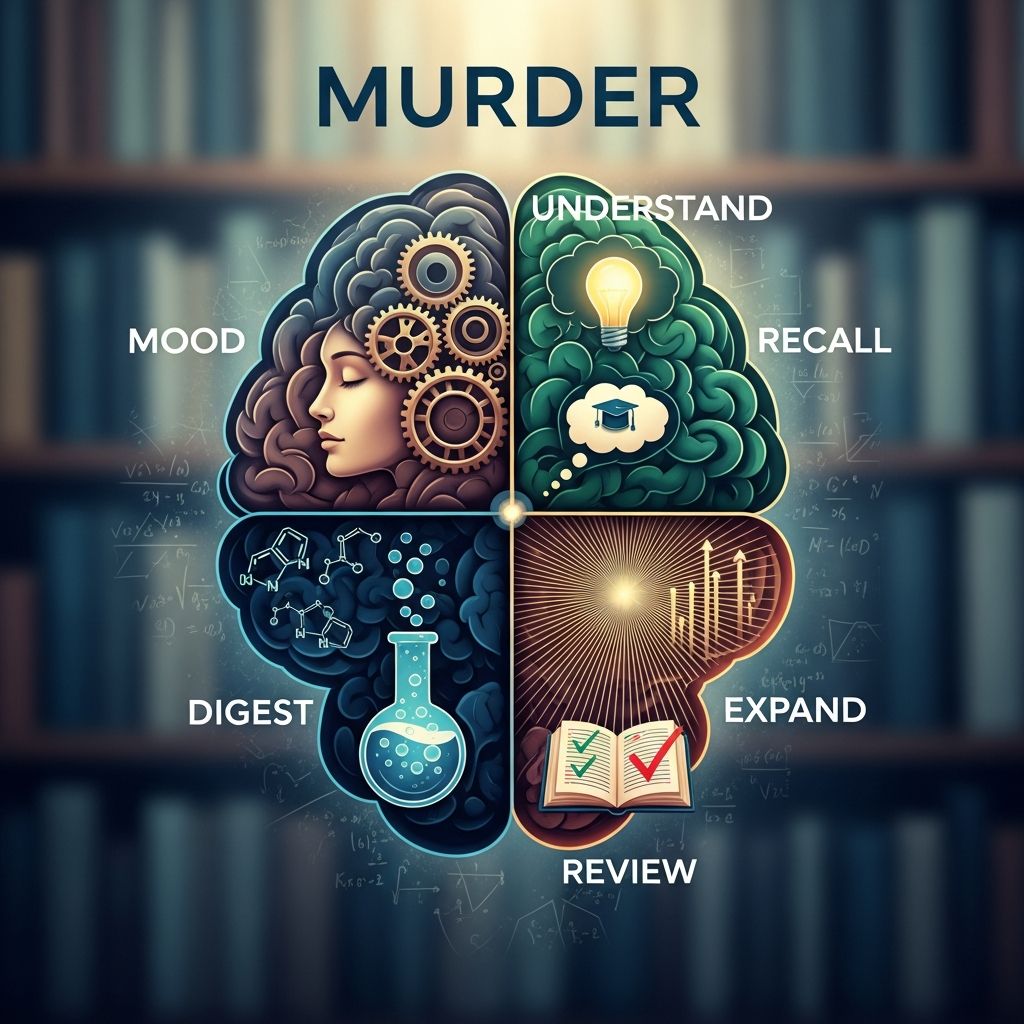
The MURDER study method offers a structured pathway to transform how students engage with complex material, promoting deeper understanding and long-term retention. Developed by educational researcher Donald Dansereau in the late 1970s, this technique breaks learning into six actionable phases: Mood, Understand, Recall, Digest, Expand, and Review. Research demonstrates its effectiveness, particularly in collaborative settings, where students using MURDER outperformed peers on post-tests.
Why Choose the MURDER Approach Over Traditional Studying?
Conventional cramming often leads to short-term memorization without comprehension. In contrast, MURDER fosters active processing, critical thinking, and knowledge application. Studies show students employing this method achieve higher post-test scores and normalized gains of 0.77 (high category), with 94% classical completeness in subjects like mathematics. Its collaborative nature also boosts engagement, with activity levels reaching 90%.
This system suits diverse learners, from high school to college, by integrating metacognition—thinking about one’s thinking—and peer interaction, which ERIC documents confirm superior to solo study.
Phase 1: Cultivating the Right Mood for Focused Learning
Success begins with mindset. The Mood phase involves creating an optimal environment: select a quiet space, minimize distractions, and adopt a positive attitude. Research emphasizes that a conducive setup enhances concentration and motivation.
- Assess your energy levels—study during peak alertness.
- Organize materials and set specific goals, like ‘master chapter 3 concepts.’
- Practice deep breathing or short meditation to reduce anxiety.
In group settings, align schedules and roles to build a supportive vibe, as passive participants can hinder progress. This foundational step ensures subsequent phases yield maximum results.
Phase 2: Building a Solid Foundation Through Understanding
Next, Understand demands careful reading. Skim for structure, then dive deep, marking confusing sections. Focus on one unit at a time to avoid overload.
Techniques include:
- Highlighting key terms and definitions.
- Annotating margins with questions or summaries.
- Visualizing concepts via diagrams.
Studies indicate this targeted reading improves initial comprehension, setting the stage for recall.
Phase 3: Strengthening Memory with Active Recall
Recall tests retention without notes. Close the book and summarize in your own words—verbally, written, or diagrammatically. This reconstructs knowledge, reinforcing neural pathways.
Benefits include:
- Identifying gaps early.
- Enhancing long-term memory over passive re-reading.
Collaborative recall, where group members quiz each other, yields superior results per ERIC research. Post-test improvements in MURDER users confirm this phase’s power.
Phase 4: Digesting Challenges with Expert Insights
Unresolved confusion? Enter Digest. Revisit marked areas, then seek clarification from textbooks, instructors, or peers. This phase processes information efficiently, focusing on main ideas rather than minutiae.
| Common Roadblocks | Digest Strategies |
|---|---|
| Abstract concepts | Break into simpler analogies |
| Technical jargon | Consult glossaries or experts |
| Interconnected ideas | Create mind maps |
Flexibility in group roles during digestion prevents dominance by overactive members.
Phase 5: Expanding Knowledge Through Critical Inquiry
Expand elevates learning by applying concepts creatively. Pose three questions:
- What would I ask the author or critique?
- How does this relate to my interests or real life?
- How can I explain it simply to others?
This develops critical thinking, as seen in improved metacognition and PAI subject outcomes. It transforms passive absorption into active innovation.
Phase 6: Solidifying Gains Through Thorough Review
Finally, Review consolidates everything. Revisit notes, recall successes, and note effective strategies for future use. Schedule spaced repetitions to combat forgetting curves.
Group reviews amplify retention, with studies showing higher pretest-to-posttest gains. Track progress in a study journal for continuous improvement.
Implementing MURDER in Group vs. Solo Settings
While effective alone, MURDER shines collaboratively. Assign roles per strengths—e.g., one leads mood-setting, another handles expansion. Research confirms cooperative MURDER outperforms independent use.
- Solo: Ideal for quick reviews; use timers for each phase.
- Group: Rotate leadership; resolve conflicts via digestion discussions.
Average implementation scores of 3.73 (well-executed) correlate with 85% post-test averages.
Real-World Evidence: Studies Validating MURDER’s Impact
Empirical data abounds. A thesis on Dansereau’s method found MURDER-taught students scored higher on post-tests despite no correlation with worksheets alone. Indonesian research on math class X reported normalized gains of 0.77 and 90% student activity. PAI implementations boosted critical thinking via expansion.
ERIC highlights integration with elaboration strategies for expository texts. These primary sources underscore MURDER’s reliability across disciplines.
Overcoming Common Hurdles in MURDER Application
Challenges include time constraints or group imbalances. Solutions:
- Shorten phases for busy schedules.
- For passive groups, enforce role rotation.
- Start small—one chapter per session.
Adapt for digital tools: apps for recall quizzes or shared docs for digestion.
Frequently Asked Questions (FAQs)
How long does a full MURDER cycle take?
Typically 45-90 minutes per unit, scalable based on material complexity and group size.
Is MURDER suitable for exam prep?
Yes—its recall and review phases mimic testing conditions, improving performance.
Can non-stem subjects use it?
Absolutely; effective in humanities like PAI for critical analysis.
What if I’m studying alone?
Solo MURDER remains potent; self-quizzing replaces group recall.
Does it work for all ages?
Primarily college-level but adaptable for high school with guidance.
Advanced Tips to Supercharge Your MURDER Sessions
Incorporate Pomodoro timers (25-min phases), multimedia for expansion (videos/podcasts), and analytics tracking retention rates. Pair with SQ3R for hybrid power.
For educators: Train classes in MURDER for 94% completeness. Students report heightened motivation from the mood phase.
Consistent use builds habits yielding sustained academic gains. Research affirms: pre-test 35 to post-test 85 in collaborative math.
References
- Implementing Dansereau’s MURDER Technique to Teach Learning — Lynn University. 2010. https://spiral.lynn.edu/cgi/viewcontent.cgi?article=1082&context=etds
- The Influence of MURDER Learning Model Towards Students — Atlantis Press. 2023. https://www.atlantis-press.com/article/125965702.pdf
- Effective Study System: M.U.R.D.E.R. — Scribd (adapted from Hayes, 1989). N/A. https://www.scribd.com/doc/267838940/murder-juga
- ED306547.pdf — ERIC, U.S. Department of Education. 1989. https://files.eric.ed.gov/fulltext/ED306547.pdf
- Application of MURDER Learning Strategy to Improve Students — UNWAHA E-Journal. 2020. https://ejournal.unwaha.ac.id/index.php/jurnal_pengabdian/article/download/1361/1373

- Integrated M.A. in Applied Linguistics, University of Hyderabad
- 5+ years in editorial, instructional, SEO, and research-based writing
Sneha is a relationships and lifestyle writer with a strong foundation in applied linguistics and certified training in relationship coaching. She brings over five years of writing experience to theskillvault, crafting thoughtful, research-driven content that empowers readers to build healthier relationships, boost emotional well-being, and embrace holistic living. Her writing and insights reflect the belief that beauty, happiness, and wellness…