
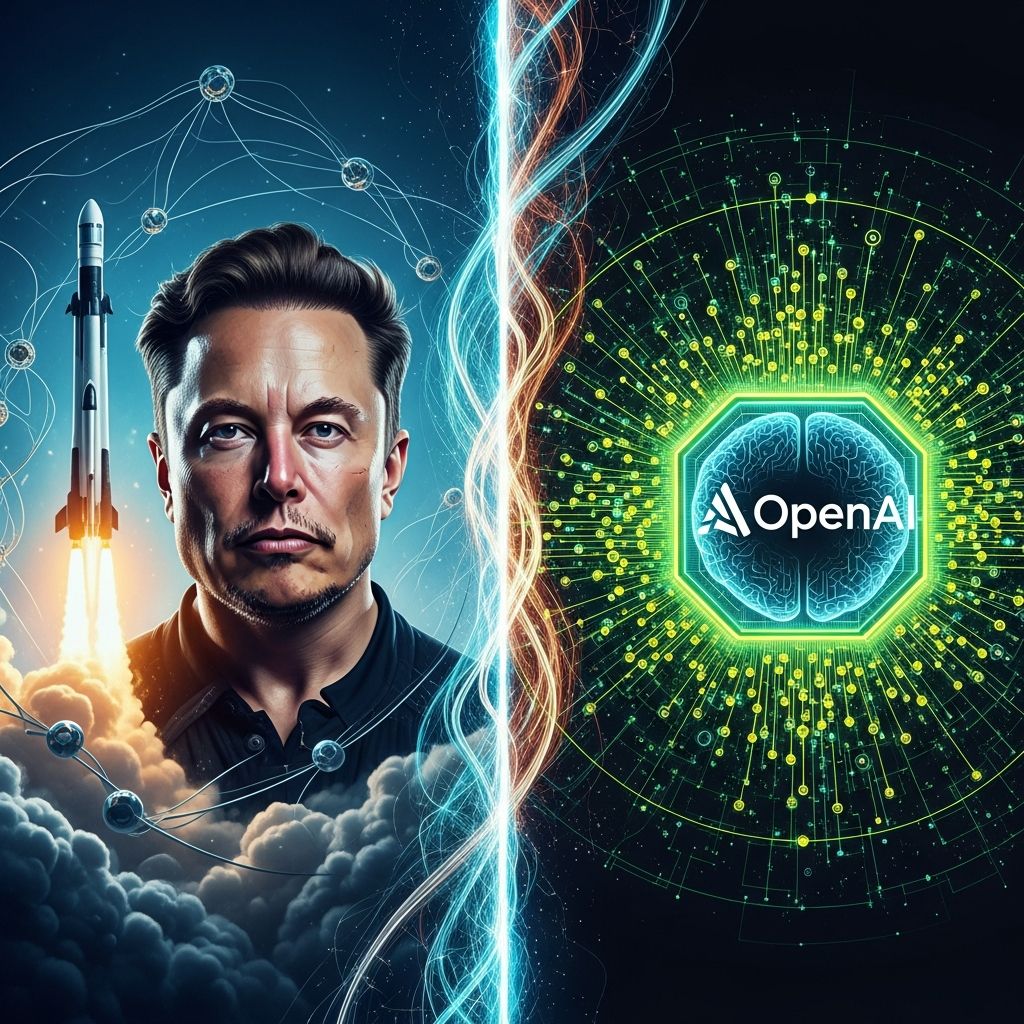
OpenAI began as an ambitious nonprofit promising to build artificial intelligence for the benefit of all humanity. Years later, it stands at the center of a complex legal fight involving Elon Musk, a powerful for-profit structure, and fundamental questions about what charities are allowed to do when vast commercial opportunities appear.
This article unpacks the legal, ethical, and governance issues behind the Musk–OpenAI dispute, taking inspiration from expert commentary on nonprofit law and recent court rulings, while situating the case in the broader landscape of AI oversight and charitable regulation.
From Idealistic Nonprofit to Hybrid AI Powerhouse
To understand the current legal battle, it helps to contrast OpenAI’s early promises with its later restructuring.
OpenAI’s original charitable idea
When OpenAI launched as a nonprofit, its public messaging emphasized:
- A mission focused on safe and broadly beneficial AI, rather than profit maximization.
- Research and deployment strategies intended to avoid winner-take-all commercial races in AI development.
- Public representations that founders did not intend to personally enrich themselves through the organization.
Under U.S. law, a charitable nonprofit typically enjoys tax benefits in exchange for pursuing public, rather than private, interests. The Internal Revenue Service requires that a charity’s resources be used for its exempt purposes and not unduly benefit insiders, a concept known as private inurement and private benefit.
The shift to a capped-profit structure and big-tech tie-ups
Over time, OpenAI adopted a more complex structure that included:
- A for-profit arm controlled by the nonprofit but able to raise outside capital.
- Partnerships with major technology companies, including large strategic investments and cloud-computing agreements.
- Incentive schemes that could provide significant financial upside to some insiders if OpenAI’s valuation grew.
Supporters of this evolution argue that frontier AI research and deployment require enormous capital and infrastructure, and that a purely charitable model would struggle to compete with deep-pocketed tech giants. Critics counter that the structure amounts to selling off charitable assets and mission for private gain.
What Elon Musk Is Arguing
Elon Musk’s federal lawsuit and related court filings present multiple strands of legal attack. While many details are technical, they break down into a few core themes.
Alleged betrayal of the charitable mission
Musk contends that OpenAI’s leadership:
- Abandoned the original nonprofit commitment to prioritize public benefit and safety over profit.
- Structured deals and governance arrangements that allegedly place commercial partners in a position of outsized influence.
- Turned OpenAI into a vehicle capable of generating large private financial returns while using a charitable origin story to attract early support.
His legal filings characterize this as a sort of bait-and-switch, where donors and the public believed they were supporting an independent charity, not laying the foundation for a lucrative corporate empire.
Claims of donor-based rights and trust
A central question is whether Musk, as a major early donor and co-founder, has special legal standing. He argues that:
- His contributions were made with the understanding that OpenAI would remain a charitable mission, not a standard profit-seeking company.
- These conditions created something like a restricted charitable gift or trust: money given only for specific purposes, which the organization must honor.
- By converting effectively into a for-profit vehicle that benefits insiders, OpenAI is breaching that understanding.
U.S. law often limits who can enforce charitable obligations, but recent cases have explored when large donors can sue to enforce the terms of their donations, especially if they were promised particular uses or structures.
Expanded federal claims: fraud, racketeering, and antitrust
More recent filings have layered on additional theories, including:
- Fraud and misrepresentation regarding the organization’s future direction and structure.
- Use of RICO (racketeering) claims, alleging a broader scheme of deception in how OpenAI evolved.
- Antitrust concerns, suggesting that OpenAI’s deals with major tech partners could distort competition in advanced AI.
These broader federal claims significantly raise the stakes, framing the dispute not simply as a private donor–charity disagreement but as alleged large-scale misconduct with systemic implications.
The Court’s Early Signals: A Legal “Time Bomb”
Recent court orders do not decide the merits of Musk’s claims, but they do offer important clues about how judges view the case so far.
Preliminary injunction: denied but not dismissed
Musk sought an early injunction to block OpenAI from proceeding with restructuring steps that could deepen its for-profit orientation. The judge:
- Denied that immediate request, noting that Musk still must prove he has standing and a high likelihood of success at trial.
- Emphasized that courts are cautious about halting complex corporate transactions before a full factual record is developed.
However, denial of a preliminary injunction does not mean Musk’s case will fail. It only indicates that, at an early stage, the demanding standard for emergency relief was not met.
Fast-tracking the charitable law questions
In an unusual move, the judge carved out the charity-law issues and set them for an expedited trial schedule.
This suggests that the court sees real public-interest questions about whether the conversion appropriately respects OpenAI’s charitable obligations and early commitments. By accelerating this piece of the case, the judge is attempting to:
- Ensure key questions are answered before irreversible structural changes are completed.
- Balance the fact that the dispute involves high-profile private parties with the broader societal implications of AI and charitable assets.
Why State Attorneys General Matter So Much
Under U.S. law, attorneys general (AGs) of the states where a charity is incorporated or operates often act as the primary guardians of the public’s interest in charitable assets.
AGs as protectors of the public’s stake
State AGs typically have the authority to:
- Investigate whether charitable organizations are complying with their missions and fiduciary duties.
- Challenge transactions that would divert charitable assets away from public benefit into private hands.
- Seek injunctions or other remedies if they believe a charity’s conversion or sale is inconsistent with its obligations.
In major nonprofit conversions—such as hospitals or insurers turning into for-profit companies—AGs often play a decisive role in reviewing and approving or opposing deals, sometimes requiring that substantial value be preserved for public purposes.
Signals aimed at California and Delaware AGs
Legal analysts and nonprofit experts have interpreted aspects of the judge’s order as a possible invitation for California and Delaware attorneys general to scrutinize OpenAI’s conversion plan.
If AGs decide to intervene, they could argue that:
- OpenAI’s restructuring is inconsistent with its promised mission of benefiting humanity.
- The transaction undervalues charitable assets or allows insiders and commercial partners to capture excessive benefits.
- Governance arrangements fail to ensure ongoing protection of the charitable purpose.
Statements from at least one state AG’s office about being prepared to act if the conversion is not entirely fair underscore how live this possibility is.
Key Legal Concepts at Stake
The Musk–OpenAI dispute touches several core doctrines in nonprofit and corporate law. Understanding these helps clarify why the case matters beyond the personalities involved.
| Concept | What It Means | Why It Matters Here |
|---|---|---|
| Charitable purpose | The mission a nonprofit commits to when it receives tax-exempt status, focused on public benefit. | OpenAI’s original focus on broadly beneficial AI is central to claims that conversion violates this purpose. |
| Private benefit & inurement | Rules limiting how much insiders or private parties can benefit from a charity’s assets. | Critics argue the conversion lets founders and partners profit from assets built under charitable auspices. |
| Fiduciary duties | Duties of care, loyalty, and obedience that directors owe to the nonprofit and its mission. | Questions arise about whether OpenAI’s board adequately protected its charitable mission in structuring deals. |
| Donor standing | When, and to what extent, donors can sue to enforce the use of their gifts. | The court must decide whether Musk can personally enforce alleged agreements about staying charitable. |
| Nonprofit conversion | Legal process for turning a charity or its operations into a for-profit enterprise. | OpenAI’s path may become a precedent for how mission-driven AI labs restructure. |
Implications for AI Governance and Public Trust
Beyond the immediate parties, this case raises deeper questions about how society should govern powerful AI systems and who gets to decide how they are used.
Who owns AI built under a charitable banner?
OpenAI’s early framing invited the public to see its work as a global public good. When a charity builds potentially transformative technology, hard questions arise:
- Should the resulting intellectual property be treated more like a public asset than a private one?
- How should value be shared between founders, donors, employees, and the broader world that was promised benefit?
- What safeguards are necessary to ensure that mission statements about serving humanity do not become marketing tools?
Existing charity law offers some tools—such as AG oversight and conversion rules—but AI’s scale and speed may push regulators to reinterpret or strengthen these mechanisms.
Concentration of power in AI ecosystems
Major AI labs can influence economic, political, and cultural systems worldwide. The Musk–OpenAI dispute highlights concerns about:
- Increasing concentration of technical capabilities in a few large companies with deep capital and compute resources.
- Potential misalignment between profit incentives and long-term safety or global welfare.
- The difficulty of ensuring meaningful public input into the direction of frontier AI research.
International organizations such as the OECD and G20 have emphasized that trustworthy AI requires robust governance, transparency, and accountability mechanisms.
Possible Futures for the Case
The litigation is still in motion, but several broad outcomes are plausible, each with its own implications.
Scenario 1: Musk loses, OpenAI’s structure stands
If the court finds that Musk lacks standing or that OpenAI’s conversion complies with relevant law, the case could end with relatively minor structural changes. This would:
- Reinforce management’s ability to evolve mission-driven organizations into hybrid or for-profit forms.
- Signal that donor complaints alone rarely overturn complex corporate restructurings.
- Leave broader AI governance largely in the hands of corporate boards and regulators outside the charity sphere.
Scenario 2: Court or AGs impose conditions or unwinding
If judges or attorneys general conclude that the conversion improperly diverts charitable value, they could:
- Require financial adjustments, such as additional assets being reserved for public-interest uses.
- Mandate governance reforms to insulate safety decisions or public-benefit commitments from commercial incentives.
- In extreme cases, unwind key transactions or block certain aspects of the conversion.
Such an outcome could create a powerful precedent for future AI labs and other high-growth nonprofits considering similar paths.
Scenario 3: Settlement with governance reforms
The parties may also settle, especially if the legal uncertainty threatens important partnerships or financing. A settlement might involve:
- Clarified commitments around AI safety, openness, or public-benefit use of certain systems.
- Modified caps on financial upside for insiders.
- Independent oversight mechanisms designed to reassure both regulators and the public.
Practical Lessons for Mission-Driven Tech Organizations
Whatever the final verdict, the Musk–OpenAI dispute offers concrete guidance for other founders, donors, and boards seeking to build transformative technologies responsibly.
- Write mission and constraints into binding documents. Lofty public statements are less important legally than charters, bylaws, gift agreements, and contracts. If founders truly wish to avoid personal enrichment or maintain nonprofit control, those commitments should be formalized.
- Anticipate growth and capital needs early. High-impact research areas like AI often require funding models that evolve. Boards should plan how to attract capital without undermining public-benefit obligations.
- Engage regulators proactively. Early dialogue with state AGs and other oversight bodies can reduce the risk of costly challenges later, especially in conversions or large partnerships.
- Design governance for conflict of interest resilience. Boards should manage relationships with major investors, donors, and executives to avoid perceptions of self-dealing or capture.
Frequently Asked Questions (FAQs)
Q1: What is the core issue in Elon Musk’s legal battle with OpenAI?
At heart, the dispute is about whether OpenAI’s shift from a pure nonprofit toward a for-profit structure is compatible with its original charitable mission and promises to donors and the public, and who has the legal right to challenge that shift.
Q2: Does Elon Musk automatically have standing as a donor and co-founder?
No. U.S. courts often limit donor standing in charity disputes, and a key question is whether Musk made restricted gifts or agreements that give him special rights to enforce how OpenAI uses his contributions.
Q3: Why are state attorneys general so important in this case?
State attorneys general are typically empowered to represent the public’s interest in charitable assets. They can investigate nonprofit conversions, challenge unfair deals, and seek remedies if a charity’s mission is compromised.
Q4: Could this case affect other AI labs or tech nonprofits?
Yes. Whatever courts and regulators decide could influence how other mission-driven labs structure for-profit arms, manage partnerships with big tech, and communicate with donors about future commercial opportunities.
Q5: What does this mean for AI safety and global public benefit?
The case spotlights tensions between profit incentives and long-term safety or fairness in AI deployment. Stronger legal constraints or governance reforms could push AI labs to more closely align with public-benefit goals, while a narrow ruling might leave these issues primarily to internal company policies and general regulation.
References
- Compliance Guide for 501(c)(3) Public Charities — Internal Revenue Service. 2021-03-01. https://www.irs.gov/pub/irs-pdf/p4221pc.pdf
- Elon Musk vs. OpenAI: What to Expect from the Showdown in 2025 — Business Insider. 2025-01-10. https://www.businessinsider.com/elon-musk-openai-lawsuit-legal-battle-key-dates-arguments-2025-1
- Judge Plants a Legal Time Bomb Under OpenAI (with Rose Chan Loui) — 80,000 Hours Podcast. 2025-01-15. https://80000hours.org/podcast/episodes/rose-chan-loui-elon-musk-openai-case-update/
- Oakland Judge Postponed Musk Suit Against OpenAI Even as Interest in the Case Gathers — Local News Matters. 2025-01-15. https://localnewsmatters.org/2025/01/15/oakland-judge-postponed-musk-suit-against-openai-even-as-interest-in-the-case-gathers/
- OECD Principles on Artificial Intelligence — Organisation for Economic Co-operation and Development. 2019-05-22. https://oecd.ai/en/ai-principles

- Integrated M.A. in Applied Linguistics, University of Hyderabad
- 5+ years in editorial, instructional, SEO, and research-based writing
Sneha is a relationships and lifestyle writer with a strong foundation in applied linguistics and certified training in relationship coaching. She brings over five years of writing experience to theskillvault, crafting thoughtful, research-driven content that empowers readers to build healthier relationships, boost emotional well-being, and embrace holistic living. Her writing and insights reflect the belief that beauty, happiness, and wellness…