
Why Your First Nursing Resume Matters More Than You Think
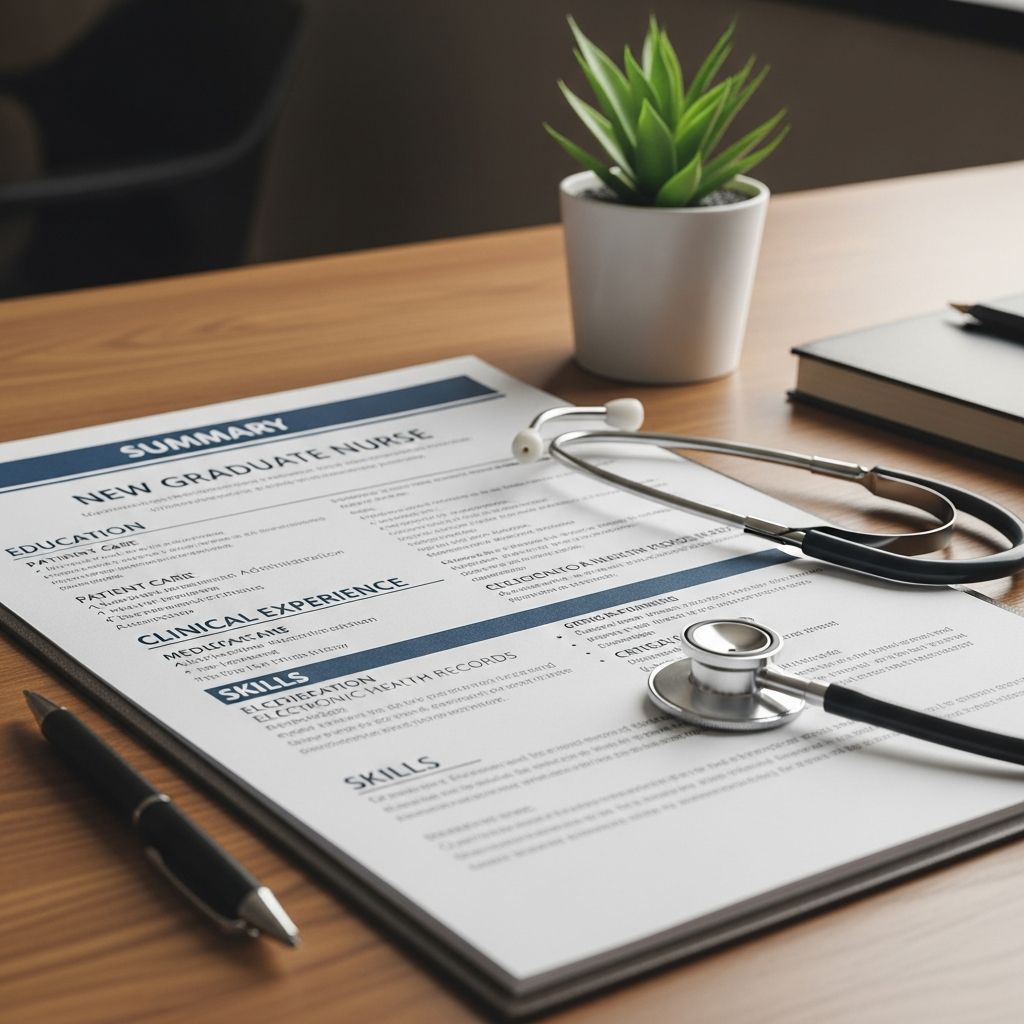
For new nursing graduates, the transition from classroom and clinicals to the job market can feel overwhelming. One of the most powerful tools in that transition is a well-crafted resume. Unlike experienced nurses who can lean heavily on years of employment history, new grads must strategically showcase their education, clinical rotations, skills, and readiness to deliver safe, effective patient care.
A strong new grad nurse resume doesn’t just list where you went to school and what units you rotated through. It tells a story: that you are a competent, detail-oriented, and compassionate professional who is prepared to step into an entry-level role and contribute from day one. This guide walks you through how to build that story in a way that resonates with hiring managers and passes automated screening systems.
Start with the Right Foundation
Before diving into content, it’s important to choose the right format and structure. For new graduates, a clean, reverse-chronological layout is almost always the best choice. This format emphasizes your most recent and relevant experience—your nursing program and clinical rotations—right at the top, where they belong.
Keep the resume to one page. Hiring managers often review dozens of applications quickly, and a concise, focused document is more likely to hold their attention. Use a professional, easy-to-read font like Arial, Calibri, or Times New Roman, with a font size between 10 and 12 points. Margins should be standard (around 0.5 to 1 inch) to ensure readability and compatibility with applicant tracking systems (ATS).
Header: Make Contacting You Effortless
At the very top of your resume, include a simple header with your full name, phone number, professional email address, and city and state of residence. If you’re open to relocation or applying for jobs in a specific region, you can list that city and state even if you’re not currently living there.
Your email address should be professional—ideally a variation of your first and last name. Avoid playful or outdated addresses that might undermine your credibility. If you have a LinkedIn profile that’s up to date and reflects your nursing background, include the link as well. This gives employers an additional way to learn about you and your professional network.
Opening Statement: Objective or Summary?
Below your contact information, include a short opening statement. For new graduates, an objective statement is often more effective than a summary. An objective clearly communicates your career goals and what you’re looking for in your first nursing role, while also highlighting your strongest qualifications.
Write 2–3 sentences that include:
- Your nursing degree and recent graduation status
- Key clinical experiences (e.g., medical-surgical, pediatrics, ICU, OB/GYN)
- Core skills or strengths (e.g., patient assessment, medication administration, EHR documentation)
- The type of role and setting you’re seeking (e.g., entry-level RN in an acute care hospital)
The goal is to give the reader a clear picture of who you are and what value you can bring to their team. Avoid generic phrases like “seeking a challenging position.” Instead, be specific about the kind of environment where you want to grow and how you plan to contribute.
Education: Your Academic Backbone
As a new graduate, your education section is one of the most important parts of your resume. Place it near the top, right after your opening statement.
For each relevant degree, include:
- Full name of the institution
- Degree earned (e.g., Bachelor of Science in Nursing)
- Graduation date (month and year)
- Location (city and state)
- Any academic honors, such as cum laude, Dean’s List, or relevant scholarships
If you completed a nursing program with a strong clinical component, you can briefly note that in this section. For example, you might mention that your program included over 800 hours of supervised clinical practice across multiple specialties. This reinforces that your education wasn’t just theoretical—it included substantial hands-on experience.
Clinical Rotations: The Heart of Your Resume
For new nurses, clinical rotations are your primary professional experience. Treat them like real jobs on your resume. List each rotation as a separate entry with the facility name, department or unit, location, and dates.
Under each rotation, use 3–4 bullet points to describe what you did and what you learned. Focus on:
- Patient populations served (e.g., adult medical-surgical, pediatric, geriatric, post-op, critical care)
- Specific nursing tasks and procedures (e.g., vital signs, wound care, IV insertion, medication administration, patient education)
- Technologies and systems used (e.g., EHR platforms like Epic or Cerner, IV pumps, telemetry monitors)
- Any measurable outcomes or contributions (e.g., “Monitored 5–7 patients per shift, identifying and reporting abnormal vital signs that led to timely interventions”)
Use strong action verbs at the start of each bullet: assessed, administered, collaborated, documented, monitored, educated, coordinated, evaluated. Avoid passive language and vague descriptions like “assisted with” or “helped with.” Instead, be direct and specific about your role and responsibilities.
Work Experience: Beyond the Hospital
If you have prior work experience, even if it’s not in healthcare, include it. Many nursing skills—communication, time management, teamwork, problem-solving—are transferable from other roles.
List each position with the job title, employer, location, and dates. For each role, include 2–3 bullet points that highlight responsibilities and achievements. If the job was in a service, retail, or administrative setting, focus on skills like customer service, multitasking, conflict resolution, and working under pressure.
For healthcare-related roles (e.g., CNA, medical assistant, patient care tech), emphasize direct patient care experience, documentation, and collaboration with nurses and other providers. This shows that you’re already familiar with the pace and expectations of a clinical environment.
Licenses and Certifications: Prove You’re Ready to Practice
Clearly list all active nursing licenses and certifications. This section should be easy to find and read, so place it in a dedicated section near the top or middle of the resume.
Include:
- Nursing license (e.g., RN, LPN) and state of licensure
- License number (optional, but often helpful)
- Expiration date
- Any specialty certifications (e.g., BLS, ACLS, PALS, NRP)
- Other relevant credentials (e.g., phlebotomy, EKG, IV certification)
If you’ve passed the NCLEX but are still waiting for your official license, you can note that you are “NCLEX-RN passed, license pending” or “Eligible for RN licensure in [State].” This shows employers that you’re on track to be fully licensed and ready to start working.
Skills Section: Show What You Can Do
A well-organized skills section helps both human readers and ATS systems quickly identify your qualifications. Group your skills into categories to make them easier to scan.
Common categories for new grad nurses include:
- Clinical Skills: Patient assessment, vital signs, wound care, IV therapy, medication administration, specimen collection
- Technical Skills: EHR/EMR systems (e.g., Epic, Cerner), IV pumps, telemetry, glucometers, infusion devices
- Procedures: Foley catheter insertion, NG tube placement, tracheostomy care, suctioning, dressing changes
- Soft Skills: Communication, teamwork, critical thinking, time management, empathy, patient education
- Specialties: Medical-surgical, pediatrics, critical care, obstetrics, mental health, geriatrics
Be honest about your skill level. If you’re comfortable performing a procedure independently, say so. If you’ve only observed or assisted, note that as well. Employers appreciate transparency and will value a candidate who knows their limits and is eager to learn.
Additional Sections to Consider
Depending on your background, you may want to include one or more of the following sections to strengthen your resume:
- Professional Affiliations: Membership in organizations like the American Nurses Association (ANA), National Student Nurses’ Association (NSNA), or specialty nursing groups.
- Volunteer Experience: Healthcare-related volunteering, community health fairs, or disaster relief work can demonstrate your commitment to service.
- Continuing Education: Workshops, conferences, or online courses related to nursing practice, safety, or leadership.
- Awards and Honors: Academic awards, scholarships, or recognition for clinical performance.
- Languages: If you’re fluent or conversational in another language, this can be a valuable asset in diverse healthcare settings.
These sections can help differentiate you from other candidates, especially if you have limited paid work experience in healthcare.
Optimizing for Applicant Tracking Systems (ATS)
Many hospitals and healthcare systems use ATS software to screen resumes before they ever reach a human. To increase your chances of getting past these systems, your resume needs to include the right keywords and be formatted correctly.
Key strategies include:
- Use standard section headings like “Education,” “Clinical Experience,” “Work Experience,” “Skills,” and “Licenses & Certifications.”
- Incorporate keywords from the job description, such as “patient care,” “medication administration,” “EHR documentation,” “team collaboration,” and specific unit types (e.g., med-surg, ICU, ER).”
- Avoid graphics, tables, columns, and unusual fonts that can confuse ATS parsers.
- Save your resume as a PDF unless the application specifically requests a Word document.
Before submitting, review the job posting and tailor your resume to match the required qualifications as closely as possible. If the job asks for experience with a specific EHR system or patient population, make sure those details are clearly visible in your resume.
Common Mistakes to Avoid
Even small errors can hurt your chances. Watch out for these common pitfalls:
- Being too vague: Instead of “assisted with patient care,” say “performed head-to-toe assessments and documented findings in the EHR for 6 patients per shift.”
- Listing only duties: Focus on achievements and outcomes, not just tasks. For example, “Identified early signs of sepsis in a post-op patient, leading to prompt intervention and improved outcomes.”
- Using an unprofessional email: Update your email address if it’s outdated or unprofessional.
- Overloading with irrelevant details: Keep the resume focused on nursing and healthcare. Hobbies and unrelated jobs should be included only if they add value.
- Ignoring formatting: Inconsistent spacing, fonts, or bullet styles can make your resume look sloppy.
Taking the time to proofread and refine your resume pays off. Ask a trusted mentor, instructor, or career advisor to review it and provide feedback.
Final Tips for a Standout Resume
Before you send your resume, ask yourself:
- Does it clearly show that I’m ready to be a safe, competent nurse?
- Have I highlighted my most relevant clinical experiences and skills?
- Is it easy to read and well-organized?
- Have I tailored it to the specific job I’m applying for?
Remember, your resume is not just a list of where you’ve been—it’s a marketing document that positions you as a valuable addition to a healthcare team. By focusing on your education, clinical rotations, skills, and readiness to learn, you can create a resume that stands out in a competitive job market.
Frequently Asked Questions
How long should a new grad nurse resume be?
For new graduates, a one-page resume is ideal. It should be concise, focused, and easy to scan. Keep it to one page unless you have extensive relevant experience that truly requires more space.
Should I include my GPA?
If your GPA is strong (typically 3.5 or higher), you can include it in your education section. If it’s lower, it’s usually better to leave it out and instead highlight academic honors, scholarships, or relevant coursework.
What if I don’t have much work experience?
That’s completely normal for new grads. Focus on your clinical rotations, skills, education, and any healthcare-related roles (like CNA or patient care tech). Emphasize transferable skills from other jobs and any volunteer or leadership experience.
How do I make my clinical rotations sound professional?
Treat each rotation like a job. Include the facility, unit, dates, and 3–4 bullet points describing your responsibilities, procedures performed, technologies used, and any measurable outcomes. Use strong action verbs and specific details.
Do I need a cover letter?
While not always required, a well-written cover letter can strengthen your application. It gives you a chance to explain why you’re interested in the role, highlight key experiences, and show your personality and professionalism.
References
- Nursing Resume Writing Guide — University of Northwestern, St. Paul. 2024. https://www.unwsp.edu/wp-content/uploads/2024/06/Nursing-Resume-Writing-Guide.pdf
- Resume Writing Guide — Yale School of Nursing. 2024. https://nursing.yale.edu/sites/default/files/ysn_resume_guide_draft_2.pdf
- Resume Writing Guide — University of Maryland School of Nursing. 2024. https://www.nursing.umaryland.edu/student-life/office-of-academic-and-career-success/baltimore/resume-writing-guide/

Medha Deb is an editor with a master's degree in Applied Linguistics from the University of Hyderabad. She believes that her qualification has helped her develop a deep understanding of language and its application in various contexts. Medha specializes in the areas of beauty, health, sports, and wellness and is committed to ensuring that the content on the website is…