
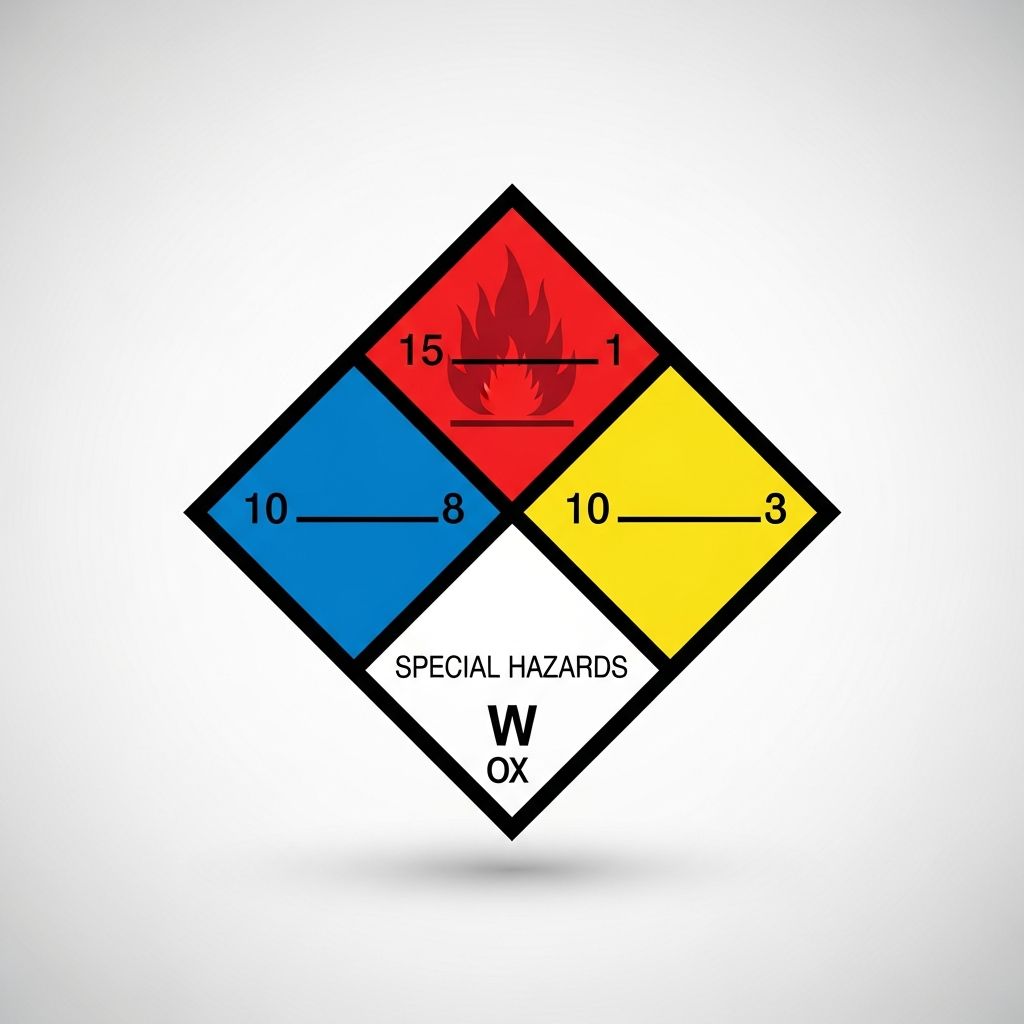
The NFPA 704 hazard diamond, often called the fire diamond, is a standardized visual system designed to communicate the risks associated with hazardous materials quickly and effectively. Developed by the National Fire Protection Association (NFPA), this iconic symbol helps emergency responders, firefighters, and facility workers assess dangers at a glance during incidents like fires, spills, or explosions.
Origins and Purpose of the NFPA 704 System
Established as the ‘Standard System for the Identification of the Hazards of Materials for Emergency Response,’ NFPA 704 provides a universal language for hazard communication. Unlike more detailed systems like Safety Data Sheets (SDS), the diamond prioritizes rapid recognition in high-stress situations. It focuses on acute, short-term exposures relevant to emergencies, enabling decisions on evacuation, firefighting tactics, and personal protective equipment (PPE).
This system gained prominence in industrial, warehouse, and laboratory settings where chemicals are stored or used. While not federally mandated by OSHA for all scenarios, many local regulations and best practices require its use on doors, storage areas, and containers.
Visual Layout and Color Coding Explained
The hazard diamond is a square rotated 45 degrees (square-on-point), divided into four equal quadrants. Each quadrant uses a distinct color to represent a specific hazard category:
- Blue (Left/Health): Indicates potential harm to human health from exposure.
- Red (Top/Flammability): Shows the material’s susceptibility to catching fire.
- Yellow (Right/Reactivity): Reveals chemical instability or explosive tendencies.
- White (Bottom/Special): Highlights unusual hazards not covered by the other sections.
A small white diamond in the center may display a number indicating overall hazard severity, though this is less common. Numbers from 0 (minimal risk) to 4 (extreme danger) fill the colored sections, with higher values signaling greater threats.
Detailed Breakdown of Health Hazard Ratings
The blue quadrant rates health risks based on exposure via inhalation, skin contact, or ingestion during emergencies. Ratings reflect severity even with prompt medical care:
| Rating | Description |
|---|---|
| 0 | Normal material; poses no unusual health risk. |
| 1 | Slightly hazardous; irritation may occur but only brief exposure needed for symptoms. |
| 2 | Hazardous; requires temporary incapacitation or requires prompt treatment. |
| 3 | Extreme danger; serious injury possible despite treatment. |
| 4 | Deadly; life-threatening even with immediate care. |
For example, a rating of 4 might apply to substances like hydrogen cyanide, which can cause rapid death.
Flammability Ratings in the Red Quadrant
The red section evaluates how easily a material ignites and burns under fire conditions. Flash point—the lowest temperature at which vapors ignite—is key here:
| Rating | Flash Point / Behavior |
|---|---|
| 0 | Will not burn under typical fire conditions. |
| 1 | Requires preheating above 200°F (93°C) to ignite. |
| 2 | Ignites if moderately heated; flash point below 200°F (93°C). |
| 3 | Flammable liquids; ignites at ambient temperatures, flash point below 100°F (38°C). |
| 4 | Highly volatile; vaporizes and burns readily below 73°F (23°C). |
Gases like acetylene often rate 4, demanding extreme caution in fire scenarios.
Reactivity and Instability in the Yellow Quadrant
Yellow denotes a material’s propensity for violent reactions, decomposition, or explosions, especially under heat, shock, or pressure:
| Rating | Behavior |
|---|---|
| 0 | Stable; no significant reactivity even in fire. |
| 1 | Unstable at high temperatures or pressures. |
| 2 | Undergoes violent chemical change when heated or shocked. |
| 3 | Shock- or heat-sensitive; capable of explosive reactions. |
| 4 | Detonates readily at normal conditions; may react explosively with water. |
Nitroglycerin exemplifies a 4 rating due to its sensitivity.
Special Hazards Denoted in the White Quadrant
Unlike other sections, white uses symbols rather than numbers for atypical risks:
- W with line: Water-reactive; reacts violently, explodes, or burns on contact with water (e.g., sodium metal).
- OX: Oxidizer; provides oxygen to fuel combustion, intensifying fires (e.g., hydrogen peroxide).
- SA: Simple asphyxiant; displaces oxygen, causing suffocation (e.g., nitrogen gas).
These pictograms alert responders to avoid standard tactics like water application.
Placement Guidelines and Sizing Standards
NFPA 704 does not dictate mandatory locations, but effective placement is crucial. Signs should appear on:
- Exterior walls near entry points.
- Doors to hazardous storage rooms.
- Container exteriors for large volumes.
- Two visible sides of outdoor tanks.
Sizing ensures legibility from specified distances:
| Viewing Distance (ft) | Minimum Letter Height (in) |
|---|---|
| 50 | 1 |
| 75 | 2 |
| 100 | 3 |
| 200 | 4 |
| 300 | 6 |
Facilities must comply with local fire codes for placement.
Real-World Applications and Case Studies
In manufacturing plants, NFPA diamonds guide spill responses by indicating if absorbents or neutralization are safe. Firefighters use them to select suppressants—foam for flammability 3, avoiding water for W-rated materials. A 2019 warehouse fire in California was mitigated faster due to prominent diamonds revealing oxidizer risks.
Laboratories at universities like UC Berkeley integrate them with GHS labels for comprehensive safety. During audits, high-compliance sites show fewer incidents, underscoring the system’s value.
Comparing NFPA 704 to Other Hazard Systems
| System | Focus | Audience | Visual Style |
|---|---|---|---|
| NFPA 704 | Emergency acute hazards | Responders | Color diamond with numbers/symbols |
| GHS/HMIS | Workplace chronic risks | Workers | Pictograms, numeric bands |
| DOT Placards | Transport hazards | Transporters | Large colored panels |
NFPA excels in speed for fires, complementing detailed SDS.
Training and Compliance Best Practices
Train staff to read diamonds in under 10 seconds. Conduct drills simulating spills with varying ratings. Regularly audit signs for fading or damage. Integrate into emergency plans, specifying PPE per rating (e.g., SCBA for health 3+).
Facilities handling rated-4 materials often require permits and inspections.
Frequently Asked Questions (FAQs)
What does a 4 in all colored sections mean?
It signals an extremely hazardous material—deadly, highly flammable, explosive, and possibly water-reactive. Immediate evacuation and specialized response are critical.
Is NFPA 704 required by law?
Not federally, but many states, localities, and fire codes mandate it for certain facilities. Check OSHA 1910.1200 and local AHJ.
Can I make my own NFPA diamond?
Yes, using official ratings from SDS, but ensure accuracy. DuraLabel recommends weatherproof materials for outdoors.
How does oxidizer (OX) affect firefighting?
OX intensifies fires; use dry chemical or CO2 suppressants, never water alone.
What’s the difference between reactivity and flammability?
Flammability is about ignition/burning; reactivity covers explosions or decomposition unrelated to fire.
References
- NFPA 704 Diamond Colors Numbers and Flammability Rating — DuraLabel Resources. 2023. https://resources.duralabel.com/articles/nfpa-704
- How to Read an NFPA Fire Diamond — Building Maps. 2023. https://www.building-maps.com/how-to-read-an-nfpa-fire-diamond/
- NFPA Hazard Diamond — University of San Francisco EHS. 2024. https://myusf.usfca.edu/environmental-health-safety/nfpa-hazard-diamond
- NFPA 704 Hazard Identification System — UC Berkeley College of Chemistry. 2022. https://chemistry.berkeley.edu/sites/default/files/ccehss-section8-nfpa.pdf
- 704 Marking System — Missouri SEMA DPS. 2021. https://sema.dps.mo.gov/docs/programs/executive/MERC/704_MARKING_SYSTEM.pdf
- NFPA 704 Guidance Document FAQ — Riverside County Environmental Health. 2023. https://rivcoeh.org/sites/g/files/aldnop361/files/migrated/Portals-0-PDF-HazMat-NFPA-FAQ.pdf
- NFPA 704 Symbols — UT Dallas Risk & Safety. 2024. https://risk-safety.utdallas.edu/fire-prevention-and-protection-programs/nfpa-704-symbols/

- Integrated M.A. in Applied Linguistics, University of Hyderabad
- 5+ years in editorial, instructional, SEO, and research-based writing
Sneha is a relationships and lifestyle writer with a strong foundation in applied linguistics and certified training in relationship coaching. She brings over five years of writing experience to theskillvault, crafting thoughtful, research-driven content that empowers readers to build healthier relationships, boost emotional well-being, and embrace holistic living. Her writing and insights reflect the belief that beauty, happiness, and wellness…