
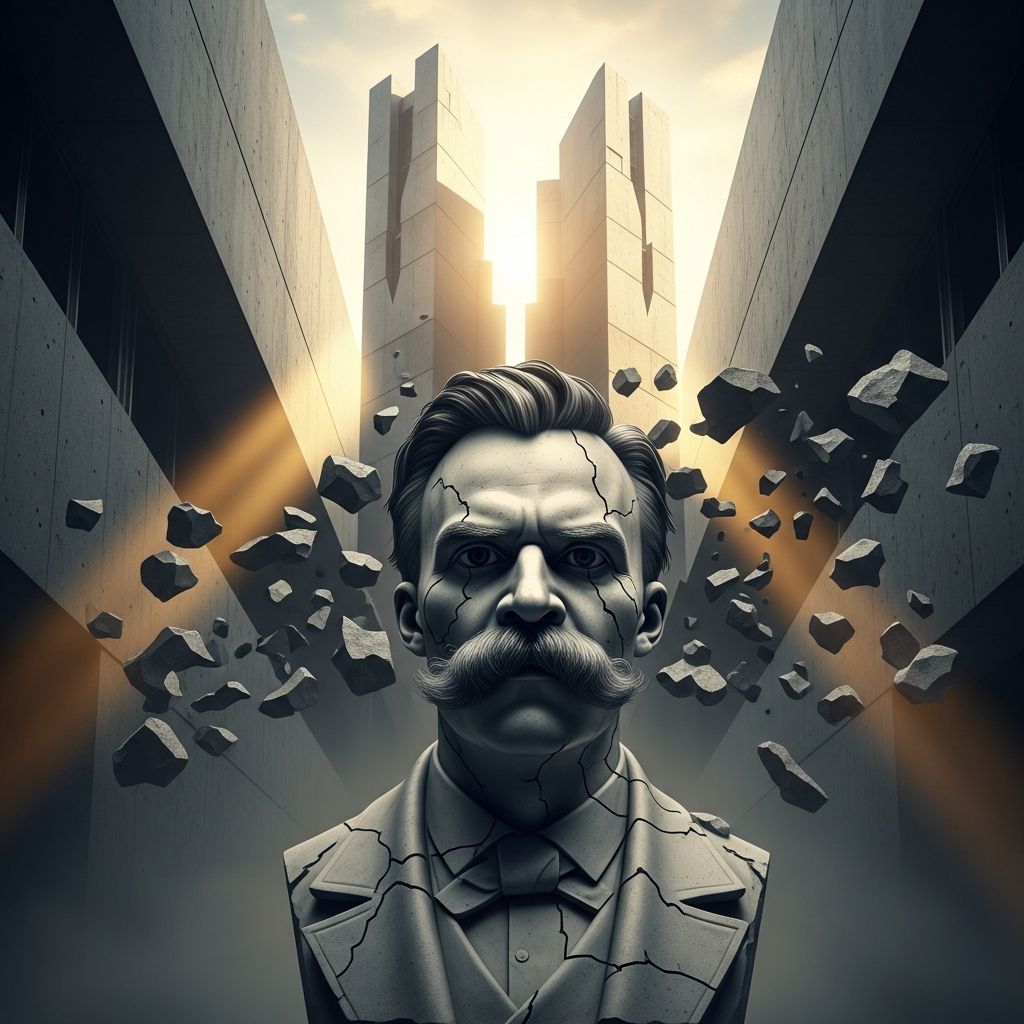
Friedrich Nietzsche is remembered as one of the most provocative and original thinkers of the modern era, a philosopher who challenged religious, moral, and cultural assumptions with relentless intensity. When viewed through the lens of modern personality theory, many of his characteristics resemble what is often called the Architect (INTJ) type: analytical, independent, future-oriented, and unapologetically unconventional.
This article does not claim that Nietzsche was an INTJ in any clinical sense; personality frameworks were developed long after his death. Instead, it uses the Architect profile as a tool to illuminate how his life, work, and inner conflicts mirror traits commonly associated with this strategic and visionary temperament.
Nietzsche in Brief: A Radical Individualist
Friedrich Nietzsche (1844–1900) was a German classical philologist, philosopher, and cultural critic. His writings explored themes such as the death of God, the critique of traditional morality, the concept of the Übermensch (“overman”), and the idea of eternal recurrence. These ideas helped shape existentialism, post-structuralism, depth psychology and much of twentieth-century philosophy.
- Early brilliance: Appointed a professor of classical philology at the University of Basel in his mid-twenties, despite having no doctorate in philosophy.
- Intellectual rebel: Broke with the cultural and religious conventions of his day, attacking what he saw as life-denying values.
- Solitary worker: Spent much of his productive life in relative isolation due to poor health, writing intensely in short bursts.
- Enduring impact: Influenced thinkers such as Sigmund Freud, Martin Heidegger, and many later philosophers and writers.
These biographical elements already hint at traits associated with the Architect personality: a preference for deep thought over social involvement, a tendency to question inherited norms, and a drive to develop a comprehensive, personally coherent worldview.
Key Architect Traits Reflected in Nietzsche
Architect types (commonly described as INTJ in some personality systems) are often characterized by four broad tendencies: introversion, intuition, thinking, and a structured, goal-driven approach. Many of Nietzsche’s habits and attitudes align naturally with these patterns.
| Architect (INTJ) Trait | Nietzschean Parallel |
|---|---|
| Introverted focus | Long periods of solitary work, health-driven retreat, and distance from academic life. |
| Intuitive vision | Big-picture concepts like the death of God, revaluation of values, and the Übermensch. |
| Analytical thinking | Ruthless critique of metaphysics, religion, and morality, often through genealogical analysis. |
| Strategic structure | Development of interconnected ideas about power, value, and human flourishing across multiple works. |
Independence Above All: Nietzsche’s Solitary Path
Architect personalities are known for intense independence and a desire to form their own conclusions rather than accept inherited beliefs. Nietzsche’s life is almost a case study in intellectual self-determination.
Breaking Away from Institutions
Although he began his career in the academic world, Nietzsche resigned his university post in his mid-thirties due to health issues and growing dissatisfaction. Away from institutional expectations, he pursued his own philosophical trajectory, often at odds with established scholarship and popular opinion.
Like many Architect types, he appeared more driven by inner standards than external rewards:
- He published works that were commercially unsuccessful in his lifetime but remained committed to his vision.
- He broke with former intellectual idols such as Richard Wagner when their values no longer matched his evolving outlook.
- He embraced experimental styles of writing (especially aphorisms and narrative philosophy) rather than safe academic prose.
Choosing Solitude Over Conformity
Nietzsche’s adult life was marked by an almost deliberate solitude. He lived in small towns and health resorts, especially in Switzerland and Italy, often choosing places where few people knew him.
For many Architect-like minds, solitude is not merely an escape but a prerequisite for sustained thought. In Nietzsche’s case, long walks in the mountains and quiet rooms became the backdrop for developing some of his most famous ideas, including the death of God and eternal recurrence.
Vision and Abstraction: Seeing Beyond the Present
Architect personalities are typically drawn to abstract concepts and long-term implications rather than immediate, concrete details. Nietzsche’s work is saturated with sweeping visions about culture, morality, and the future of humanity.
Reimagining Morality and Meaning
Nietzsche argued that traditional European morality, heavily shaped by Christianity, was historically contingent and no longer viable in an increasingly secular world. His famous phrase “God is dead” was not a celebration of atheism but a diagnosis of a deep cultural shift.
In typical Architect fashion, he did not stop at criticism. He asked what should come after the collapse of old certainties:
- Nihilism and crisis: Without a divine framework, values risk losing all authority, creating a sense of meaninglessness.
- Revaluation of values: Nietzsche called for a fundamental reassessment of the origin and purpose of moral values.
- The Übermensch: He developed the ideal of the “overman,” a human who creates and affirms values rooted in life, strength, and creativity rather than inherited dogma.
Eternal Recurrence as an Extreme Thought Experiment
The idea of eternal recurrence — that one might have to live one’s life, in every detail, over and over again — became a central, if enigmatic, theme in Nietzsche’s later work. While interpretations vary, one influential reading sees it as a test of radical life-affirmation: could one affirm a life so fully that one would be willing to relive it endlessly?
This abstract, demanding thought experiment exemplifies the way an Architect-type mind might push a concept to its logical and existential limit, using it as a tool to probe character, commitment, and authenticity.
Relentless Analysis: The Architect’s Critical Edge
Architect personalities are often known for piercing analysis, logical rigor, and an impatience with ideas that seem inconsistent or sentimental. Nietzsche’s style of critique matches this tendency in several ways.
Genealogy as a Tool of Demolition
Nietzsche’s later works, especially On the Genealogy of Morals, approach morality historically rather than as a set of timeless truths. He traces moral concepts back to psychological and social forces, such as resentment and power struggles, to show that what many treat as universal and absolute is in fact contingent and human-made.
This method reflects a deeply analytical orientation:
- Decomposing complex cultural phenomena into underlying drives and conditions.
- Questioning hidden assumptions that other thinkers take for granted.
- Preferring uncomfortable truths over comforting illusions.
Clash with Sentimentality and Idealism
Nietzsche frequently criticized what he saw as life-denying tendencies in both religion and philosophy, including idealist systems that downplayed the body, instinct, and struggle. Architect-like thinkers often resist sentimental narratives that gloss over conflict and complexity, and Nietzsche was no exception.
At times, this critical edge made his writing abrasive, even shocking. Yet it also contributed to the enduring force of his work, which continues to challenge readers to rethink assumptions about morality, truth, and power.
Strengths and Costs of the Architect Style in Nietzsche’s Life
Looking at Nietzsche through this personality lens highlights both impressive strengths and serious personal costs.
Notable Strengths
- Originality: Nietzsche developed ideas that were strikingly ahead of his time, anticipating later debates in psychology, literary theory, and existential philosophy.
- Intellectual courage: He took positions that alienated many contemporaries, preferring intellectual honesty to social acceptance.
- Conceptual depth: His major themes — power, value, meaning, self-overcoming — interlock into a complex, if fragmented, vision of human life.
- Commitment to self-overcoming: Nietzsche emphasized becoming who one is through struggle, reflection, and transformation, a deeply Architect-like ideal of development.
Potential Pitfalls
However, traits linked to an Architect style can become problematic, and Nietzsche’s biography illustrates some dangers:
- Isolation: Long periods of solitude, while productive, also left him with limited emotional and social support.
- Misunderstanding: His aphoristic style and extreme formulations made it easy for later readers, including political movements he opposed, to misinterpret or misuse his work.
- Perfectionism of thought: A drive to think everything through to the limit can intensify both creativity and personal strain, especially in the face of chronic illness.
Lessons for Modern Architect-Type Personalities
For people who identify with an Architect (INTJ) profile, Nietzsche’s life and ideas can be both inspiring and cautionary.
What to Embrace
- Value independent thought: Nietzsche demonstrates the power of questioning inherited norms and building a coherent personal worldview.
- Pursue depth, not distraction: His commitment to deep reflection and sustained projects mirrors the Architect drive for mastery.
- Use criticism constructively: Rather than criticizing for its own sake, Nietzsche tried to clear space for more life-affirming values and ways of being.
What to Balance
- Cultivate connections: Even the most independent thinkers benefit from supportive relationships that provide perspective and emotional grounding.
- Communicate clearly: Highly abstract or provocative language can obscure valuable insights; translating complex ideas into accessible terms can increase positive impact.
- Respect limits: Intense mental work, especially under physical strain, carries risks. Aligning ambitions with sustainable habits can help avoid burnout.
FAQs: Nietzsche, Personality, and the Architect Archetype
Q1: Can we say with certainty that Nietzsche was an INTJ?
No. Modern personality frameworks did not exist in Nietzsche’s time, and any specific type attribution is speculative. The comparison to an Architect (INTJ) profile is a metaphorical tool to highlight patterns in his behavior and thought, not a clinical diagnosis.
Q2: How did Nietzsche’s ideas influence later psychology and philosophy?
Nietzsche’s analyses of motivation, resentment, and power relations influenced Sigmund Freud, existentialist thinkers, and later critical theorists. His emphasis on interpretation, perspective, and the critique of absolute truths also shaped twentieth-century continental philosophy.
Q3: What does “God is dead” actually mean in Nietzsche’s work?
The phrase signals the decline of traditional religious and metaphysical belief in European culture, not the literal death of a deity. Nietzsche saw this as creating a crisis of meaning and value that required new, life-affirming frameworks rather than simple denial or nostalgic return.
Q4: Is the Übermensch a political or racial ideal?
No. Scholarly sources emphasize that Nietzsche’s Übermensch is a philosophical and existential figure, not a racial category or political program. Later attempts by extremist ideologies to claim Nietzsche as a precursor are widely regarded as distortions of his views.
Q5: What can modern readers, especially analytical personality types, learn from Nietzsche?
They can learn the importance of questioning inherited assumptions, striving for inner coherence, and embracing the demanding work of self-knowledge and self-overcoming. At the same time, Nietzsche’s life illustrates the need to balance intellectual intensity with care for one’s health, relationships, and practical well-being.
References
- Friedrich Nietzsche — Encyclopaedia Britannica. 2024-05-22. https://www.britannica.com/biography/Friedrich-Nietzsche
- Nietzsche, Friedrich — Internet Encyclopedia of Philosophy. n.d. https://iep.utm.edu/nietzsch/
- Friedrich Nietzsche — EBSCO Research Starters. 2017-01-01. https://www.ebsco.com/research-starters/history/friedrich-nietzsche
- Friedrich Nietzsche’s Life, Insanity, and Legacy — Philosophy Break. 2021-09-15. https://philosophybreak.com/articles/friedrich-nietzsches-life-insanity-and-legacy/
- Friedrich Nietzsche — Stanford Encyclopedia of Philosophy. 2017-03-17. https://plato.stanford.edu/entries/nietzsche/

Medha Deb is an editor with a master's degree in Applied Linguistics from the University of Hyderabad. She believes that her qualification has helped her develop a deep understanding of language and its application in various contexts. Medha specializes in the areas of beauty, health, sports, and wellness and is committed to ensuring that the content on the website is…