
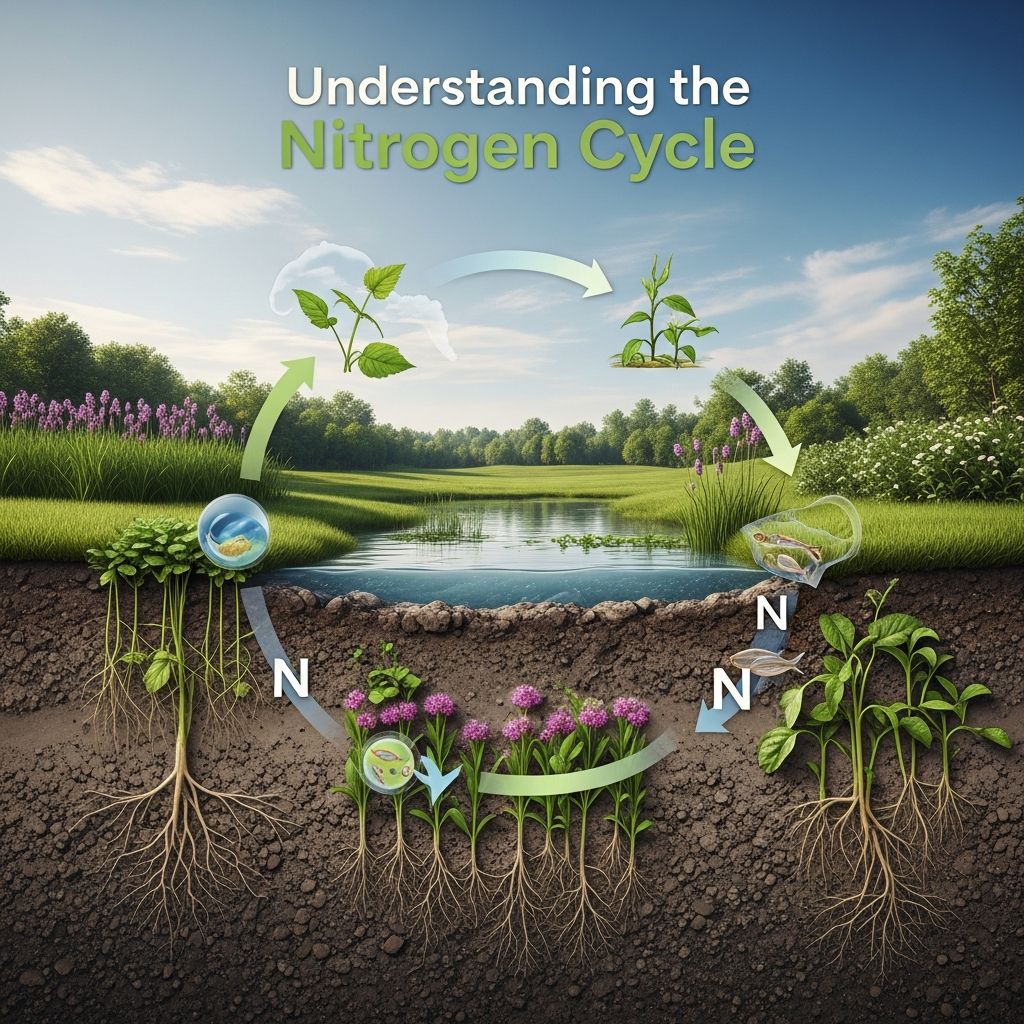
The nitrogen cycle is a vital biogeochemical process that circulates nitrogen through Earth’s atmosphere, soil, water, and living organisms, making this essential element available for life. Comprising about 78% of the atmosphere as inert N2 gas, nitrogen is crucial for building proteins, DNA, and chlorophyll, yet plants and animals cannot directly utilize it without transformation.
The Critical Role of Nitrogen in Life and Ecosystems
Nitrogen forms the backbone of amino acids, nucleic acids, and other biomolecules necessary for all living things. Plants absorb nitrogen primarily as nitrates or ammonium, using it to synthesize proteins and support growth. Animals obtain nitrogen through their diet, passing it along food chains. Without the cycle, nitrogen would remain locked in the atmosphere, starving ecosystems of this nutrient.
In agriculture, the cycle underpins soil fertility. Farmers rely on natural processes or fertilizers to replenish nitrogen, but imbalances can lead to issues like eutrophication in waterways. Understanding this cycle helps in sustainable farming and mitigating pollution from excess nitrates leaching into rivers.
Key Processes Driving the Nitrogen Cycle
The cycle involves interconnected stages: fixation, ammonification (or mineralization), nitrification, assimilation, immobilization, and denitrification. Microorganisms orchestrate most transformations, thriving in soil, water, and plant roots.
Nitrogen Fixation: Unlocking Atmospheric Nitrogen
Nitrogen fixation converts atmospheric N2 into ammonia (NH3), the first usable form. This energy-intensive process breaks the stable triple bond in N2. Three main types exist:
- Biological fixation: Symbiotic bacteria like Rhizobium in legume root nodules and free-living bacteria such as Azotobacter perform 60-70% of natural fixation. Blue-green algae (cyanobacteria) contribute in aquatic systems.
- Atmospheric fixation: Lightning oxidizes N2 to nitrates, depositing them via rain.
- Industrial fixation: The Haber-Bosch process synthesizes ammonia for fertilizers, supporting half the world’s food production but contributing to environmental strain.
The reaction is: N2 + 8H → 2NH3 + H2, catalyzed by nitrogenase enzymes.
Ammonification: Recycling Organic Nitrogen
Dead organisms, waste, and plant debris contain organic nitrogen. Decomposers like bacteria and fungi break these down via ammonification (or mineralization), releasing ammonium (NH4+). This process recycles nitrogen, preventing loss from ecosystems.
For example, manure or fallen leaves are microbially decomposed: Organic N → NH4+. Soil pH and temperature influence rates, with warmer, moist conditions accelerating breakdown.
Nitrification: From Ammonia to Nitrates
Nitrification oxidizes ammonium to nitrites (NO2–) and then nitrates (NO3–), forms plants prefer due to ammonia’s toxicity. Two bacterial groups handle this:
- Nitrosomonas converts NH4+ to NO2–: 2NH3 + 3O2 → 2NO2– + 2H+ + 2H2O.
- Nitrobacter oxidizes NO2– to NO3–: 2NO2– + O2 → 2NO3–.
This aerobic process thrives in well-aerated soils but slows in waterlogged areas.
Assimilation and Immobilization: Nitrogen Uptake Dynamics
Plants assimilate nitrates or ammonium via roots, incorporating them into organic compounds. Animals assimilate through consumption. Immobilization occurs when soil microbes temporarily bind inorganic nitrogen into their biomass, balancing availability. Mineralization reverses this, releasing nitrogen back.
These processes ensure nitrogen matches ecosystem demands, with legumes efficiently fixing and sharing nitrogen.
Denitrification: Returning Nitrogen to the Atmosphere
Denitrifying bacteria like Pseudomonas and Clostridium convert nitrates back to N2 in low-oxygen conditions, such as wetlands or flooded soils: NO3– → NO2– → NO → N2O → N2. This closes the cycle but can deplete soil fertility if excessive.
Visualizing the Nitrogen Cycle Flow
The cycle can be represented in a table for clarity:
| Stage | Input | Process | Output | Key Organisms |
|---|---|---|---|---|
| Fixation | N2 | Reduction | NH3/NH4+ | Rhizobium, Azotobacter |
| Ammonification | Organic N | Decomposition | NH4+ | Decomposer bacteria/fungi |
| Nitrification | NH4+ | Oxidation | NO3– | Nitrosomonas, Nitrobacter |
| Assimilation | NO3–/NH4+ | Uptake | Organic N (proteins) | Plants/Animals |
| Denitrification | NO3– | Reduction | N2 | Pseudomonas |
This table summarizes transformations, highlighting microbial roles.
Human Impacts on the Nitrogen Cycle
Fossil fuel combustion, fertilizers, and livestock manure overload ecosystems with reactive nitrogen, causing acid rain, ozone depletion, and algal blooms. The Haber-Bosch process has doubled global reactive nitrogen, boosting crop yields but polluting waters via leaching.
Climate change alters microbial activity; warmer soils speed mineralization but enhance denitrification losses. Sustainable practices like crop rotation with legumes and precision farming minimize disruptions.
Importance Across Environments
In oceans, nitrogen limits phytoplankton, affecting fisheries. Forests rely on fixation by understory plants. Agriculture mimics natural cycles with cover crops. Disruptions threaten biodiversity and food security.
Frequently Asked Questions (FAQs)
What is the main purpose of the nitrogen cycle?
It converts unusable atmospheric nitrogen into forms plants can absorb, sustaining life and ecosystems.
Which bacteria are involved in nitrogen fixation?
Symbiotic Rhizobium in legumes and free-living Azotobacter.
Why is denitrification important?
It returns nitrogen to the atmosphere, completing the cycle, though excess reduces soil fertility.
How do humans affect the nitrogen cycle?
Through fertilizers and pollution, causing eutrophication and greenhouse gas emissions.
Can plants fix their own nitrogen?
No, they depend on bacteria; legumes host symbiotic fixers.
Maintaining Balance in the Nitrogen Cycle
Conservation tillage, organic amendments, and reduced fertilizer use promote balance. Monitoring nitrate levels prevents runoff. Research into efficient nitrogen-fixing crops advances sustainable agriculture. Global efforts address ‘nitrogen pollution’ via policies like the EU’s Nitrates Directive.
(Word count: 1723)
References
- What Is the Nitrogen Cycle and Why Is It Key to Life? — Frontiers for Young Minds. 2019-06-25. https://kids.frontiersin.org/articles/10.3389/frym.2019.00041
- Nitrogen Cycle Definition – BYJU’S — BYJU’S. 2023-10-01. https://byjus.com/biology/nitrogen-cycle/
- The Nitrogen Cycle! – YouTube — YouTube (Khan Academy). 2018-05-15. https://www.youtube.com/watch?v=uip4Q6t7yfQ
- The nitrogen cycle (video) | Ecology — Khan Academy. 2023-01-12. https://www.khanacademy.org/science/biology/ecology/biogeochemical-cycles/v/nitrogen-cycle
- Nitrogen Cycle | Yale Peabody Museum — Yale Peabody Museum. 2022-08-10. https://peabody.yale.edu/article/nitrogen-cycle
- 6.8: Nitrogen Cycle – Biology LibreTexts — Biology LibreTexts. 2023-09-05. https://bio.libretexts.org/Bookshelves/Introductory_and_General_Biology/Introductory_Biology_(CK-12)/06:_Ecology/6.08:_Nitrogen_Cycle
- Nitrogen Basics – The Nitrogen Cycle [PDF] — Cornell Cooperative Extension Onondaga. 2021-04-20. https://cceonondaga.org/resources/nitrogen-basics-the-nitrogen-cycle
- The nitrogen cycle (article) | Ecology — Khan Academy. 2024-02-28. https://www.khanacademy.org/science/biology/ecology/biogeochemical-cycles/a/the-nitrogen-cycle

- Integrated M.A. in Applied Linguistics, University of Hyderabad
- 5+ years in editorial, instructional, SEO, and research-based writing
Sneha is a relationships and lifestyle writer with a strong foundation in applied linguistics and certified training in relationship coaching. She brings over five years of writing experience to theskillvault, crafting thoughtful, research-driven content that empowers readers to build healthier relationships, boost emotional well-being, and embrace holistic living. Her writing and insights reflect the belief that beauty, happiness, and wellness…