
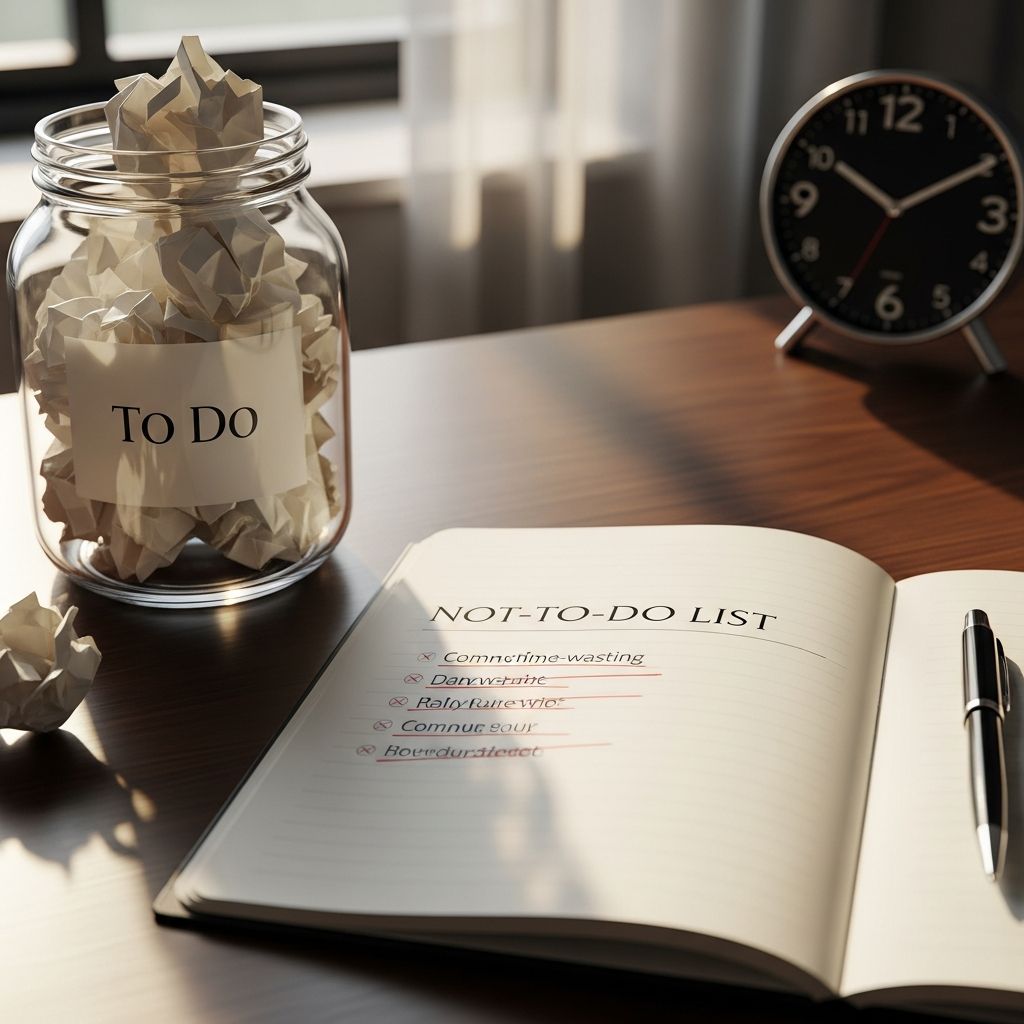
In today’s fast-paced world, traditional to-do lists often lead to overwhelm rather than accomplishment. Endless tasks pile up, creating mental clutter that paralyzes action. Enter the not-to-do list—a counterintuitive yet powerful tool that shifts your focus from adding more to eliminating distractions. By intentionally listing what you won’t do, you create mental space, protect your energy, and zero in on high-impact activities. This approach, backed by productivity experts, helps you achieve more with less effort.
Why Traditional To-Do Lists Fail
To-do lists promise organization but frequently backfire. They grow uncontrollably, mixing urgent tasks with vague someday ideas, leading to decision fatigue. Research from productivity studies shows that overloaded lists trigger procrastination because the brain perceives them as insurmountable. Items linger indefinitely, mocking unfinished progress and eroding motivation. Without clear boundaries, low-priority distractions—like endless email checks or social media scrolls—consume prime focus hours.
Consider this: the average person juggles 20-30 daily tasks, but only 3-5 truly drive results. The rest? Noise. A not-to-do list flips the script, acting as a shield against energy drains. It enforces discipline by pre-deciding boundaries, freeing cognitive resources for deep work.
Understanding the Not-To-Do List Concept
A not-to-do list is a curated inventory of habits, behaviors, and activities you commit to avoiding for a set period—daily, weekly, or ongoing. Unlike rigid rules, it’s flexible and personalized, targeting personal productivity killers. The core idea: subtraction beats addition for sustainable progress.
- Daily Not-To-Do: Short-term avoids like “No social media before noon.”
- Weekly Not-To-Do: Broader boundaries such as “No unplanned meetings on Tuesdays.”
- Lifetime Not-To-Do: Permanent eliminations like “No multitasking during creative work.”
This method draws from decision theory, where pre-committing to ‘no’s reduces willpower depletion. Harvard Business Review notes that high achievers succeed by mastering refusal, not acceptance.
Key Habits to Add to Your Not-To-Do List
Building your list starts with self-audit: track a day or two, noting energy thieves. Common culprits fall into categories. Here’s a starter guide:
Digital Distractions
- No checking notifications during focused work blocks.
- No phone scrolling in the first hour after waking.
- No email before completing your top priority task.
People-Pleasing Traps
- No saying yes to non-essential requests without review.
- No over-explaining decisions to others.
- No responding to non-urgent messages instantly.
Productivity Pitfalls
| Habit to Avoid | Why It Hurts | Replacement Strategy |
|---|---|---|
| No multitasking | Reduces efficiency by 40% per APA studies | Single-task with timers |
| No adding tasks without removing one | Prevents list bloat | Maintain 3-5 items max |
| No skipping breaks or meals | Leads to burnout | Schedule self-care |
| No negative self-talk | Undermines motivation | Affirm progress daily |
Mental Clutter Busters
- No comparing yourself to others’ highlight reels.
- No dwelling on minor setbacks.
- No ‘someday’ tasks on active lists—park them elsewhere.
These entries create guardrails, ensuring your day aligns with goals.
Implementing Your Not-To-Do List: Step-by-Step Guide
Transitioning requires intention. Follow this blueprint:
- Audit Your Week: Log activities and rate energy post-task. Identify patterns.
- Prioritize 3-5 Avoids: Start small to build momentum.
- Make It Visible: Use a app, whiteboard, or paper next to your to-do list.
- Pair with Mini To-Do: Limit do’s to 3, don’ts to 3 for balance.
- Track Wins: Note each honored ‘no’—celebrate with a checkmark.
- Review Weekly: Adjust based on what drained or boosted you.
Example Daily Combo:
- Do: Finish report, exercise 30 mins, connect with family.
- Don’t: Check Slack before lunch, accept extra calls, browse news.
Over time, this ritual rewires habits, turning avoidance into automatic protection.
Real-World Benefits and Success Stories
Users report 2x productivity gains. One professional ditched email-first mornings, reclaiming 90 minutes daily for strategy. Another banned multitasking, boosting output quality. Studies from the American Psychological Association confirm single-tasking enhances focus and reduces errors.
Long-term, it fosters work-life harmony. By not overcommitting, you prevent burnout—vital as WHO reports 745,000 annual deaths from overwork. Boundaries honor your finite energy.
Common Challenges and Solutions
Resistance arises: FOMO from ignored messages or guilt from ‘no’s. Counter with:
- Communicate boundaries: “I’ll respond by EOD.”
- Use tech: App blockers for enforces.
- Start micro: One don’t per day.
If slips happen, forgive and reset—no self-judgment, as it perpetuates cycles.
Frequently Asked Questions (FAQs)
What if I forget my not-to-do list?
Set phone reminders or place it visibly. Habit forms in 21 days with consistency.
Can I use this for long-term goals?
Yes—lifetime lists eliminate recurring drains like toxic relationships or perfectionism.
Does it replace to-do lists entirely?
No, combine with slimmed-down versions focused on actionable, dated items.
How do I handle urgent interruptions?
Triage: True emergencies only. Most can wait, preserving flow.
Is this suitable for teams?
Absolutely—shared not-to-do’s like “No meetings before 10 AM” boost collective focus.
Elevate Your Routine: Advanced Strategies
Integrate mindfulness: Pair avoids with meditation to notice urges without acting. Experiment with themed days—no meetings Mondays for deep work. Track metrics: Hours saved, tasks completed. Apps like Focus@Will or Freedom amplify enforcement.
For leaders, model it: Public not-to-do’s inspire teams. Data from McKinsey shows boundary-setters outperform by 20% in output.
Transform Overwhelm into Achievement
Embracing a not-to-do list isn’t laziness—it’s strategic genius. By curating ‘no’s, you amplify ‘yes’s impact. Start today: Pick three avoids, watch clarity emerge. Productivity isn’t about doing more; it’s mastering what matters.
References
- The Anti-To-Do List That Boosts Your Productivity — Vocal Media / Razaul Karim Bhuiya. 2023. https://vocal.media/lifehack/the-anti-to-do-list-that-boosts-your-productivity
- Outsmarting To-Do List Overwhelm: Tips for Getting Unstuck — YouTube / Lifehack Tribe. 2023-10-15. https://www.youtube.com/watch?v=noa-Qdzf8Zg
- American Psychological Association: Multitasking Report — APA. 2022-01-20. https://www.apa.org/topics/research/multitasking
- 20 Things That Everyone Should Have In the To Don’t List — Lifehack.org. 2021-05-12. https://www.lifehack.org/articles/productivity/20-things-that-everyone-should-have-the-dont-list.html
- WHO: Long Working Hours Increase Deaths — World Health Organization. 2021-05-17. https://www.who.int/news/item/17-05-2021-long-working-hours-increasing-deaths-from-heart-disease-and-stroke-who-ilo

Medha Deb is an editor with a master's degree in Applied Linguistics from the University of Hyderabad. She believes that her qualification has helped her develop a deep understanding of language and its application in various contexts. Medha specializes in the areas of beauty, health, sports, and wellness and is committed to ensuring that the content on the website is…