
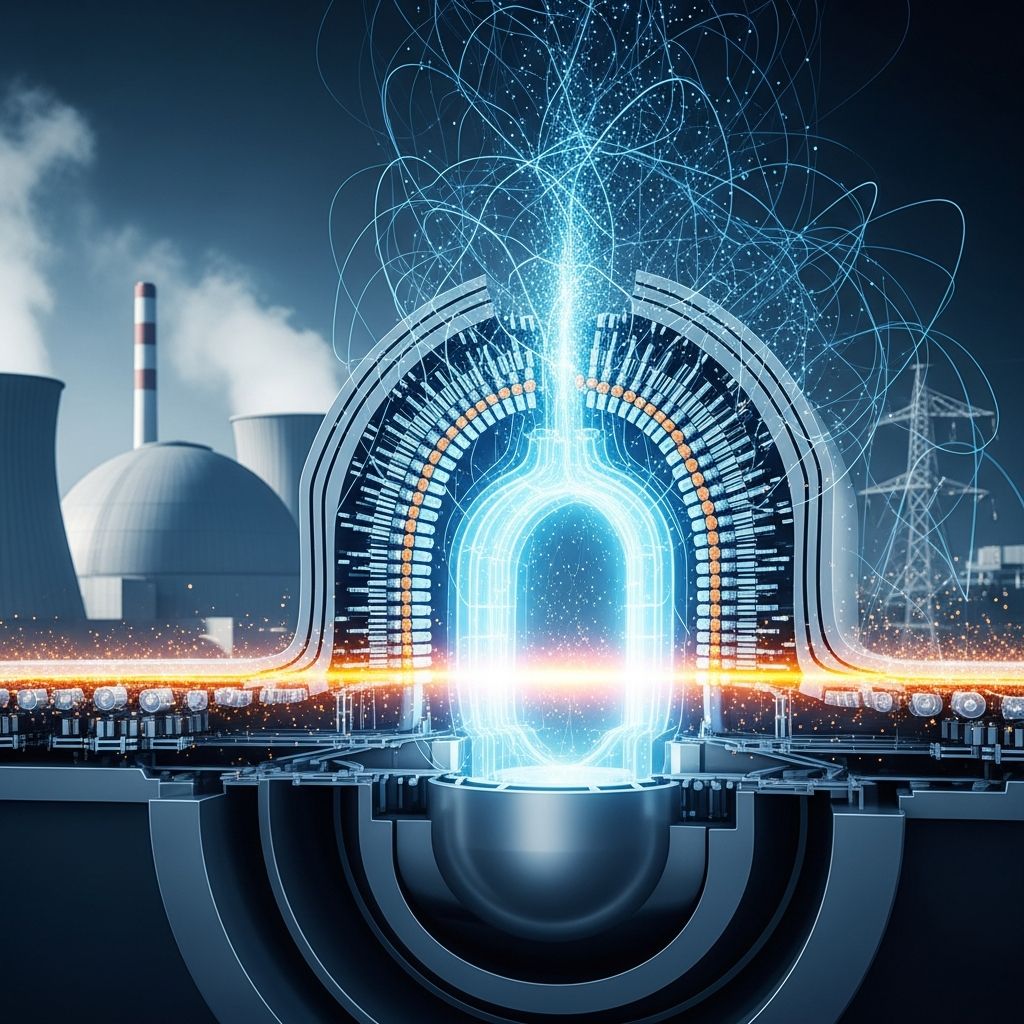
Nuclear criticality represents the balanced state where a nuclear fission chain reaction sustains itself without growing or diminishing, forming the foundation of controlled energy production in nuclear power plants. This condition ensures steady power output while prioritizing safety through precise neutron management.
The Science Behind Fission Chain Reactions
At the core of nuclear power lies nuclear fission, where heavy atomic nuclei like uranium-235 split after absorbing a neutron, releasing energy and additional neutrons. These neutrons can trigger further fissions, creating a chain reaction. The key metric is the effective neutron multiplication factor, denoted as keff, which quantifies the ratio of neutrons produced to those lost or absorbed in each generation.
A chain reaction’s viability depends on neutron economy: too few neutrons lead to decay, while excess causes runaway growth. In power plants, engineers meticulously arrange fuel rods, moderators, and control rods to achieve and maintain criticality, converting fission heat into electricity via steam turbines.
Defining Key Reactor States
Reactors operate in distinct states based on keff values, each with unique implications for power generation and safety.
- Subcritical State (keff < 1): Neutron production falls short of losses, causing the neutron population to decline exponentially. This is the default during shutdowns or startups, preventing unintended reactions.
- Critical State (keff = 1): Neutrons produced exactly match those lost, maintaining a constant neutron level and steady power output. This is the ideal operational mode for power plants.
- Supercritical State (keff > 1): Excess neutrons drive exponential growth in fissions, used briefly during startups but requiring rapid control to avoid instability.
These states are dynamically managed using reactivity controls like boron in coolant or movable control rods that absorb neutrons.
Prompt vs. Delayed Criticality: A Critical Distinction
Neutrons in fission are categorized as prompt (instantly emitted, ~99% of total) or delayed (from fission product decay, ~1% but crucial for control). Prompt neutron lifetime is about 10-5 seconds, while delayed ones average 0.1 seconds.
Delayed Critical relies on both, allowing slow power adjustments via control systems. Prompt Critical (reactivity ρ ≥ βeff, where βeff is the delayed neutron fraction ~0.0065 for uranium-235) sustains reactions with prompt neutrons alone, leading to explosive power surges in ~10-5 seconds. All commercial reactors are designed to remain prompt subcritical, with safety systems ensuring ρ < βeff.
| State | keff | Reactivity (ρ) | Neutron Behavior | Application |
|---|---|---|---|---|
| Delayed Critical | =1 | 0 | Stable, slow response | Normal operation |
| Prompt Subcritical, Delayed Supercritical | >1 | 0 < ρ < βeff | Slow exponential increase | Controlled startup |
| Prompt Critical | >1 | ρ ≥ βeff | Rapid exponential increase | Avoided in power reactors |
This table illustrates how reactor designs prioritize delayed neutron dependence for controllability.
How Reactors Achieve and Maintain Criticality
During initial fuel loading, reactors are subcritical. Operators gradually withdraw control rods and adjust coolant chemistry to increase keff toward 1. Flux detectors monitor neutron levels, signaling when criticality is neared—often celebrated as the ‘first criticality’ milestone.
Operational criticality demands constant adjustments for fuel burnup, temperature effects (e.g., Doppler broadening reduces reactivity), and xenon poisoning. Pressurized water reactors (PWRs) face power defects up to 2500 pcm (percent mille), necessitating control rods exceeding this for safe shutdowns.
Safety Systems and Preventing Accidents
Safety hinges on redundant systems: control rods scram (insert rapidly) on anomalies, emergency boron injection dilutes coolant, and passive cooling prevents meltdown. Regulations from the U.S. Nuclear Regulatory Commission mandate designs incapable of prompt criticality under credible scenarios.
Historical incidents like Chernobyl underscore supercritical risks from xenon override and operator errors, prompting global standards for conservative reactivity margins.
Historical Milestones in Criticality Achievement
The first sustained criticality occurred on December 2, 1942, with Chicago Pile-1, a graphite-moderated pile proving controlled fission feasible. Modern examples include Vogtle Unit 4 in 2024, marking U.S. nuclear resurgence.
These events validate decades of physics advancing safe commercialization, from experimental piles to gigawatt-scale plants supplying 10% of global electricity carbon-free.
Criticality in Fuel Cycle and Waste Management
Beyond reactors, criticality concerns fresh fuel fabrication, spent fuel pools, and repositories. Geometric arrangements prevent accidental chains; for instance, borated water in pools maintains subcriticality.
Advanced reactors like small modular designs incorporate integral control for inherent safety, minimizing external interventions.
Future of Criticality Control in Next-Gen Reactors
Gen IV reactors emphasize passive safety, with molten salt or gas coolants enabling wider criticality margins. Fusion research explores analogous plasma stability, but fission remains dominant.
Digital twins and AI predict reactivity shifts, enhancing precision amid aging fleets and new builds targeting net-zero goals.
Frequently Asked Questions (FAQs)
What does it mean when a reactor goes critical?
It achieves a self-sustaining chain reaction where neutron production balances losses, enabling stable power generation.
Is criticality dangerous?
No, in controlled reactors it’s the normal, safe operating state. Uncontrolled supercriticality poses risks, hence stringent safeguards.
How is prompt criticality prevented?
Designs limit maximum reactivity below the delayed neutron fraction, backed by automatic shutdowns and negative feedback coefficients.
What is keff?
The effective multiplication factor measuring neutrons per generation; keff=1 defines criticality.
Can criticality occur outside reactors?
Yes, in fuel handling or accidents, but safety protocols like spacing and poisons mitigate risks.
References
- Reactor Criticality | Definition & States — nuclear-power.com. 2023. https://www.nuclear-power.com/nuclear-power/reactor-physics/nuclear-fission-chain-reaction/reactor-criticality/
- Criticality | Nuclear Regulatory Commission — NRC.gov. 2024-02-14. https://www.nrc.gov/reading-rm/basic-ref/glossary/criticality
- Nuclear Criticality in Nuclear Fission and Nuclear Energy — PMF IAS. 2023. https://www.pmfias.com/nuclear-criticality/
- 8 Nuclear Energy Terms that Don’t Mean What You Think — U.S. Department of Energy. 2024. https://www.energy.gov/ne/articles/8-nuclear-energy-terms-dont-mean-what-you-think
- Critical Mass – Manhattan Project History — U.S. Department of Energy OSTI.gov. 2023. https://www.osti.gov/opennet/manhattan-project-history/Science/NuclearPhysics/critical-mass.html

Medha Deb is an editor with a master's degree in Applied Linguistics from the University of Hyderabad. She believes that her qualification has helped her develop a deep understanding of language and its application in various contexts. Medha specializes in the areas of beauty, health, sports, and wellness and is committed to ensuring that the content on the website is…