
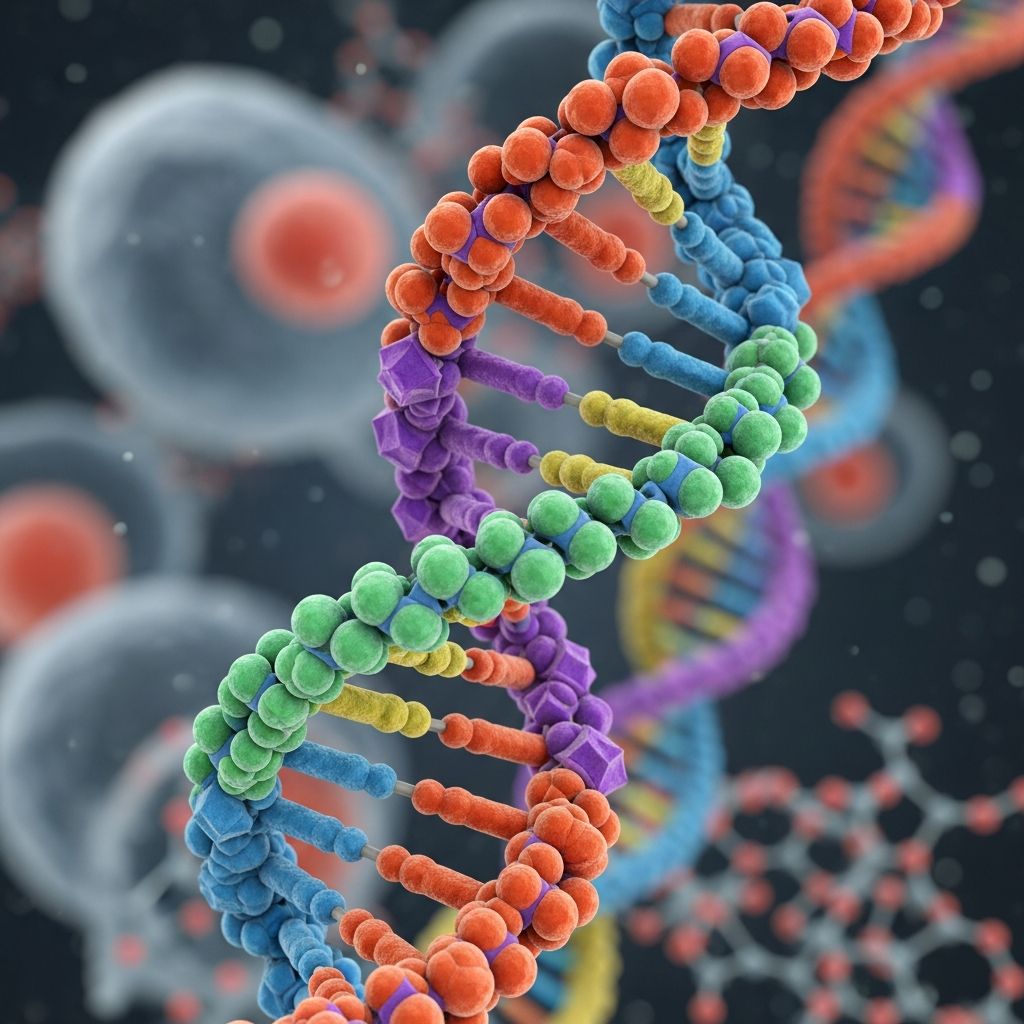
Nucleotides serve as the fundamental units of nucleic acids, which store and transmit genetic information in all living organisms. Each nucleotide consists of three key components: a pentose sugar, a nitrogenous base, and one or more phosphate groups. These molecules link together to form long chains in DNA and RNA, enabling processes like replication, transcription, and protein synthesis.
Fundamental Composition of Nucleotides
At their core, nucleotides are organic compounds that combine specific chemical groups to create versatile biomolecules. The integration of these parts allows nucleotides to polymerize into the double helix of DNA or the single-stranded structure of RNA. Understanding this composition reveals how genetic instructions are encoded and expressed.
The sugar provides a stable framework, the base carries the genetic code, and the phosphate links units together while contributing negative charges that influence molecular behavior. This tripartite structure ensures nucleotides can form precise hydrogen bonds essential for genetic fidelity.
The Pentose Sugar: Structural Backbone
The sugar in a nucleotide is a five-carbon monosaccharide known as a pentose. In DNA, this is deoxyribose, while RNA uses ribose. Deoxyribose lacks an oxygen atom at the 2′ carbon position compared to ribose, a modification that enhances DNA stability by reducing reactivity.
Carbon atoms in the sugar are numbered from 1′ to 5′. The 1′ carbon bonds to the nitrogenous base via a glycosidic linkage, forming a nucleoside. Phosphates attach to the 5′ and 3′ carbons, enabling chain elongation in the 5′ to 3′ direction.
- Deoxyribose in DNA: Promotes double-helix formation due to its rigidity and lack of 2′-OH group.
- Ribose in RNA: The extra hydroxyl group makes RNA more flexible and prone to hydrolysis, suiting its transient roles.
- Structural role: Sugars alternate with phosphates to create the nucleic acid backbone.
This sugar difference underlies key distinctions between DNA’s long-term storage and RNA’s short-term functions.
Nitrogenous Bases: Carriers of Genetic Information
Nitrogenous bases are heterocyclic compounds containing nitrogen that attach to the sugar’s 1′ carbon. They divide into purines (adenine, guanine) with two fused rings and pyrimidines (cytosine, thymine/uracil) with one ring. These bases dictate base pairing: adenine pairs with thymine (DNA) or uracil (RNA), and guanine with cytosine.
| Base Type | Examples | Found In | Pairing Partner |
|---|---|---|---|
| Purines (double ring) | Adenine (A), Guanine (G) | DNA and RNA | A-T/U, G-C |
| Pyrimidines (single ring) | Cytosine (C), Thymine (T), Uracil (U) | C in both; T in DNA; U in RNA | C-G; T/U-A |
Purines and pyrimidines ensure uniform spacing in the DNA helix, with hydrogen bonds stabilizing the structure: two between A-T/U and three between G-C.
Thymine’s methyl group in DNA protects against mutations, unlike uracil in RNA.
Phosphate Groups: Linking and Energizing
Phosphate groups (PO4) connect nucleotides via phosphodiester bonds between the 3′ carbon of one sugar and the 5′ of the next. A single phosphate defines a nucleotide; additional ones form diphosphates (e.g., ADP) or triphosphates (e.g., ATP).
These groups impart a negative charge, making nucleic acids hydrophilic and aiding compaction in cells. In energy metabolism, ATP’s high-energy bonds drive cellular reactions.
- Mono-, di-, tri-phosphate: Vary by phosphate count; triphosphates power polymerization.
- Backbone formation: Phosphodiester bonds create the sugar-phosphate backbone, protecting bases inside the helix.
- Directionality: Chains grow 5’→3′, critical for enzymatic processes.
Assembling Nucleotides into Nucleic Acids
Nucleosides (sugar + base) gain a phosphate to become nucleotides. Polymerization joins thousands into polynucleotides. DNA’s antiparallel strands form a right-handed double helix with major/minor grooves for protein binding.
RNA often folds into complex shapes via intramolecular base pairing, functioning in catalysis (ribozymes) or as messengers.
Base sequence encodes genes; A-T/G-C ratios vary by organism but maintain Chargaff’s rules.
Biological Roles Beyond Genetics
Nucleotides aren’t just structural. ATP fuels contraction and synthesis; GTP aids signaling; cAMP regulates metabolism; NAD+/FAD support redox reactions.
Coenzymes derive from nucleotides, highlighting their metabolic versatility.
Comparing DNA and RNA Nucleotides
| Feature | DNA Nucleotides | RNA Nucleotides |
|---|---|---|
| Sugar | Deoxyribose | Ribose |
| Bases | A, G, C, T | A, G, C, U |
| Structure | Double helix, stable | Single strand, diverse folds |
| Function | Genetic storage | Expression, regulation |
These differences suit DNA for archiving and RNA for dynamic roles.
Frequently Asked Questions
What defines a nucleotide?
A nucleotide comprises a pentose sugar, nitrogenous base, and phosphate group, forming nucleic acid monomers.
How do purines differ from pyrimidines?
Purines have two rings (A, G); pyrimidines one (C, T/U), affecting pairing and helix geometry.
Why is deoxyribose crucial for DNA?
Absence of 2′-OH prevents hydrolysis, stabilizing the genome.
What role do phosphates play in chains?
They form phosphodiester bonds, creating the directional backbone.
Can nucleotides function outside DNA/RNA?
Yes, as ATP for energy, signaling molecules, and coenzymes.
Advances in Nucleotide Research
Modern studies use synthetic nucleotides in CRISPR editing and mRNA vaccines, expanding their applications. Nucleotide analogs treat viruses and cancer by disrupting replication.
Understanding modifications like 5-methylcytosine reveals epigenetic regulation.
References
- What Are the Three Main Parts of a Nucleotide? — BYJU’S. 2023. https://byjus.com/biology/three-main-parts-of-a-nucleotide/
- Nucleotide — Wikipedia. 2026-04-01. https://en.wikipedia.org/wiki/Nucleotide
- Definition of nucleotide — National Cancer Institute. 2024. https://www.cancer.gov/publications/dictionaries/genetics-dictionary/def/nucleotide
- Nucleic acids — Khan Academy. 2025. https://www.khanacademy.org/science/ap-biology/gene-expression-and-regulation/dna-and-rna-structure/a/nucleic-acids
- Nucleotide — National Human Genome Research Institute. 2024-02-15. https://www.genome.gov/genetics-glossary/Nucleotide

- Integrated M.A. in Applied Linguistics, University of Hyderabad
- 5+ years in editorial, instructional, SEO, and research-based writing
Sneha is a relationships and lifestyle writer with a strong foundation in applied linguistics and certified training in relationship coaching. She brings over five years of writing experience to theskillvault, crafting thoughtful, research-driven content that empowers readers to build healthier relationships, boost emotional well-being, and embrace holistic living. Her writing and insights reflect the belief that beauty, happiness, and wellness…