
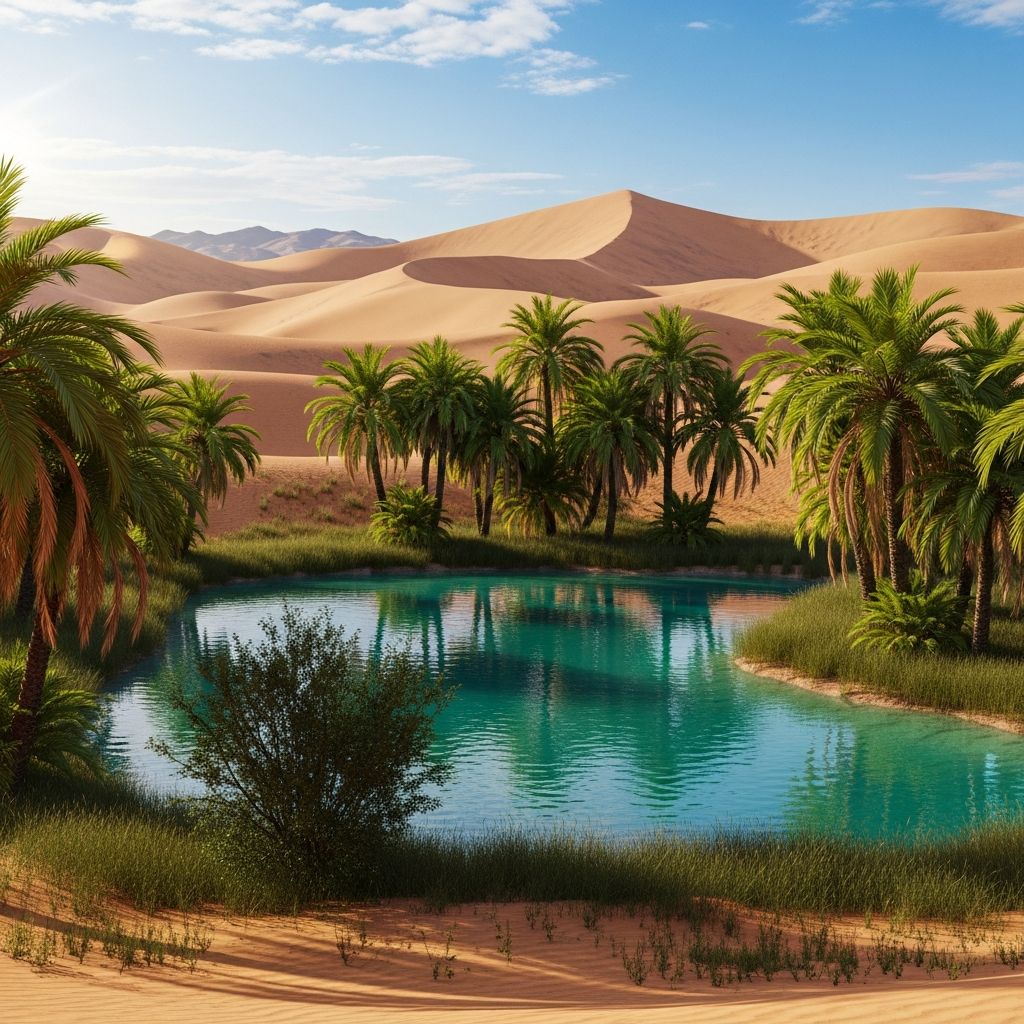
Fertile oases stand as remarkable exceptions in vast, barren deserts, where underground water sustains lush vegetation and supports human communities amid extreme aridity. These green havens have enabled survival, trade, and civilization for millennia.
Defining the Oasis Phenomenon
An **oasis** is a distinct area within a desert or semi-arid region featuring vegetation, often with surface water like springs or ponds, sustained by groundwater from aquifers, wells, or underground rivers. Unlike surrounding sands, oases harbor trees, crops, and wildlife, creating isolated ecosystems.
The term derives from Greek via Late Latin, originally denoting a specific Egyptian site but now universally applied. Plural form is oases. Sizes range from tiny plots around a single spring to expansive valleys like Egypt’s Nile corridor, spanning thousands of square kilometers.
How Oases Emerge Naturally
Oases form when groundwater reaches the surface naturally or through human intervention. Key processes include:
- Aquifer outcrops: Water-bearing rock layers (aquifers) intersect the surface, forming springs where pressure pushes water upward.
- Artesian wells: Confined aquifers under pressure allow water to rise without pumping when drilled.
- Fossil water: Ancient rainwater trapped underground during wetter climates seeps to the surface.
- Wind erosion: Winds deflate loose sand, lowering the surface until it meets the water table.
Human-made oases amplify this by digging wells or qanats—ancient underground channels directing water from distant mountains. Most modern oases blend natural and artificial elements.
The Unique Ecology of Desert Havens
Oases host specialized **riparian ecosystems** thriving on reliable moisture. Dominant plants include date palms providing shade and fruit, alongside figs, olives, pomegranates, and grains like wheat or barley.
Fauna adapts too: birds migrate to drink, mammals like foxes visit at night, and insects flourish. Microclimates form under canopies, cooling air by 10-15°C and raising humidity, fostering biodiversity hotspots.
| Plant Type | Role in Oasis | Examples |
|---|---|---|
| Tall Trees | Shade, fruit, windbreak | Date palm, acacia |
| Shrubs & Vines | Ground cover, soil stabilization | Grapes, tamarisk |
| Crops | Food production | Wheat, alfalfa |
| Grasses | Forage for livestock | Bermuda grass |
These ecosystems are fragile; overgrazing or water depletion can lead to desertification.
Historical Impact: Cradles of Desert Civilizations
Oases were pivotal in human history, serving as:
- Trade hubs: Caravan stops on Silk Road or African routes, like Timbuktu in Mali.
- Agricultural bases: Enabling settled life in Sahara, Arabian Peninsula.
- Cultural centers: Birthing cities like Damascus (Al-Ghutah oasis) and ancient Mesopotamian settlements between Tigris-Euphrates.
Egypt’s Nile Valley, a mega-oasis, powered pharaonic civilization through irrigation. Nomads mapped oases mentally for migration routes.
Renowned Oases Around the World
Global examples showcase diversity:
- Siwa Oasis, Egypt: 800km west of Nile; salt lakes, hot springs, ancient oracle temple.
- Alhambra Oasis, Algeria: Largest Saharan (200km²); palm groves, ksour fortresses.
- Huacachina, Peru: Seaside desert lagoon drawing tourists.
- Palm Springs, USA: Colorado Desert hot springs turned resort city.
- Liwa Oasis, UAE: Modern farming via desalination.
These sites blend natural beauty with human ingenuity.
Water Management Strategies in Arid Zones
Sustaining oases demands sophisticated techniques:
- Foggaras/Qanats: Gravity-fed tunnels from aquifers.
- Drip irrigation: Modern efficiency minimizing evaporation.
- Shade structures: Palm thatch reducing sun exposure.
- Communal rules: Rotational water use preventing depletion.
UNESCO recognizes many as World Heritage sites for cultural-hydrological value.
Modern Challenges Facing Oases
Climate change, population growth, and overexploitation threaten oases:
- Depleting aquifers: Pumping exceeds recharge rates.
- Salinization: Evaporation concentrates salts, killing plants.
- Tourism pressure: Huacachina’s lagoon shrinks from overuse.
- Desert expansion: Reduced rainfall stresses ecosystems.
Initiatives like Saudi Arabia’s afforestation and Morocco’s solar-powered desalination aim to preserve them.
Oases as Metaphors in Culture
Beyond geography, “oasis” symbolizes relief: a quiet café in a busy city or a vacation spot. Literature like Arabian Nights romanticizes them; modern usage evokes sanctuary.
Frequently Asked Questions (FAQs)
What causes an oasis to form?
Oases form when underground water from aquifers reaches the surface via springs, wells, or erosion, supporting vegetation in deserts.
Are all oases natural?
No, many are human-enhanced through wells and irrigation, though they rely on natural groundwater sources.
Can oases disappear?
Yes, overpumping and climate change deplete water, causing some to shrink or vanish, like parts of the Sahara.
What grows in oases?
Date palms, fruits (figs, dates), grains (wheat), and fodder crops thrive, plus native shrubs and grasses.
Are there oases in America?
Yes, examples include Palm Springs (California) and Darwin Falls (Death Valley).
Preserving Desert Lifelines for Tomorrow
Oases remain vital for biodiversity, culture, and potential water security. Sustainable practices—renewable energy desalination, efficient farming, and conservation—can ensure their endurance. As deserts grow, these green islands offer lessons in resilience.
References
- Oasis – Wikipedia — Wikimedia Foundation. 2023-10-15. https://en.wikipedia.org/wiki/Oasis
- Oasis – Definition, Meaning & Synonyms — Vocabulary.com. Accessed 2026. https://www.vocabulary.com/dictionary/oasis
- OASIS Definition & Meaning — Merriam-Webster. Accessed 2026. https://www.merriam-webster.com/dictionary/oasis
- Oasis – Students | Britannica Kids — Encyclopædia Britannica. Accessed 2026. https://kids.britannica.com/students/article/oasis/276148
- Oasis Lesson for Kids: Definition & Facts — Study.com. Accessed 2026. https://study.com/academy/lesson/video/oasis-lesson-for-kids-definition-facts.html

- Integrated M.A. in Applied Linguistics, University of Hyderabad
- 5+ years in editorial, instructional, SEO, and research-based writing
Sneha is a relationships and lifestyle writer with a strong foundation in applied linguistics and certified training in relationship coaching. She brings over five years of writing experience to theskillvault, crafting thoughtful, research-driven content that empowers readers to build healthier relationships, boost emotional well-being, and embrace holistic living. Her writing and insights reflect the belief that beauty, happiness, and wellness…